
Exodus 27
Exodus 27 describes the place where Israel comes near to Yahweh. The bronze altar stands at the entrance, establishing that sacrifice must come first, and the courtyard sets clear boundaries around the holy space. The continual light within the tabernacle is sustained by the people and tended by the priests. The chapter shows that Yahweh dwells among Israel, yet access to Him is defined, ordered, and always begins with atonement.
Exodus 27 Explained: The Altar, the Courtyard, and the Way to Approach Yahweh
Exodus 27 continues the description of the sanctuary by moving from the tabernacle itself to the place where Israel approaches Yahweh. The first object described is the bronze altar. Anyone who enters the sanctuary encounters the altar first. Before anyone can approach the dwelling place of God, sacrifice must be made.
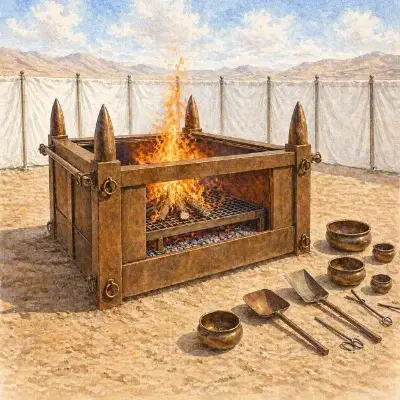
The altar is made of acacia wood and overlaid with bronze. Its size is given as five cubits long, five cubits wide, and three cubits high. A cubit is usually estimated at about forty-five centimetres, so the altar would be about 2.25 metres long and wide, and about 1.35 metres high. It is a large square structure capable of holding a substantial fire for burning sacrifices.
A horn rises from each of the four corners, formed from the same piece as the altar. Later instructions explain that the blood of certain offerings is placed on these horns. From the beginning the altar is identified as the place where atonement takes place. Atonement refers to sin being covered so that it no longer stands exposed before Yahweh. The blood represents the life of the animal given in place of the worshipper. Anyone approaching Yahweh must first come to the place where sin is dealt with.
The same section lists the utensils used at the altar: containers for ashes, shovels, bowls, meat hooks, and firepans. All are made of bronze. The altar will be used constantly. Animals are burned there, ashes accumulate, and the priests regularly remove the remains of earlier offerings. The work of sacrifice does not occur once and then stop. It continues day after day as the priests minister before Yahweh.
Inside the altar a bronze grating is placed halfway down the structure. This network supports the wood and the sacrificial pieces while allowing air to circulate through the fire. The fire burns on the grating while ash falls below it, where it can be removed. Rings are attached so that poles can be inserted and the altar carried with the camp as Israel travels through the wilderness.
Like the other furnishings, the altar is portable. Israel is still travelling toward the promised land, and the place where sacrifice is offered moves with the people as Yahweh goes with them. The altar is hollow and built according to the pattern shown on the mountain. The sanctuary is not designed by Israel. Yahweh reveals the pattern.
After the altar, the chapter describes the courtyard that surrounds the tabernacle. Linen hangings form the boundary of this area. On the south and north sides the hangings stretch one hundred cubits and are supported by twenty pillars set in bronze bases. Using the same estimate, each side would be about forty-five metres long.
The west side of the court is fifty cubits wide, about twenty-two and a half metres, supported by ten pillars. The east side is also fifty cubits wide, but here an entrance is left in the centre. Linen hangings extend along each side, while a woven screen forms the gate itself. The gate is twenty cubits wide, roughly nine metres, made from blue, purple, and scarlet yarn with fine linen.
These are the same colours used in the tabernacle curtains. Anyone entering the court sees that this space leads toward Yahweh’s dwelling. The linen walls stand five cubits high, just over two metres. The sanctuary appears as a large rectangular enclosure rising above the desert ground. The pillars stand in bronze bases and are fitted with silver bands and hooks. Even the pegs that secure the structure are made of bronze.
The courtyard separates the sanctuary from the rest of the camp. Yahweh lives among His people, but His dwelling place is set apart. The linen walls mark the space where sacrifice takes place. Anyone who approaches Yahweh must come through the gate that He has appointed.
The chapter closes with instructions about the oil for the lamp inside the tabernacle. The sons of Israel are to bring pure oil from beaten olives so that the lamp burns continually from evening until morning. This lamp stands on the golden lampstand described earlier. It is placed in the room before the veil. Aaron and his sons arrange it each night before Yahweh.
The priests tend the lamp, but the people supply the oil. The light that burns in the sanctuary is sustained by the whole nation. This instruction is described as a perpetual statute throughout their generations.
Exodus 27 describes the place where Israel approaches Yahweh. The altar stands at the entrance, where sacrifice deals with sin. The courtyard marks the boundary of the sacred space. The lamp inside the tabernacle burns continually before God. Yahweh lives among His people, and anyone who approaches Him must first come to the place where sacrifice deals with sin.