
Genesis 13
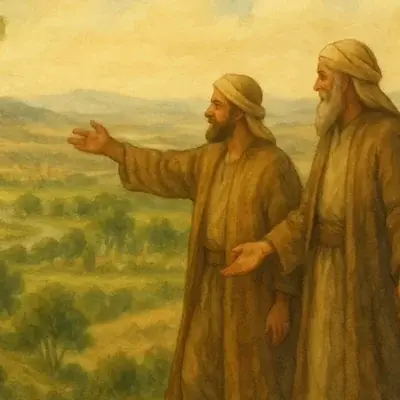
Abram and Lot part ways as the land cannot support both their herds. Lot chooses the well-watered Jordan valley, near the wickedness of Sodom. Abram remains in the land of promise, and Yahweh reaffirms His covenant by expanding the vision of Abram’s inheritance.
Abram returns to Yahweh - Lot goes East
In Genesis 12, Abram had received Yahweh’s call, responded in faith, and entered the land Yahweh promised him. But when famine struck, he turned aside to Egypt. There, out of fear, he deceived Pharaoh and put the promise at risk.
Yet Yahweh remained faithful. He preserved Sarai, upheld His word, and brought Abram out of Egypt with even greater possessions than before. But now, as Abram returns to the land, the question is whether he will return to Yahweh. Will the man who failed in Egypt now walk again by faith?
Lot and Abram come out of Egypt together, both with great wealth. But the unity between them does not last. The land cannot sustain them, and conflict arises between their herdsmen.
This conflict becomes a test of what will govern their decisions: wealth or worship, sight or promise. Lot and Abram both possess abundance, but how they respond to it reveals the heart of the chapter.
Abram’s first action is to return to the place where his tent had been at the beginning. He retraces his steps to Bethel, to the altar he had made before.
There he calls on the name of Yahweh. The pattern of worship that had been absent in Egypt is now restored.
The altar had marked his previous dependence on Yahweh before Egypt, and by returning to it, Abram acknowledges where trust must be rooted.
He does not build a new altar or seek a new path, but comes back to the place where he had once called on the name of Yahweh.
This physical act of returning highlights a spiritual realignment. His journey from Egypt to Bethel becomes a reversal of the detour into self-reliance and a return to dependence on Yahweh’s promise.
In other words, we are seeing a return to the trust Abram had at the beginning of chapter 12.
Abram’s nephew Lot is also extremely wealthy. He has flocks, herds, and tents. But the shared wealth between the two men leads to tension.
The land cannot bear them both, and their wealth becomes a cause of separation. The presence of the Canaanite and the Perizzite is mentioned again, as it was in Genesis 12, reminding us that the land is not empty and peace is not guaranteed.
Lot and Abram do not quarrel directly, but their wealth is clearly getting in the way of their relationship.
It is important to note that the text presents wealth not only as a sign of blessing, but also as a threat to obedience. The land cannot sustain their combined wealth. In this way, this passage subtly teaches that prosperity, while not evil, demands spiritual clarity. Without that clarity, it becomes a master that can separate us from God.
Abram speaks first, seeking peace. He gives Lot the freedom to choose any direction he pleases. It is a generous offer, but one that places the burden of discernment on Lot.
Abram does not assert his right as the elder or the one called by Yahweh. Instead, he lets Lot choose.
Lot lifts his eyes. What he sees is pleasing, well-watered, like the garden of Yahweh, like the land of Egypt.
He chooses what looks fruitful and journeys east. This is the same direction taken by those who left Eden, who settled in Babel.
The language echoes those earlier movements. Lot chooses for himself and goes east, away from the man of promise.
The land he chooses is near Sodom, and the Bible immediately tells us its character. The men of Sodom are evil and great sinners against Yahweh. Lot does not yet live there, but he moves his tents as far as Sodom. He sets himself on a bad path.
Lot moves closer to a city already known for its opposition to Yahweh. There is no mention of prayer, no seeking of God’s wisdom, and no weighing of the spiritual cost.
His eyes govern his decision. The absence of any appeal to Yahweh underscores the danger of pursuing gain without reference to God.
Lot is not portrayed as wicked himself, but he makes his home among those who are, and that proximity will have consequences.
After Lot departs, Yahweh speaks to Abram.
Yahweh tells Abram to lift his eyes and gives Abram a promise. Yahweh shows Abram the land in every direction and declares that it will belong to his seed forever.
It is worth noting the clear contrast between the two men. Lot chose to grasp what looked good. Abram receives what Yahweh shows and will one day give.
Yahweh’s promise expands beyond what can be counted. Yahweh commands Abram to walk the land, to see its length and breadth.
Yahweh’s promise to Abram is also an escalation of the blessing previously promised. In Genesis 12, Yahweh had promised to make Abram a great nation. Now He speaks of offspring as numerous as the dust of the earth.
This escalation of blessing reinforces that the promise does not hinge on Abram’s current strength, wealth, or circumstances.
The multiplication of seed, like the possession of land, will come by divine action. Yahweh’s words stretch Abram’s view forward and upward, away from present uncertainty and toward a future shaped entirely by God’s faithfulness.
This is not a claim by conquest, but a mark of trust. Abram will not possess the land now, but he is to live in it with confidence that it will one day belong to his seed.
Abram settles by the oaks of Mamre, in Hebron. He pitches his tent, and he builds an altar. Unlike Lot, he does not pursue what is pleasing to the eye. He remains in the land Yahweh has shown him, and he worships.
It is worth noting the deliberate contrast. Lot chooses for himself and moves toward a city known for its wickedness. Abram receives what Yahweh gives and returns to worship. Both men are wealthy. Both could have let their wealth determine the course. Lot does. Abram does not.
Lot could have said, “Do not send me away.” He could have given away his wealth and remained with the one through whom the promise was given. But he separates, and in doing so, he steps away from the place of worship and the word of Yahweh.
What we see in Genesis 13 is a contrast between the man of faith and the man compromised by wealth.
Lot has allowed his wealth to shape his decisions, and it leads him east, away from the land of promise, toward the land of wickedness. Abram, by contrast, remains in the land Yahweh has given him and once again builds an altar.
Abram has returned back to the land Yahweh promised him, and he does not let his wealth get in the way of worship. The man of faith receives rather than grasps, and he anchors himself not in his personal wealth, but in the word of Yahweh.