
Genesis 22
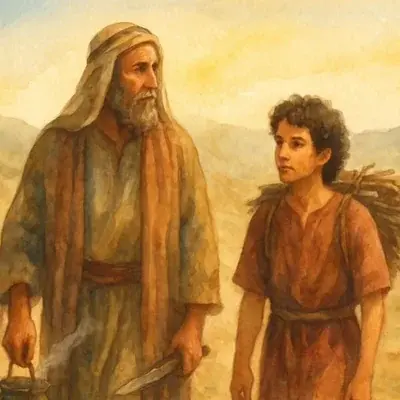
Genesis 22 tells the powerful story of the offering of Isaac—Abraham’s greatest test and one of the most dramatic moments in all of Scripture. Commanded to sacrifice his beloved son, Abraham obeys in faith. But at the very last moment, Yahweh provides a ram, sparing Isaac and reaffirming His covenant promise.
The Offering of Isaac and the God Who Provides
Genesis 22 is the final and greatest test of Abraham’s life. After all the waiting, believing, stumbling, and receiving, Yahweh commands what seems impossible.
The son of promise is to be offered back to the One who gave him. The narrator begins plainly: “Now it happened after these things, that God tested Abraham.”
This is not punishment or doubt on Yahweh’s part. The test is meant to show Abraham’s fear of God, not just to Yahweh and to Abraham himself, but to everyone who reads this story.
When the angel of Yahweh later says, “Now I know,” it is not because Yahweh learned something new. He already knows everything.
Instead, the test brings Abraham’s trust into the open through his obedience, standing as a witness to God’s faithfulness for all generations.
Yahweh’s command, “Take your son, your only one, whom you love, Isaac,” strikes slowly and deliberately, emphasizing Isaac as the sole bearer of the covenant promise after Ishmael’s departure. This son, miraculously born, deeply loved, and divinely appointed, must now be laid on the altar.
The cost is made plain before the command is complete. Abraham is told to offer Isaac in the land of Moriah, on a mountain Yahweh will reveal, just as he was once told to leave his father’s house for a land God would show him. This is the ultimate test of Abraham’s faith.
Abraham obeys without hesitation.
Rising early, he prepares the donkey, the servants, and the wood. There are no recorded words. The narrative simply shows silent trust and faithful obedience.
On the third day, he lifts his eyes and sees the mountain in the distance, three days in which Isaac has already been given over in his heart.
At the foot of the mountain, Abraham tells the young men, “We will worship, and we will return.” These words suggest more than optimism.
They show confidence in God’s faithfulness, even if Abraham does not yet know how the promise will survive.
Hebrews 11 later affirms that he believed God could raise the dead.
Abraham then places the wood on Isaac’s back, while he himself carries the fire and the knife. And the two of them walk on together. The details are sparse but important. The son carries the wood for his own offering.
The father walks beside him with the instruments of death.
This moment points forward to another beloved Son who will walk up another hill.
Twice we are told, “the two of them walked on together.” Between those two statements comes the only conversation between father and son. “My father… where is the lamb for the burnt offering?”
Isaac’s question is innocent, but perceptive. He sees the fire and the wood. Something is missing.
Abraham answers, “God will provide for Himself the lamb, my son.”
It is both a confession of faith and a forward-looking hope. He does not know yet how Yahweh will intervene, but he believes He will.
Three times in this chapter Abraham responds with the phrase “Here I am.”
It means more than “I am here.” Literally, it means “Behold me.” It is the language of attentiveness and readiness.
Unlike Adam, who hid when God called, Abraham stands before Yahweh in full availability.
He says it to God, to Isaac, and finally to the angel of Yahweh.
In each case, he does not argue or delay. He listens. Faith does not always speak much, but it shows up when called.
At the summit, Abraham builds the altar, arranges the wood, binds his son, and lays him on top.
No struggle is recorded.
Isaac, strong enough to carry the wood, is also willing.
The obedience here is not only Abraham’s. The son lies down, and Abraham lifts the knife.
Then the call comes, “Abraham, Abraham!”, a doubled name that marks urgency.
The angel of Yahweh speaks.
Again, “Here I am.” The voice now speaks from heaven. The test is complete. “Do not stretch out your hand… for now I know that you fear God, since you have not withheld your son, your only one, from Me.”
Yahweh affirms Abraham’s obedience and names it for what it is, fear of God shown through trust, even when the command seemed to threaten the promise.
Then Abraham lifts his eyes once more. A ram is caught by its horns in a thicket. He takes it and offers it in the place of his son.
This is substitution, not as an idea, but as an act. The son is spared. Another takes his place.
And Abraham names the place Yahweh Yir’eh, “Yahweh Will Provide,” or more literally, “Yahweh Will See.” In Hebrew, the verb ra’ah means both “to see” and “to provide.”
Because Yahweh sees, He supplies. The saying that follows, “In the mount of Yahweh it will be provided,” will echo far beyond that moment. What God has done here foreshadows what He will do again.
Yahweh now speaks a second time, swearing an oath: “By Myself I have sworn…” Nowhere else in Genesis does God bind Himself this way, marking the certainty of His promise.
Because Abraham has not withheld his son, Yahweh confirms the covenant with absolute finality. The seed will multiply, the nations will be blessed, and Abraham’s offspring will possess their enemies’ gates.
This promise of victory echoes the pledge that the woman’s seed will crush the serpent’s head, pointing to Christ’s decisive triumph over Satan.
While it anticipates Israel’s conquests in the promised land, its deeper fulfilment lies in Jesus, the true Seed, who breaks Satan’s power and blesses all nations.
After his journey to Mount Moriah, Abraham returns to Beersheba, where he previously called on Yahweh’s name, and lives there again.
The chapter ends with a short genealogy from Nahor’s family, which might seem out of place at first, but it functions as a quiet bookend to Abraham’s journey and prepares for the transition to Isaac.
Among the names in the genealogy is Rebekah, daughter of Bethuel, introduced almost in passing, yet clearly set apart by God. With the covenant reaffirmed on the mountain and the promised seed preserved, only two things remain: a burial place in the land, and a bride for Isaac.
This closing genealogy signals that Yahweh is already providing both, guiding the covenant forward not by chance or human strength, but by His own faithful hand.
These events on Moriah, God’s provision, Abraham’s obedience, and the victory of the seed, form a pattern foreshadowing God’s greater plan.
Isaac, called “your son, your only one, whom you love,” is the child of promise, miraculously born by God’s power.
So too, Jesus, declared God’s beloved Son at His baptism, is the true Seed, born by the Spirit. Isaac carries the wood; Jesus carries the cross.
Isaac submits willingly, asking only, “Where is the lamb?” Jesus, silent as a lamb, offers Himself. On Moriah, a ram is provided, sparing the son.
But at Calvary, no substitute spares Jesus, for He is the Lamb, given by God to take away sin.
Moriah, later the site of the temple where sacrifices atone for sin, points to Christ’s final sacrifice.
The oath that the seed will bless all nations finds its fulfilment in Jesus, the true Seed, whose death and resurrection bring life to many.
Genesis 22 is not an allegory, but a pattern, revealing a God who provides, not just a ram, but His own Son, not for one man, but for all nations.
The mountain of Moriah testifies to Abraham’s steadfast faith in Yahweh, especially His boundless grace. Yahweh sees, and provides.