
Hebrews 11
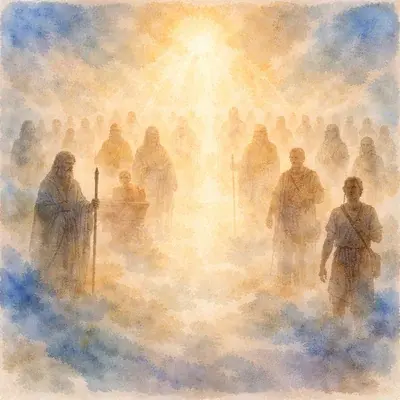
Hebrews 11 shows that God’s people have always lived by faith. They trusted what God had said, even when they did not see the fulfilment in their lifetime. Their lives form a testimony. They were approved, not because their works were flawless, but because they relied on God’s promise. Some conquered. Others suffered. Some were delivered. Others died. All are placed together because all lived by faith. This chapter prepares us to understand what faith is and what it produces: endurance grounded in the certainty of God’s word.
Hebrews 11 Explained: The Faith of the Cloud of Witnesses
Hebrews chapter 10 ended with this statement: “We are not of those who shrink back to destruction, but of those who have faith to the preserving of the soul.”
Chapter 11 now explains what that faith is and what it looks like in history.
“Now faith is the assurance of things hoped for, the conviction of things not seen.” Faith rests on what God has spoken. It treats His promises about the future as certain, and it accepts unseen realities as true because God has revealed them.
Faith believes despite appearances. It is anchored in the word of God.
Verse 2 says, “For by it the men of old gained approval.” They were approved through faith, not because their works were flawless. Their faith was counted as righteousness. Their lives demonstrated trust in God’s promise.
Verse 3 starts at the beginning. “By faith we understand that the worlds were prepared by the word of God.” None of us witnessed creation. By faith we acknowledge God as the Creator. Faith does not only look forward to what God has promised. It also trusts what God has revealed about the past.
It confesses that what is visible came into being through the invisible word of God. Faith rests entirely on divine revelation.
The chapter then walks through Scripture in order.
Abel offered a better sacrifice than Cain. The difference was not effort but trust. Abel approached God in the way God required. Cain did not. Faith listens to God and responds accordingly.
Enoch was taken up so that he would not see death. Hebrews explains why he pleased God: “Without faith it is impossible to please Him.” Enoch pleased God because he trusted Him. He lived in confidence that the Lord was living and faithful, and his life was characterised by walking with Him in faith.
Noah was warned about things not yet seen. He trusted God’s word that He would send a flood in judgment upon the world’s evil, and he built the ark in obedience and faith.
Abraham obeyed when called to go out to a place he was to receive as an inheritance. He went without knowing where he was going. He lived in tents in the land of promise as a foreigner. He died without possessing it in fullness. Why?
“For he was looking for the city which has foundations, whose architect and builder is God.” The land pointed beyond itself. Faith sees through the temporary to the permanent.
Sarah received ability to conceive because she regarded Him faithful who had promised. Faith evaluates God’s reliability above physical limitation. God’s promise outweighed her age.
Verse 13 shows what all the patriarchs had in common. “All these died in faith, without receiving the promises.” They saw them from a distance. They confessed that they were strangers and exiles on the earth. If they had been longing for the country they left, they could have returned.
Instead they desired a better country, a heavenly one. Faith fixes its hope beyond this present world. That is why “God is not ashamed to be called their God.”
Abraham offering Isaac shows the logic of faith most clearly. God promised descendants through Isaac. God then commanded Isaac’s sacrifice. Abraham concluded that God could raise the dead. Faith holds God’s promise even when obedience appears to contradict it.
Isaac blessed Jacob and Esau concerning things to come. Jacob blessed the sons of Joseph and worshiped, leaning on the top of his staff.
Joseph spoke of the exodus and gave commands concerning his bones. Each looked beyond his own lifetime. Faith speaks about a future that only God can bring about.
Moses’ parents hid him and were not afraid of the king’s edict, protecting their son and putting their own lives in danger.
Moses himself refused to be called the son of Pharaoh’s daughter. He chose to endure ill-treatment with the people of God rather than to enjoy the passing pleasures of sin. Hebrews explains why.
He regarded the reproach of Christ greater riches than the treasures of Egypt, for he was looking to the reward. Faith measures value differently. It weighs present comfort against eternal reward and chooses in light of God’s promise.
By faith he left Egypt. By faith he kept the Passover. By faith Israel passed through the Red Sea. They acted on God’s word before they saw the outcome.
Hebrews then moves to the book of Joshua. “By faith the walls of Jericho fell down.” “By faith Rahab the harlot did not perish.” Rahab’s inclusion makes an important point. Faith is not confined to ethnic Israel. She trusted the God of Israel and was spared, even though she was a Canaanite.
From verse 32 onward, the chapter gathers the rest of Israel’s history into a compressed survey. Gideon, Barak, Samson, Jephthah, David, Samuel, and the prophets are named. Many of these men were deeply flawed.
Samson was morally compromised. Jephthah made a reckless vow. David committed serious sin. Their inclusion teaches that approval before God rests on faith, not on moral perfection.
If righteousness depended on spotless works, many of these names would not appear here. They were approved through faith.
The actions listed in verses 33 and 34 draw from recognisable events.
“Shut the mouths of lions” points directly to Daniel. When a royal decree forbade prayer to anyone but the king, he continued to pray to his God. He was cast into the den for defying the law, and God closed the lions’ mouths.
“Quenched the power of fire” recalls Shadrach, Meshach, and Abednego. They refused to bow before the golden image set up by Nebuchadnezzar and declared in faith that even if God did not deliver them, they would not serve another god.
“Women received back their dead by resurrection” refers to the widow of Zarephath in 1 Kings chapter 17 and the Shunammite woman in 2 Kings chapter 4.
“Escaped the edge of the sword” and “wandered in deserts and mountains and caves” recall Elijah and others who fled under threat. When Jezebel sought his life, Elijah fled into the wilderness and took refuge in a cave at Horeb. God fed him there while the king’s house hunted him.
“Mockings and floggings, chains and imprisonment” fit the experience of Jeremiah. He was beaten, placed in stocks, imprisoned, and lowered into a cistern to die because he proclaimed the word of Yahweh.
The same prophet whose promise of a new covenant Hebrews quotes at length also stands in the line of those who suffered for speaking God’s word.
“They were stoned” recalls Zechariah son of Jehoiada in 2 Chronicles 24, who was killed in the court of the house of Yahweh for speaking God’s word. In Acts, Stephen was stoned for the same reason, showing that he belongs to the same pattern of faithful witness.
“They were sawn in two” does not correspond to any event recorded in the Old Testament. However, later Jewish accounts state that the prophet Isaiah was executed in that manner under Manasseh.
“Others were tortured, not accepting their release, so that they might obtain a better resurrection.” This language closely matches the suffering of Jewish martyrs under Antiochus IV, who endured torture rather than deny their allegiance to God, expressing hope in resurrection. Hebrews includes them within the same line of faith.
Verse 38 adds, “Of whom the world was not worthy.” Their faith set them apart from a world marked by unbelief. In rejecting them, the world exposed its own faithlessness. Because of their faith they were approved by God.
The chapter concludes: “All these, having gained approval through their faith, did not receive what was promised, because God had provided something better for us, so that apart from us they would not be made perfect.”
They were approved through faith. Their standing before God did not rest on their works, but on trusting what He had said. They died before the fulfilment because the promise pointed forward to Christ. The “better” thing is the reality secured in Him. The perfection of that promise comes through His finished work.
Hebrews 11 teaches this clearly:
Faith trusts the promises of God in spite of appearances.
Faith obeys even when fulfilment is delayed.
Faith measures present suffering against future reward.
Faith does not rest on moral perfection but on God’s word.
Faith endures whether God delivers or allows death.
All the people mentioned and alluded to in this chapter looked forward to what God had promised, while we look back to what God has done.
The One they looked forward to and the One we look back to are the same. The promise they were waiting for and the salvation we proclaim find their fulfilment in Christ.
God did not complete the promise in their day apart from us. He has determined that His people across all ages would share together in the fulfilment secured in His Son.