
Genesis 15
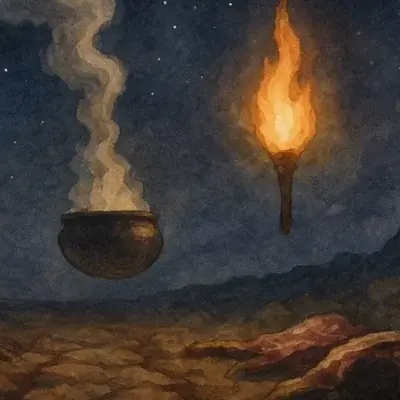
Yahweh confirms His covenant with Abram through vision and sacrifice. Abram believes Yahweh, and it is counted to him as righteousness. The covenant ceremony declares that Yahweh alone guarantees the promise, even through suffering and delay.
Genesis 15 Explained: Abram’s faith. Yahweh’s covenant.
In Genesis 15, Yahweh makes a covenant with Abram, reaffirming the threefold promise of Genesis 12: land, seed, and blessing.
The theological heart of the chapter is found in verse 6: “Then he believed in Yahweh; and He counted it to him as righteousness.”
A chiastic structure frames the chapter around this central statement, highlighting faith in Yahweh as the key to God’s covenant blessing.
Abram’s trust is not perfect—he asks questions, expresses uncertainty, and trembles before Yahweh’s presence.
Abram’s belief, not his works, is what Yahweh counts as the foundation of blessing. And as we shall see, what counts is not the strength of Abram’s faith, but the strength of Yahweh.
Genesis 15 teaches us that Yahweh is sovereign and faithful, calling His people to rest entirely on His word.
The chapter opens with Yahweh appearing in a vision to Abram. He says, “Do not fear, Abram. I am a shield to you; your reward shall be very great.”
But Abram responds with confusion. He has no heir. The promise of offspring in Genesis 12 still hangs unresolved, and Abram voices his concern openly: “O Lord Yahweh, what will You give me, as I go on being childless?”
He does not accuse Yahweh of failure, but seeks clarity. His words are the cry of faith seeking understanding, not rebellion.
The issue is not whether Yahweh can give—Abram already believes that He can—but how, when the years pass and Sarai remains barren. The man of faith is still a man who wrestles with the unseen.
As noted earlier, a chiasm shapes the structure of the chapter. In verses 1–3, we see Yahweh’s promise and Abram’s question about the absence of an heir, followed by the promise of seed as numerous as the stars in verses 4–5.
At the center stands Abram’s belief, which Yahweh counts as righteousness.
The second half then turns to the land: Yahweh affirms His gift in verse 7. In verse 8, Abram asks, “How may I know that I will possess it?”
And Yahweh confirms it through covenant in the remainder of the chapter.
Seed and land echo the original promise in Genesis 12, while the structure reveals what undergirds both: righteousness from faith.
The parts of the chiasm—promise and fulfillment—surround the core of covenant relationship: Abram’s faith in Yahweh.
Having outlined the structure, we now return to the centre of the chapter to consider the promises in more detail.
Verses 4–8, which mirror one another in the chiasm, reveal how Yahweh personally affirms both seed and land. These promises are not abstract—they are spoken directly to Abram in response to his honest questions.
And it is here, in the heart of the covenant, that faith takes shape.
Yahweh’s reply in verses 4–5 directly addresses Abram’s concern: “This man will not be your heir; but one who will come forth from your own body, he shall be your heir.”
Then He brings Abram outside and points to the sky: “Look toward the heavens and number the stars, if you are able… So shall your seed be.” We see here how Yahweh has escalated his promise.
In Genesis 12 Yahweh had spoken of making Abram a great nation, but now his seed is uncountable.
The stars become a visible anchor for Abram: a constant reminder every night of what Yahweh has promised.
And in that moment, Abram believes. Verse 6 is one of the most significant statements in all of Scripture.
Abram does not earn righteousness; it is counted to him.
His faith is not a work—it is trust in the God who gives life and keeps His word.
The focus then shifts to the land in verse 7. “I am Yahweh who brought you out of Ur of the Chaldeans, to give you this land to possess”.
Abram again asks, “O Lord Yahweh, how may I know that I will possess it?” Some might read this as doubt, but Abram isn’t asking if it will happen; he’s asking how it will happen. It reflects Abram’s desire to understand Yahweh’s ways.
We can tell this is a question from faith and not unbelief, because Yahweh does not rebuke him. Instead, He initiates a covenant ceremony that confirms His promise.
Abram brings five animals: a heifer, a goat, a ram, a turtledove, and a pigeon. The larger animals are cut in half, their divided carcasses laid opposite one another.
This ritual, common in ancient treaties, symbolised the fate of the covenant-breaker: “May it be done to me as to these animals if I do not keep my word.”
As night falls, a deep sleep overtakes him, and a dreadful darkness descends. Then Yahweh appears, not in bodily form but through a smoking oven and a flaming torch, passing between the pieces alone.
Just like the Covenant God made with Noah, this covenant is completely one-sided. Abram contributes nothing. Yahweh binds Himself to his promise, swearing by His own name. What He began, He will finish.
This image—the smoke and fire—points forward to the cloud and flame that will later lead Israel through the wilderness.
Yahweh is both obscured by the smoke and present: He is both hidden and holy, yet guiding and committed.
But the promise will not come quickly. Yahweh tells Abram that his seed will live as strangers in a land not their own, where they will be enslaved and afflicted for four hundred years.
This is not a detour from the covenant—it is part of it. Before they receive the land, they will suffer. Yet Yahweh will bring them out with great possessions, and this is precisely what happens in the Exodus.
Abram himself will not live to see it, but in the “fourth generation” his descendants will return to the promised land.
This language of “four generations” implies roughly one hundred years per man. Corresponding to the lifespans of the four men listed later—Levi, Kohath, Amram, and Moses.
This is not the first time Yahweh’s purposes have moved forward during a long silence.
From Shem to Abram, Yahweh did not speak for 400 years. Now, another four centuries will pass before His word is fulfilled.
Yahweh also explains the reason: “The iniquity of the Amorite is not yet complete”. The land is not empty, and judgment is not rushed. Just as in the days of Noah, Yahweh gives time.
The land will not be taken by conquest, but given by God when justice demands it.
The chapter closes with a formal covenant declaration: “To your seed I have given this land,” spoken in the past tense to underline the certainty of what Yahweh will do.
The territory is vast—from the river of Egypt to the Euphrates—yet ten nations still occupy it.
This is no small promise. But Yahweh is not small. His word, once given, will not fail.
Genesis 15 shows us that faith is not a vague optimism or inner strength. It is a response to the living God who speaks, who promises, and who binds Himself by covenant.
Abram will not live to see the fulfilment—he has no son, no land, no sign of global blessing. But he believes Yahweh, and his righteousness is based on faith alone. His faith does not remove the waiting, or the suffering, or the long years of silence to come.
What matters is not what Abram brings, but whom he trusts. The seed has not yet come. The land is not yet possessed. The nations are not yet blessed. But Yahweh has spoken. And Abram believes.