
Genesis 45
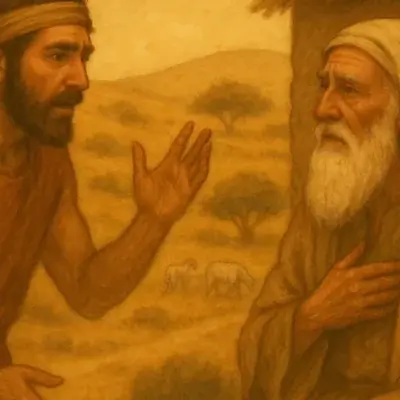
Genesis 45 records the dramatic moment when Joseph finally reveals himself to his brothers. After years of testing, he can no longer hold back his emotion. With tears and compassion, Joseph declares, “I am Joseph,” and reassures his brothers that God sent him ahead to preserve life.
Joseph reveals God’s plan to save the family
Genesis 45 brings the long conflict between Joseph and his brothers to its resolution, where hidden purposes are revealed and God’s hand is made plain. Joseph, who has tested his brothers and concealed his identity, can no longer restrain himself, and he clears the room so that only his brothers remain.
What follows is the unveiling of God’s providence as Joseph draws near to his brothers and interprets their betrayal in the light of God’s saving plan. Despite sending all the Egyptians away, he cries so loudly that they still hear, and Pharaoh’s household learns of it.
Joseph then reveals himself to his brothers: “I am Joseph.” The brothers, struck with fear, cannot answer him, for the one they betrayed and sold into slavery now stands as lord over all Egypt.
Yet Joseph’s first concern is not revenge, but reconciliation. So he draws them near and speaks words of astonishing grace. His speech in verses 4 to 13 forms the theological heart of the chapter.
Joseph acknowledges their sin without evasion: “I am Joseph your brother, whom you sold into Egypt,” but immediately reframes the entire history under the hand of God. Three times he declares, “God sent me before you,” each time enlarging the scope of God’s purpose. First, God sent him to preserve life. Second, to establish a remnant on the earth. Finally, to set him as ruler in Egypt.
Joseph does not deny the brothers’ guilt, but he insists that their wickedness was used by God. What they meant as betrayal, God meant as preservation. Their act of selling him was real and evil, but it was also the instrument God used to secure His covenant promises.
This passage presses us to think about the relationship between human freedom and God’s sovereignty. The brothers acted willingly when they sold Joseph. No one compelled them. Their jealousy and hatred drove them to sin. Yet Joseph insists that God was at work in and through their actions.
God did not cause their hatred, but He governed its outcome. Their free choice was evil, but God turned it to accomplish something good. This is the mystery of providence. Man’s will inclines towards sin, but God’s will stands above it. He does not remove responsibility. Joseph still names their betrayal plainly, but he reveals that their sin was folded into God’s larger plan. What they meant for destruction, God meant for salvation.
This also brings the story back to Genesis 12, where God first promised Abraham that through his seed all the families of the earth would be blessed. In this famine, Abraham’s family is spared, but so also is Egypt, for Joseph’s wise rule has saved an entire nation from starvation.
The covenant blessing begins to extend outward as Pharaoh and the Egyptians share in the life that God preserves through Joseph. The evil of the brothers becomes the channel by which God upholds His promise to Abraham.
This is why Joseph urges them not to be grieved or angry with themselves. Their sin is undeniable, but God’s sovereignty has overruled it for salvation. This is not God repairing an accident. It is His determined purpose unfolding even through the free choices of sinful men to keep His chosen family and bring blessing to the nations.
The reconciliation is not sealed by words alone. Joseph falls on Benjamin’s neck and weeps, then embraces and kisses all his brothers. Only after this do they speak with him. Fellowship is restored through enacted forgiveness, not just words and explanation.
Here, the covenant family, once fractured by jealousy and deceit, is bound together again under the mercy of God. When the news reaches Pharaoh’s house, his response is generous and welcoming.
Far from resenting the arrival of Joseph’s family, Pharaoh is pleased and offers them the best of the land and provision for the journey. This too is a fruit of the Abrahamic promise. Those who bless Abraham’s offspring will be blessed. Egypt, through Joseph, receives life, and Pharaoh extends that blessing to Israel.
God’s abundant provision is in view here. God moves the heart of the king of Egypt to protect His chosen people.
The theme of sending is also clear at the end of the chapter. Just as Joseph three times declared that God sent him, the chapter records that Joseph sent provisions, garments, silver, donkeys laden with Egypt’s best, and wagons to carry Jacob back to Egypt. This is an elegant piece of symmetry. God sent Joseph into Egypt for preservation, and now Joseph sends for his family and his father to come to Egypt.
Also, the gifts Joseph sends back with his brothers reverse earlier sins. The brothers had stripped Joseph of his robe and sold him for silver. Now Joseph clothes them with garments and gives Benjamin silver in abundance. What once marked betrayal now signals reconciliation, and the wagons, foreign and unmistakable, provide the visible confirmation that Jacob cannot deny. It is the visible proof, more than words, that revives his spirit.
The chapter closes with Jacob’s stunned disbelief turning into renewed hope. At first, his heart is numb, echoing the disbelief of the brothers when confronted with Joseph’s dreams. But when he sees the wagons, the evidence of Joseph’s glory in Egypt, his spirit revives, and the text deliberately shifts to call him Israel.
The covenant name is symbolic. It signals that the reviving of Jacob is the reviving of the promise-bearing line. Jacob, who had once said, “I will go down to Sheol to my son mourning,” now says, “It is enough. My son Joseph is still alive. I will go and see him before I die.”
What he thought lost to death is restored, and with it the hope of the covenant is renewed.
Genesis 45, then, is not simply a story of family reconciliation. It is the unveiling of God’s providence in history, where sin and famine become the very instruments of covenant preservation. The promises given to Abraham in Genesis 12, offspring preserved, blessing flowing to the nations, are already taking shape through Joseph’s suffering and exaltation.
Sin is real. Betrayal has wounded. Famine threatens. Yet God has sent Joseph to preserve life. God’s promise holds firm. The remnant is sustained, and the blessing of life extends even to Egypt.
What men intended for evil, God governs for His saving purposes, ensuring that His word to Abraham stands firm and His people live.