
Genesis 33
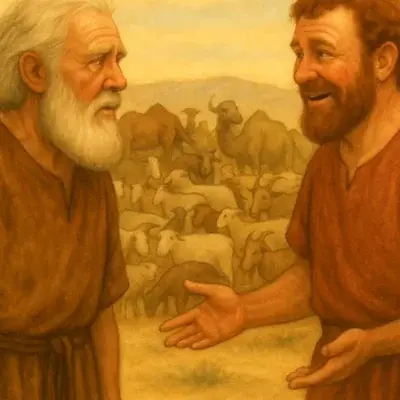
Genesis 33 records Jacob’s return to the land after twenty years away. The chapter begins with the tense approach of Esau and his 400 men, but instead of conflict, the brothers embrace in peace.
Jacob’s Escape, Laban’s Pursuit, and God’s Protection
In Genesis 32, we saw the scheme Jacob had devised to meet the threat of Esau’s approach, a calculated attempt both to appease his brother with gifts and to ensure that part of his household could escape if things turned violent. That plan was shaped by fear, even as Jacob prayed for deliverance and wrestled with God at Peniel. Now in chapter 33, we will see what comes of all his preparations.
Jacob lifts his eyes and sees Esau coming with four hundred men. The fear that has been pressing on him since his messengers returned now takes visible form. In response, Jacob arranges his family in sequence: the servants and their children first, Leah and hers next, Rachel and Joseph last. This ordering puts those dearest to him, Rachel and Joseph, at the greatest distance from danger.
However, Jacob does not hide behind them. He moves ahead, bowing to the ground seven times until he comes near to his brother.
The tension breaks in a single unexpected act. Esau runs to meet Jacob, embraces him, falls on his neck, kisses him, and they weep. The man Jacob last saw in anger now meets him with overflowing warmth.
We are not told why Esau has had such a complete change of heart. The simplest explanation is that Yahweh had gone before Jacob, doing all that was needed to secure his safety. All Jacob’s preparations were unnecessary. He need not have feared, for God had everything firmly in hand, not only because of Jacob’s prayer for safety and deliverance, but because God had already promised to be with him and to protect him.
Yahweh had been at work in Esau’s heart, answering Jacob’s prayer from chapter 32 in a way far beyond what Jacob expected.
When Esau asks about the caravans of animals he met on the way, Jacob insists they were to find favour in his brother’s sight. Esau refuses, saying he has enough, but Jacob presses him until he accepts, framing the gift in theological terms: “Please take my blessing, because God has dealt graciously with me.”
The word “blessing” should remind us of the blessing Jacob took from Esau twenty years earlier, and here it functions as a symbolic act of closure. Yet the very insistence that Esau take it also signals that Jacob does not entirely trust the reconciliation to stand on goodwill alone.
In the ancient world, a gift of this kind created an obligation on the part of the receiver, and Jacob may well have been seeking to secure Esau’s goodwill. In the same way, his gift is in effect an attempt to buy favour, something that is not confined to the ancient world. People do the same thing today, hoping to win the favour of others.
That same guardedness shows in what follows. Esau proposes they travel together to Seir under the protection of his men, but Jacob declines, citing the pace of the children and livestock. He promises to follow, yet instead turns towards Succoth.
This is more than a change of travel plans. It is a deliberate move to put distance between himself and Esau. It is still the old Jacob speaking here, courteous, deferential, and diplomatic, yet not truthful. His instinct for self-protection and his readiness to bend the truth to serve his own interests remain firmly in place.
At Succoth, Jacob builds a house and shelters for his livestock. This is the first time one from the chosen line of promise is said to build a house in the land. It signals permanence, a readiness to settle rather than sojourn. To build in this way is to act on the conviction that he is home by God’s appointment, trusting that Yahweh will keep him there.
From there, he comes safely to Shechem, where he purchases a plot of land from the sons of Hamor. Like Abraham’s purchase of the cave of Machpelah, this is a public act of ownership rooted in God’s promise that the land will belong to his descendants.
The chapter closes with Jacob erecting an altar and calling it El-Elohe-Israel, God, the God of Israel. In naming it this way, Jacob publicly embraces the new name God gave him in the previous chapter, binding his identity to the God who blessed him at Peniel. It is a confession that the God of his fathers is now the God of Israel, not just the nation that will bear his name, but the man himself.
In this moment, Jacob shows none of the guardedness he displayed toward Esau. Before his brother, he kept his distance, but before Yahweh, he openly worships.
The return that began with angels at Mahanaim and reached its centre at Peniel now ends with an altar in Canaan. God has brought him back, preserved him from his brother, and kept His covenant word.
Jacob’s faith has been uneven, but his trust is deepening, and Yahweh’s faithfulness has not wavered.