
Exodus 11
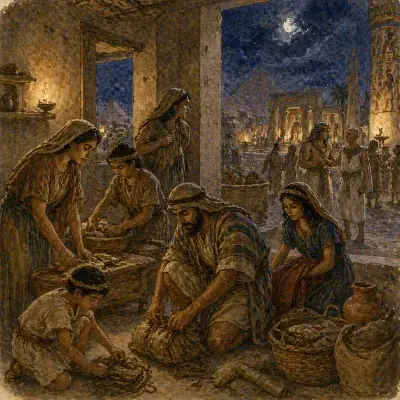
Exodus 11 stands at the threshold of Israel’s deliverance, where Yahweh declares the final plague that will break Pharaoh completely and bring His people out of Egypt. This chapter does not describe the event itself, but announces it with clarity and certainty, showing that what is about to happen is not sudden or unpredictable, but the fulfilment of Yahweh’s word spoken long before. The death of the firstborn, the plundering of Egypt, and the distinction between Israel and Egypt all arise from Yahweh’s covenant faithfulness and His righteous judgment. Every detail moves toward a decisive separation, where Yahweh will act in the midst of Egypt so that His people are delivered and His name is known.
Exodus 11 Explained: The Final Plague and the Fulfilment of Yahweh’s Promise
Exodus 11 begins with Yahweh announcing the final plague and what will happen as a result.
He says, “One more plague I will bring on Pharaoh and on Egypt; after that he will let you go from here.”
He adds that Pharaoh will not simply release Israel but will “surely drive you out from here completely.”
The king who once sought to crush Israel will expel them because Yahweh Himself has determined to break Pharaoh’s resolve.
Yahweh tells Moses to instruct the people to ask their Egyptian neighbours for articles of silver and gold.
This command fulfils Yahweh’s earlier word at the burning bush when He said Israel would “plunder the Egyptians.”
It also fulfills God’s promise he made to Abraham in Genesis 15 verse 14, where Yahweh had said He would judge the nation that enslaved Israel and bring His people out with many possessions.
The covenant language itself confirms the fulfilment, since the verb used in Genesis 15 shares the same root as the word “plunder” in Exodus 3:22 and in the following chapter: Exodus 12 verse 36.
Yahweh gives Israel favour in the sight of the Egyptians, and they hand over their wealth in fear and reverence.
The same Yahweh who hardens Pharaoh’s heart softens the hearts of the people, inclining them toward Israel and making His purpose stand in both hardening and favour.
Moses is described as “very great in the land of Egypt,” honoured by Pharaoh’s servants and by the people, even while Pharaoh remains hardened in rebellion.
Moses then speaks Yahweh’s final declaration to Pharaoh, announcing that around midnight Yahweh will go out in the midst of Egypt.
He declares that every firstborn in the land will die, from Pharaoh’s firstborn on the throne to the firstborn of the servant-girl behind the millstones and the firstborn of the cattle.
This judgment fulfils the warning Yahweh gave at the beginning of Moses’ mission when He said, “Israel is My son, My firstborn.
Let My son go that he may serve Me, but if you refuse, I will kill your son, your firstborn.”
The death of Egypt’s firstborn is therefore not arbitrary violence but Yahweh’s righteous answer to Pharaoh’s long refusal to release His firstborn son.
It also stands as justice for Egypt’s earlier attempt to extinguish Israel’s children when Pharaoh commanded the slaughter of the Hebrew boys.
Moses says the cry that will arise in Egypt will be unlike anything before or after, matching the earlier cry of Israel under its oppression.
Yahweh hears the cry of the afflicted, and He answers with judgment that reaches from palace to grinding-stone.
Moses adds that Israel will remain untouched on that night of death.
He says, “Not even a dog will bark” against the sons of Israel, whether man or beast.
This image is a symbol of perfect safety. Dogs were scavengers that roamed scenes of death: for example, picking over the dead after a battle.
Yahweh will again distinguish between Israel and Egypt.
Egypt will be filled with mourning, but Israel will rest in calm because Yahweh makes a distinction between His chosen people and the nation that opposes them.
Moses tells Pharaoh that all his servants will bow before him and urge him to send Israel out.
The proud court that once oppressed Israel will plead for their departure.
Moses then leaves Pharaoh “in hot anger,” revealing a rare glimpse into the heart of the servant of Yahweh.
He has spoken Yahweh’s sentence of death and has seen Pharaoh refuse again, and his anger reflects the weight of the judgment now fixed upon those who oppose Him.
His anger arises from the righteousness of the moment, for Pharaoh’s rebellion has sealed the fate of Egypt.
Yahweh closes the chapter by affirming the purpose behind Pharaoh’s hardness.
He says, “Pharaoh will not listen to you, so that My miraculous wonders will be multiplied in the land of Egypt.”
Pharaoh’s refusal has not hindered Yahweh’s plan; it has brought it to completion.
Moses and Aaron performed the signs Yahweh commanded, and Yahweh strengthened Pharaoh’s heart so that His works would be displayed in full before the final plague.
Israel now stands on the threshold of deliverance, and Yahweh prepares to separate His people from Egypt with a final act of judgment so that every generation may know that He is Yahweh.