
John 13
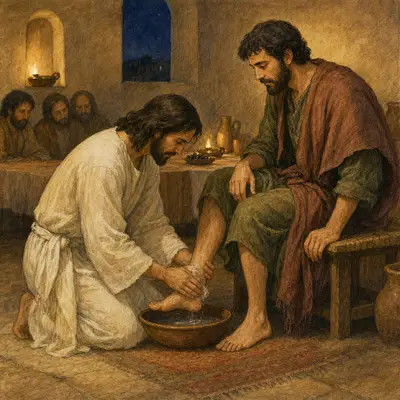
John 13 opens the final movement of John’s Gospel as Jesus, knowing that His hour has come, loves His own to the end. He rises from supper, lays aside His garments, and washes the disciples’ feet, giving visible form to the cleansing His death will accomplish. Judas eats bread from His hand and goes out into the night, while Peter overestimates his own devotion and is warned that he will deny Jesus before the rooster crows. Between these failures, Jesus gives His disciples a new commandment: to love one another as He has loved them, the mark by which the world will know they belong to Him.
John 13 Explained: Love to the End
John 13 opens the final major movement of John’s Gospel. Jesus’ public ministry has reached its conclusion, the signs performed before Israel have brought increasing opposition rather than national repentance, and the remaining chapters turn towards the disciples as Jesus prepares them for His death, resurrection, return to the Father, and the coming work of the Holy Spirit. John has repeatedly said that Jesus’ hour had not come, but in chapter 12 Jesus declared, “The hour has come for the Son of Man to be glorified.” Chapter 13 now begins with Jesus knowing that His hour had come to depart out of this world to the Father. The cross stands immediately before Him, and John describes it as the appointed hour in which the Son will complete the work given to Him and return to the glory He shared with the Father before the world was.
John introduces this hour through the love of Christ: “having loved His own who were in the world, He loved them to the end.” “To the end” means love that does not stop until it has finished what it set out to do. Jesus will love His people through betrayal, abandonment, suffering, crucifixion, and death. His love will accomplish everything necessary to cleanse them, reconcile them to God, preserve them through their failure, and bring them into the fellowship He has with His Father. The footwashing that follows gives visible form to that love, while the cross will accomplish the cleansing towards which the washing points.
The words “His own who were in the world” also explain why Jesus washed the disciples’ feet rather than turning this into a public act performed for everyone in Jerusalem. This was a private sign given to the men whom He was preparing to serve as His witnesses after His departure. Jesus had shown mercy throughout His ministry to the sick, the poor, the unclean, the rejected, and even His enemies. The particular purpose of this action concerns His own people and the life they must share with one another. Jesus will repeatedly say “one another” when He explains the meaning of what He has done. The church must become a community shaped by the love of the Lord who stooped to wash the feet of His disciples and then laid down His life for them.
The scene takes place during supper while the devil has already put betrayal into the heart of Judas Iscariot. Judas is preparing to betray Him, and at the same moment Jesus knows that the Father has given all things into His hands, that He came forth from God, and that He is going back to God. Nothing taking place that night lies outside His knowledge or His Father’s purpose. Judas will act willingly and wickedly, Satan will act with murderous hatred, and through their sin the determined purpose of God will be accomplished.
The statement that the Father had given all things into the hands of Jesus repeats what John has already said in chapter 3 verse 35: “The Father loves the Son and has given all things into His hand.” This is not a direct Old Testament quotation, but it echoes the Bible’s wider picture of the Messiah ruling over everything.
Psalm 8 speaks of all things being placed under the feet of the Son of Man, and Daniel 7 describes the Son of Man receiving dominion, glory, and a kingdom from the Ancient of Days. This shows the absolute authority of Jesus as He rises from supper. All things are in His hands, and those hands now take up a towel and wash the dirt from the feet of His disciples.
His service flows directly from His knowledge of who He is. Jesus knows His origin, His destination, and His authority. He came forth from God and is returning to God. John uses similar language throughout the Gospel to describe the mission of the eternal Son. Jesus says in chapter 16 verse 28, “I came forth from the Father and have come into the world; I am leaving the world again and going to the Father.” He does not rise to wash their feet because He has forgotten His dignity. The Lord and Teacher knowingly assumes the work of a slave.
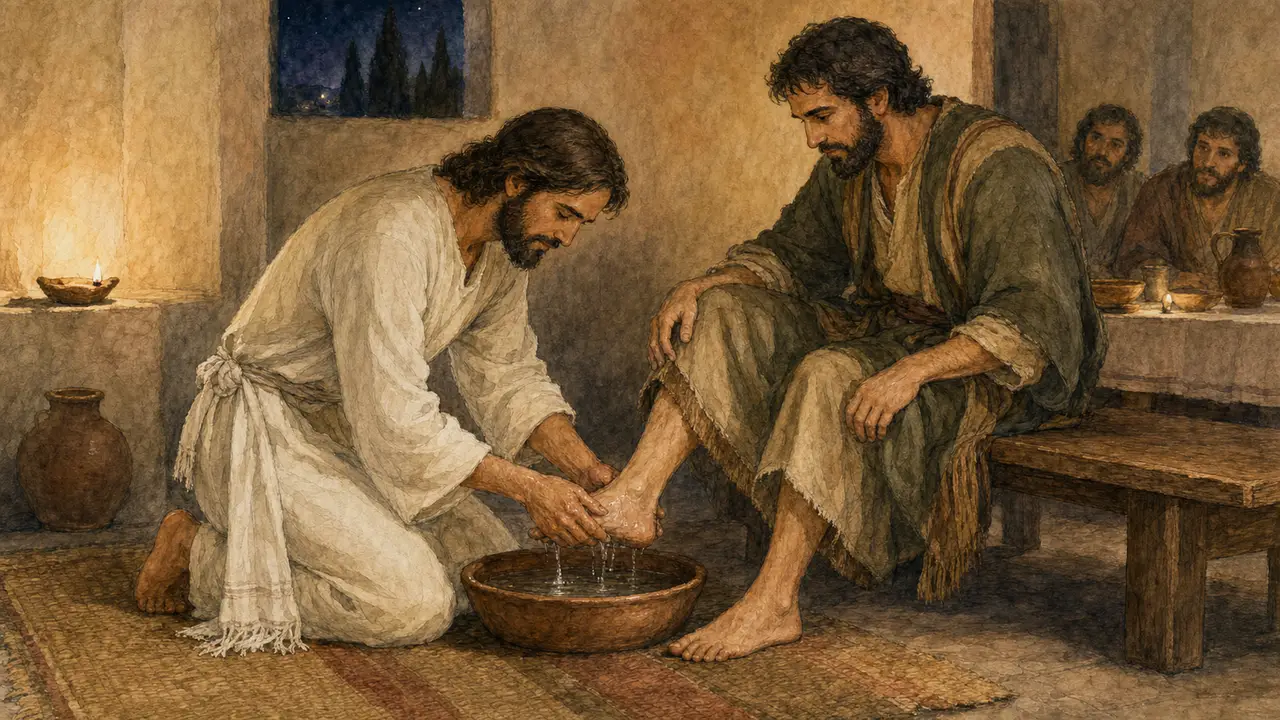
John slows down here: Jesus gets up from supper, lays aside His garments, takes a towel, ties it around Himself, pours water into the washbasin, begins to wash the disciples’ feet, and wipes them with the towel. Every movement gets its own mention. John could have simply said that Jesus washed their feet, but he lists each step, because Jesus is deliberately taking on the posture and work of a servant.
These verbs also echo what Jesus had already said about His death and resurrection. In John 10, Jesus declared that He lays down His life so that He may take it again. In John 13, He lays aside His garments and later takes them again. The footwashing therefore anticipates the larger movement of the hour that has now arrived. The Son lays aside His garments, descends to the place of service, washes His people, takes His garments again, and returns to His place at the table. Within hours He will lay down His life, accomplish the cleansing of His people through His blood, take up His life in resurrection, and return to the Father.
Jesus pouring water into the washbasin makes the scene physical: real water, real dirt, a towel, and the feet of men who will soon abandon Him. In the biblical world, water for washing feet belonged to ordinary hospitality, as when Abraham offered water so his visitors could wash their feet in Genesis 18, though usually the guest or a servant did the washing. Jesus takes this lowly work upon Himself.
Washing also carries an established biblical connection with cleansing before God. The priests washed their hands and feet at the bronze basin before approaching the altar or entering the tent of meeting. The fullest background appears in Yahweh’s new covenant promise in Ezekiel 36: “Then I will sprinkle clean water on you, and you will be clean; I will cleanse you from all your uncleanness and from all your idols. Moreover, I will give you a new heart and put a new spirit within you.” Yahweh then promises, “I will put My Spirit within you and cause you to walk in My statutes.” Cleansing, a new heart, and the gift of the Spirit belong together in that promise, issuing in a life of obedience.
John has already drawn upon this language when Jesus told Nicodemus that a person must be born “of water and Spirit” to enter the kingdom of God. Jesus was speaking to a teacher of Israel who should have recognised Yahweh’s promise to cleanse His people and give them His Spirit. The footwashing in John 13 belongs within the same covenant pattern. Jesus must cleanse His people before they can share life with Him, a cleansing His Spirit will apply to them.
When Jesus comes to Simon Peter, Peter asks, “Lord, are You going to wash my feet?” Peter understands the social offence of the action. His Lord and Teacher has taken the place that should have belonged to one of the disciples. Luke records that the disciples disputed that same evening about which of them was greatest. While they thought about rank, Jesus took the towel. Peter is disturbed because the action overturns his understanding of how the Lord should behave, but his reverence becomes disobedience when he attempts to forbid Jesus from serving him.
Jesus answers, “What I am doing you do not realize now, but you will understand afterwards.” John has already explained that the disciples understood certain events only after Jesus was raised from the dead, when the Spirit would bring His words to their remembrance. Peter sees his Lord washing feet. After the cross and resurrection, he will understand that the Son of God came to cleanse His people through an act of service far lower and more costly than anything occurring in that room.
Peter responds with an absolute refusal: “You will never wash my feet, ever!” Jesus answers: “If I do not wash you, you have no part with Me.” Peter cannot belong to Christ without receiving the cleansing that Christ provides. No disciple cleanses himself, and no disciple enters Christ’s kingdom through personal resolve, religious status, or willingness to make sacrifices. Jesus must wash him.
The word translated “part” refers to a share or portion. Peter must receive his portion from Christ through the cleansing work of Christ, in which He will bear sin, satisfy divine justice, and cleanse His people from all unrighteousness. Peter’s first error was attempting to prevent Jesus from washing him. His next error is attempting to determine how Jesus should wash him. He says, “Lord, not only my feet, but also my hands and my head.” Peter moves quickly from complete refusal to demanding a complete bath, because he still has not understood what Jesus is teaching.
Jesus replies, “He who has bathed needs only to wash his feet, but is completely clean; and you are clean, but not all of you.” A person who had bathed before the meal could arrive with dirty feet after walking outside. He remained bathed, although his feet required washing. Jesus applies that distinction to His disciples. In John 15 verse 3, He will tell them, “You are already clean because of the word which I have spoken to you.” They have received His word and belong to Him. They remain dependent upon His continuing cleansing as they walk through a sinful world and continue to sin, as First John 1 later confirms: the blood of Jesus cleanses from all sin, and God forgives and cleanses those who confess it.
Judas stands outside this cleansing. Jesus says, “you are clean, but not all of you,” because He knows the one who is betraying Him. Nothing suggests Jesus skipped Judas during the footwashing: Judas receives the same outward washing as the others while remaining inwardly unclean. He has shared their ministry, witnessed the signs, heard the teaching, eaten at the table, and received the touch of Jesus upon his feet. None of these privileges cleanses him, because his heart remains committed to sin and unbelief. Water applied to his feet could remove dirt from his skin. It could not remove the treachery from his heart. Judas therefore gives a severe warning against trusting in outward association with Christ: the cleansing that gives a person a part with Him comes through His saving work and is received by faith, not through office, ceremony, or proximity to holy things.
After washing their feet, Jesus takes His garments, reclines at the table again, and asks, “Do you know what I have done to you?” They know what He did, but they still need Him to explain what it means. Jesus does not leave it for others to reinterpret later. He tells them precisely what they must learn from it.
“You call Me Teacher and Lord; and you are right, for so I am.” Jesus affirms both titles. He is not playing the part of a servant because He has ceased to be Lord. The One washing their feet remains their Teacher and Lord throughout the action. Because He has that authority, His example is binding: “If I then, the Lord and the Teacher, washed your feet, you also ought to wash one another’s feet.”
The command falls upon the disciples mutually. They must wash one another’s feet. Actual footwashing may express obedience where it serves a genuine need, but the command reaches much further than the repetition of a ceremony. Jesus calls His action an example and then explains its principle through the relation between a slave and his master. His disciples must accept lowly service because their Lord accepted it. No task required for the true good of a brother or sister lies beneath someone who follows Christ.
Reducing the command to an annual ritual could allow a person to perform the outward action while avoiding the life of humble service that Jesus requires. Christ’s example governs the ordinary relationships of His people: they must forgive one another, carry one another’s burdens, and willingly accept work that receives little recognition. The Lord of glory used His hands to wash dirty feet. His servants have no basis for protecting their pride when love requires them to stoop.
“One another” is the particular emphasis here. Scripture commands believers to love their neighbours and even their enemies, but John 13 addresses the shared life of Christ’s disciples as He prepares them for His departure. Jesus washed the feet of His own and told His own to serve one another. No church office, location, annual observance, or later decree has authority to replace the meaning Jesus Himself supplied.
Jesus continues, “Truly, truly, I say to you, a slave is not greater than his master, nor is one who is sent greater than the one who sent him.” If the Master serves, the slave must serve. If the One sent by the Father humbles Himself, those sent by Christ must follow the same course. Christian ministry cannot be used as a ladder towards status because the Lord who sends His servants defines ministry through His own self-giving love.
Jesus then says, “If you know these things, you are blessed if you do them.” Knowledge alone receives no commendation. The disciples have now been told what the action means, and blessing belongs to obedience. A person may understand the symbolism of the towel, basin, and water, defend the correct interpretation, and still refuse the lowly service Christ commands. Jesus directs His disciples from understanding to action.
Verse 18 introduces Judas directly into the explanation: “I do not speak about all of you. I know the ones I have chosen; but that the Scripture may be fulfilled, ‘He who eats My bread has lifted up his heel against Me.’” The quotation comes from Psalm 41 verse 9. David describes betrayal by a close companion who shared his bread and then turned against him. Sharing bread expressed fellowship, peace, and trust. To lift the heel against someone means turning on a friend with violence.
David endured betrayal within his own circle, a pattern fulfilled more fully in the greater Son of David. The psalm likely echoes Ahithophel’s desertion of David for Absalom, though it names no one directly. Judas belongs to the same pattern with greater guilt: he has lived in the presence of the Messiah, received bread from His hand, and now conspires to hand Him over to death.
Jesus’ use of Psalm 41 also shows that Judas’s betrayal does not catch Him unprepared. Jesus knows His own, knows His betrayer, knows the Scripture, and knows what will occur. The fulfilment of Scripture does not excuse Judas or make Satan innocent. Judas desires money and chooses betrayal. Satan desires the destruction of Christ and acts through Judas. God rules over their evil so completely that their rebellion fulfils His written Word and advances the redemption they hate.
Jesus explains why He tells them beforehand: “so that when it does occur, you may believe that I am He.” The word “He” has been supplied in English to complete the expression. The Greek reads egō eimi, “I am.” The closest Old Testament parallel is Isaiah 43 verse 10, where Yahweh says to Israel, “So that you may know and believe Me and understand that I am He.” The Greek wording of Isaiah and John contains the same central sequence: “that you may believe that I am.”
In Isaiah, Yahweh distinguishes Himself from idols by declaring events before they occur and bringing His declared purpose to pass. Jesus now announces the betrayal before it occurs so that its fulfilment will confirm His identity. He does what Yahweh claims as His own divine prerogative. This goes back to Yahweh’s self-identification to Moses in Exodus 3, though Isaiah 43 is the closer match in wording. Jesus wants the disciples to understand that the One betrayed at the table is the eternal “I am.”
After saying these things, Jesus becomes troubled in spirit. John has used similar language when Jesus stood before the tomb of Lazarus and when He contemplated the approaching hour of His death. His knowledge of the divine purpose does not make betrayal painless. Judas has walked with Him, heard Him, received His patience, and eaten at His table. Jesus knows that Judas is about to surrender himself fully to Satan and go to destruction, and He bears witness plainly: “one of you will betray Me.”
The disciples look at one another in confusion. Judas has concealed his true character so effectively that they do not immediately suspect him. Peter gestures to the disciple whom Jesus loved, who is reclining beside Jesus, and asks him to discover the betrayer’s identity. Jesus answers that it is the one for whom He will dip the piece of bread and give it to him.
Jesus then gives the bread to Judas. This sharpens the words of Psalm 41: “He who eats My bread has lifted up his heel against Me.” Judas receives bread directly from the hand of the One he has decided to betray. He receives another act of personal kindness while his heart remains fixed upon evil. After the piece of bread, Satan enters into him. Earlier the devil had put betrayal into his heart; now Judas gives himself over to the one whose purpose he has embraced.
Jesus says, “What you do, do quickly.” Judas and Satan do not seize control of the hour. Jesus directs the final movement towards the cross. The other disciples still fail to understand. Some think that Judas, as keeper of the money box, has been instructed to purchase something for the feast or give something to the poor. His office and outward conduct have hidden his corruption from them.
Judas receives the bread and leaves immediately. John concludes, “And it was night.” It really was night, but throughout John’s Gospel, darkness also stands for unbelief, evil, and judgment. Men love darkness rather than light because their deeds are evil. Jesus is the Light of the world, and Judas walks out from His presence into the night. He has rejected the Word, the signs, the fellowship, the warning, the washing, and the bread. He now goes to complete his betrayal.
When Judas has gone out, Jesus says, “Now is the Son of Man glorified, and God is glorified in Him.” The departure of Judas begins the final sequence that will lead to arrest, trial, crucifixion, resurrection, and return to the Father. Jesus speaks of the glorification as already present because the appointed hour has arrived and its completion is certain.
The cross reveals the glory of the Son because there He completes the Father’s will, bears the sins of His people, and lays down His life in love. God is glorified in Him because the cross reveals His justice and mercy held together. The Father will glorify the Son in Himself by raising Him from the dead and restoring Him to the glory He possessed before the world existed.
Jesus addresses the disciples as “little children” and tells them that He will remain with them only a little longer. They will seek Him, but where He is going they cannot come. He must enter the suffering of the cross alone. None of the disciples can share in the work He must accomplish at the cross, where He will bear the guilt of His people, endure the judgment their sins deserve, and reconcile them to God. They will follow later because His death will open the way, His resurrection will conquer death, and His Spirit will preserve them until their own appointed service is complete.
Jesus now gives the command the whole scene has been building to: “A new commandment I give to you, that you love one another, even as I have loved you, that you also love one another.” The law had already commanded Israel to love their neighbour as themselves, so the newness does not consist in the first appearance of a command to love. Jesus now establishes His own love as the pattern and measure of that love, and He gives the command as the One who is about to establish the new covenant through His blood.
The covenant connection is now complete. The cleansing water, new heart, and indwelling Spirit that Ezekiel promised are what the footwashing anticipates and the cross secures. The new commandment belongs with the new covenant: those who receive it will be made new by Christ’s saving work and enabled by His Spirit to love as He has loved them.
The love introduced in verse 1 now becomes the command of verse 34. Jesus washed their feet, and He will bear their sins at the cross and seal the new covenant in His blood. He commands them to love one another according to that same pattern. The footwashing therefore stands between the opening declaration of His love and the new commandment as a visible sign of the cleansing and humble service that will mark His covenant people.
“By this all will know that you are My disciples, if you have love for one another.” Jesus gives the world the identifying mark of His people. Their witness includes the proclamation of His truth, and their life together must display the love created by that truth. A church may possess buildings, offices, ceremonies, historical claims, and public influence. Jesus points to the love of believers for one another as the visible evidence that they belong to Him.
This love remains governed by His Word. It does not excuse sin, abandon truth, or permit the church to change what Christ has commanded. The same Jesus who tells His disciples to love one another also tells them to keep His commandments. Christian love listens to Christ, receives His cleansing, submits to His teaching, and serves His people according to His example.
Peter responds by returning to Jesus’ statement about leaving: “Lord, where are You going?” Jesus tells him, “Where I go, you cannot follow Me now; but you will follow later.” Peter will eventually follow Jesus through suffering and death. John 21 records Jesus restoring Peter and telling him that another will stretch out his hands and take him where he does not wish to go. Peter will glorify God through his death, but first Christ must die for Peter, rise again, restore him, and give him strength through the Holy Spirit.
Peter asks, “Lord, why can I not follow You right now? I will lay down my life for You.” There is painful irony in what he says. Jesus has already declared that the good shepherd lays down His life for the sheep. Peter now claims that he will lay down his life for the Shepherd. Within hours, he will deny that he even knows Him.
Jesus answers, “Will you lay down your life for Me? Truly, truly, I say to you, a rooster will not crow until you deny Me three times.” Peter speaks sincerely and greatly overestimates the strength of his own devotion. He believes his courage can carry him wherever Jesus goes. He has not understood the weakness of his flesh, the pressure of temptation, or his complete dependence upon Christ.
The towel and washbasin lead us to the cross. The Lord who stooped to wash dirty feet will soon be lifted up to bear the sin of His people, take up His life again, and return to the Father before sending the Holy Spirit to complete in them what His washing began. Redeemed people therefore live under the authority of His Word and within the pattern of His love: “even as I have loved you, that you also love one another.”