
Genesis 50
Genesis 50 brings the book of beginnings to its close with a chapter filled with grief, forgiveness, covenant hope, and faith in God’s promises.
Forgiveness, Covenant Hope, and God’s Promises
Genesis 50 brings the book to its close with a chapter that gathers together grief, covenant hope, fear, forgiveness, and faith in God’s promises.
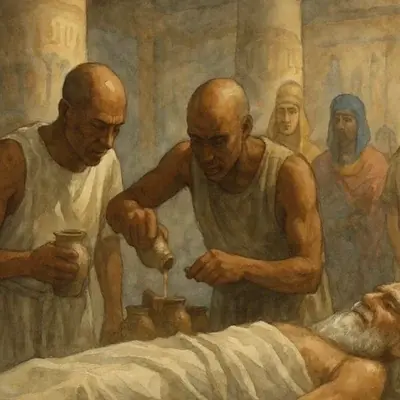
The opening scene is marked by deep sorrow as Jacob dies and Joseph falls on his father’s face and weeps. Egypt’s physicians embalm Jacob, and seventy days of mourning are observed, a period which was longer than for many Pharaohs. Even in death, Jacob is honoured before the nations because God has exalted His covenant people in the sight of the world, just as He promised Abraham that his seed would bring blessing among the nations.
Joseph then seeks Pharaoh’s permission to bury his father in Canaan as Jacob had commanded. Pharaoh grants the request, not only recognising the binding nature of the oath, but also showing the continued favour Joseph enjoyed with the king of Egypt.
The funeral procession that follows is extraordinary. The elders of Pharaoh’s household, the leaders of Egypt, the households of Israel, and even chariots and horsemen join the journey. It is best described as a state funeral, testifying to the dignity God has given Jacob in the land of his sojourning.
At the threshing floor of Atad, east of the Jordan, the mourning is so great that the Canaanites name the place Abel-mizraim, the mourning of Egypt. However, the heart of the procession is covenantal, not Egyptian. Jacob is buried in the cave of Machpelah with Abraham, Sarah, Isaac, Rebekah, and Leah. His final act in death is an act of faith. He anchors his hope in the promised land, trusting that God will restore his descendants there. Egypt is not their home.
After the burial, the story turns back to Joseph and his brothers. With Jacob gone, Joseph’s brothers are overcome with fear. They worry that he has only restrained himself for their father’s sake, and that now vengeance will fall on them.
They send word, claiming Jacob commanded Joseph to forgive them, though Scripture records no such command. It seems likely their message is born more of desperation than of truth.
When Joseph hears it, he weeps. Perhaps he weeps because their fear shows how little they trust his grace, or because their guilt still binds them even after years of kindness.
They fall before him, offering themselves as slaves, a bitter fulfilment of Joseph’s youthful dreams. Here the chapter reaches its centre, and Joseph’s words become the theological core of the entire story:
“Do not be afraid, for am I in God’s place? As for you, you meant evil against me, but God meant it for good in order to keep many people alive.”
In these sentences, we see how forgiveness operates in Scripture. Joseph does not excuse their sin, but names it as evil. At the same time, he refuses to take God’s place as judge. Instead, he entrusts the matter to God’s providence.
This is forgiveness in its true biblical sense: releasing the claim to vengeance and leaving justice with God, while at the same time showing mercy. It anticipates the gospel pattern, where forgiveness never trivialises guilt, but rests in God’s sovereign grace fulfilled supremely at the cross of Christ.
Joseph goes still further, promising to continue to bless them: “So now do not be afraid. I will provide for you and your little ones.” He speaks to their hearts and comforts them. Forgiveness does not express itself in neutrality, but in active provision and kindness. The one they betrayed now becomes their benefactor, a living picture of God’s covenant mercy, who provides for those who wrong Him.
The chapter then moves toward its close with the death of Joseph. He lives to 110, the age considered in Egypt the fullness of life, seeing the third generation of his descendants.
But through all this, Joseph’s heart is not set on Egypt, but on God’s promise. He tells his brothers, “God will surely visit you and bring you up from this land to the land He swore to Abraham, Isaac, and Jacob.”
He makes them swear to carry his bones up when God fulfils that promise. His embalmed body lies in a coffin in Egypt and waits for four hundred years, when Moses will finally carry his bones to Shechem.
The coffin in Egypt is not a symbol of defeat, but of patiently waiting for the fulfilment of God’s promises. It testifies that the covenant is not finished, that God will certainly act to redeem His people.
Genesis closes as it began, with life, death, and promise. The book opened in Eden with life lost through sin, and it ends with a coffin in Egypt. However, the book does not end in despair, but hope, because Joseph dies in faith that God will bring His people home.
The theological centre of the chapter is grace and forgiveness. The evil of men cannot overturn the purposes of God, and His mercy triumphs over fear and guilt. The covenant closes not with the perfection of God’s people, but with the perfection of God’s promise.
He will visit His people. He will redeem them. And He will bring them into the land of life.
Egypt is not Israel’s home, and it is not ours either. Christians, too, live outside the promised land, waiting for the deliverer to come and bring us into the inheritance He has sworn.
We do not set our hearts on Egypt, but on the God who fulfils His promises. And while we wait, we live as Joseph lived, blessing the nations and pointing them to the forgiveness accomplished at the cross.
The one greater than Joseph has already spoken, “Father, forgive them.” And by His blood, He has secured a better covenant. Thus, Genesis ends where the Christian life begins, with faith in God’s promise, waiting in hope, and bearing witness in the world until the day He brings us home.