
Luke 13
Some report the Galileans whose blood Pilate mixed with their sacrifices, and Jesus answers that unless His hearers repent, they will all likewise perish. He tells the parable of the barren fig tree, frees a woman whom Satan had bound for eighteen years, and compares the kingdom of God to a mustard seed and to leaven. Asked whether only a few are being saved, He commands His hearers to strive to enter through the narrow door. Warned that Herod wants to kill Him, He continues towards Jerusalem and laments over the city that kills the prophets.
Luke 13 continues the teaching of the previous chapter, where Jesus warned His disciples and the crowds to be ready for the coming judgement. He had spoken about servants who must remain watchful for their master’s return, about the consequences of failing to recognise the times, and about the urgency of settling a dispute before reaching the judge. Now Jesus develops those warnings further, confronting His hearers with the necessity of repentance and the consequences of refusing God’s kingdom. Throughout the chapter, the same two themes appear together: the certainty of judgement upon those who reject God, and the establishment of His kingdom through Jesus Christ. That kingdom is already demonstrating its power over Satan, and it will continue to grow according to God’s purposes. But those who presume upon their religious privileges while refusing to repent will find themselves excluded. The chapter begins with a warning about sudden death and ends with Jesus lamenting over Jerusalem, the city that kills the prophets sent to her.
Some people approach Jesus with news about Galileans whom Pontius Pilate had killed while they were offering sacrifices. Luke gives us no further details about this incident, but the description suggests an especially terrible act of violence, with the victims’ blood mixed with their sacrifices. Jesus recognises the assumption underlying the report. Were these Galileans greater sinners than others because they suffered such a terrible death? He answers plainly that they were not. He then recalls another tragedy, in which eighteen people died when a tower in Siloam fell on them. Again He rejects the suggestion that these victims were worse offenders than everyone else living in Jerusalem. One event involved deliberate human violence, while the other appears to have been an accident, but Jesus draws the same conclusion from both.
The assumption that extraordinary suffering must indicate extraordinary sin was familiar within Israel. Job’s friends reasoned in much the same way, assuming that his calamities must have been the consequence of some great wickedness. Scripture certainly teaches that God judges sin, and that particular acts of disobedience can bring particular consequences, but it does not permit us to conclude that those who suffer most must be the greatest sinners. Jesus rejects that reasoning and turns the attention of His hearers away from the dead and towards the living. Twice He declares, “unless you repent, you will all likewise perish.” The immediate question is not why those particular people died, but whether the living are prepared to face God themselves. Neither the people beneath the tower nor the Galileans at their sacrifices expected to die that day. Jesus uses these tragedies to expose the danger of assuming that judgement is something that happens to other people. His warning also anticipates the destruction that will eventually come upon Jerusalem, although its significance extends beyond that historical event. The manner of a person’s death does not reveal their standing before God. The question is whether they have repented and received the salvation He offers, because, as Hebrews chapter 9 says, “it is appointed for men to die once and after this comes judgment.”
Jesus then tells a parable about a fig tree planted in a vineyard. For three years the owner has come seeking fruit on it without finding any, and he orders the vineyard-keeper to cut it down: “Why does it even use up the ground?” His judgement is reasonable, because the tree has failed to fulfil the purpose for which it was planted. The vineyard-keeper asks for one more year, so that he can dig around it and put in manure, and if it remains barren after that, it will be cut down. The parable follows directly from Jesus’ declaration that all must repent or perish, and it answers the question that declaration raises. If everyone deserves judgement, why has that judgement not already fallen? Because God is patient with sinners, granting time for repentance. But the delay of judgement is not evidence that judgement will never come. The additional year does not remove the threat, and the tree must eventually bear fruit or be cut down. The parable ends before we learn whether the tree produces anything, leaving the hearers to consider their own response to God’s patience.
The imagery of a cultivated plant that fails to produce good fruit has deep roots in the Old Testament. In Isaiah chapter 5, Isaiah sings of Yahweh’s vineyard. Yahweh had dug it all around, removed its stones, planted it with the choicest vine and hoped for good grapes, but it produced only worthless ones. Then Yahweh asks, “What more was there to do for My vineyard that I have not done in it?” Isaiah explains that “the vineyard of Yahweh of hosts is the house of Israel,” and that Yahweh hoped for justice and righteousness among His people, but found bloodshed and a cry of distress. So Yahweh declared that He would remove its hedge, break down its wall and lay it waste. The vineyard was His covenant people, and its judgement came after all the care He had given it. The vineyard-keeper in Jesus’ parable likewise asks to dig around the fig tree and put in manure before it is condemned. In both pictures, judgement falls only after patient care has been given. Jeremiah chapter 8 likewise uses the absence of figs as an image of judgement upon God’s unfaithful people. Although Jesus does not explicitly identify the fig tree as Israel, the shared imagery makes the connection hard to miss. God had chosen Israel, given His people His law, sent His prophets and called them to repentance, and many continued to refuse Him.
The meaning of fruit has also been established earlier in Luke’s Gospel. John the Baptist commanded the crowds to bear fruits in keeping with repentance, and he warned that every tree that does not bear good fruit is cut down and thrown into the fire. He then explained what repentance should produce in the lives of those who came to him, including generosity, honesty and justice. Repentance involves turning away from sin and towards God, and its reality becomes evident in a changed life. Jesus’ parable reinforces John’s warning. The barren fig tree represents the danger of receiving opportunity after opportunity to repent while remaining unchanged.
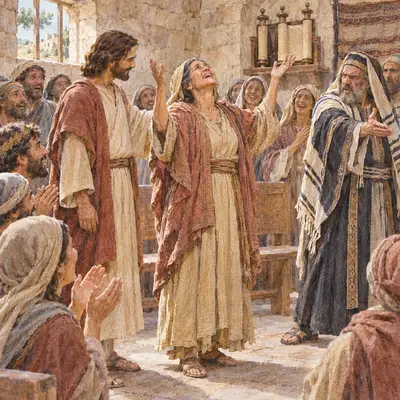
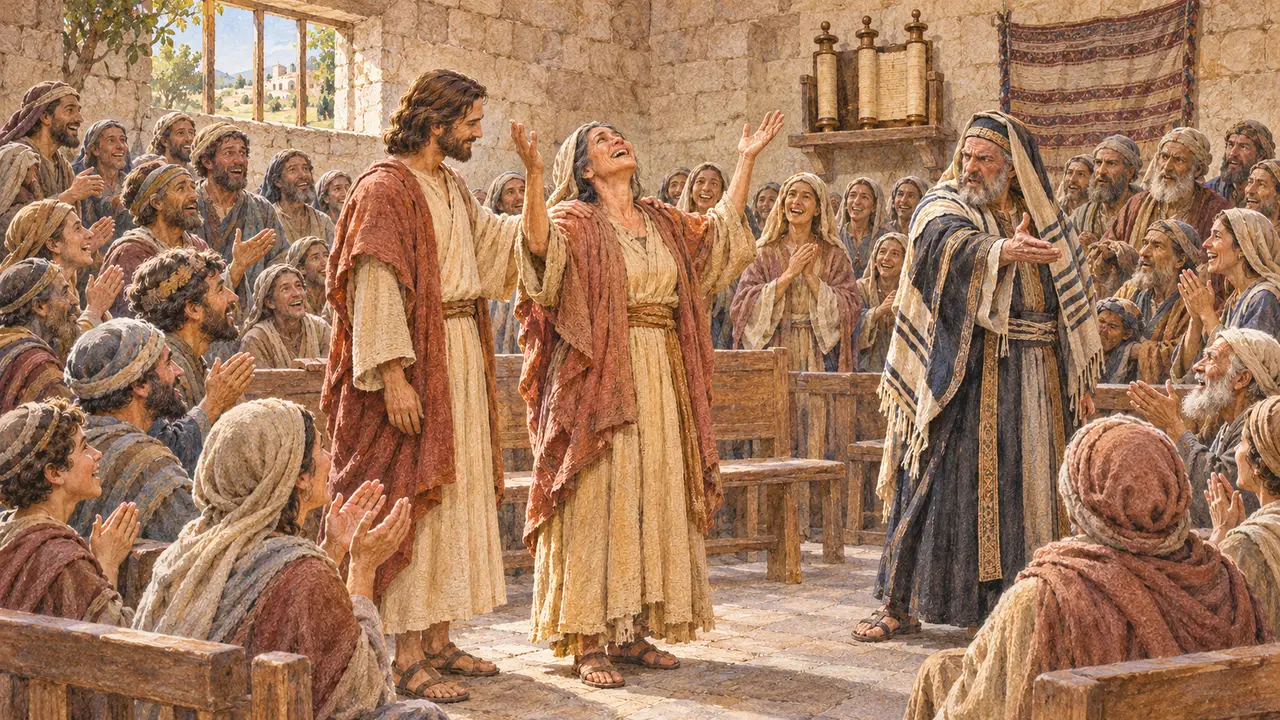
Luke then records an event in a synagogue on the Sabbath. Jesus is teaching when He sees a woman who has had a sickness caused by a spirit for eighteen years. She is bent double and could not straighten up at all. Luke describes a severe and longstanding physical condition, and Jesus later identifies Satan as the one who has bound her. There is no indication that she approaches Jesus to request healing. Jesus sees her, calls her over and declares, “Woman, you are freed from your sickness.” He lays His hands upon her, and immediately she is made erect again and begins glorifying God.
The healing demonstrates the authority of Jesus over the powers of darkness. In Luke chapter 4, Jesus had announced the fulfilment of Isaiah’s prophecy concerning good news to the poor, release to the captives and freedom for the oppressed. Here, through His word and touch, He immediately releases a woman whom Satan has held in bondage, and her response is to glorify God. The miracle reveals the character of the kingdom Jesus is establishing. Through Him, God’s promised deliverance is becoming a present reality.
But the synagogue official responds with indignation because Jesus has healed on the Sabbath. Instead of joining the woman in glorifying God, he addresses the crowd and tells them that there are six days in which work should be done, so they should come and be healed on those days and not on the Sabbath. His complaint reflects the religious authorities’ understanding of Sabbath observance, under which healing could be treated as prohibited work when there was no immediate danger to life. His response exposes a serious misunderstanding of what God had commanded. In Exodus chapter 31, Yahweh gave the Sabbath to Israel as “a sign between Me and you throughout your generations,” a mark of His covenant with them, and it commemorated God’s own rest after creation. In Deuteronomy chapter 5, Israel was also commanded to keep it in remembrance that they had been slaves in Egypt and that Yahweh their God had brought them out. The Sabbath therefore had a direct connection with God’s deliverance of His people from bondage.
Jesus answers, “You hypocrites,” and exposes their inconsistency by appealing to something they already accepted. On the Sabbath, each of them would release his ox or donkey from the stall and lead it away to water it. Should not this woman, a daughter of Abraham whom Satan had bound for eighteen years, have been released from her bond on the Sabbath day? Jesus deliberately uses the language of binding and release. The animal is released from its stall, and the woman whom Satan bound is released from her bond. The Sabbath, which commemorated Yahweh’s deliverance of Israel from slavery, becomes the occasion on which Jesus delivers one of Abraham’s descendants from the oppression of Satan. There could hardly be a more appropriate day for such a work. By calling her a daughter of Abraham, Jesus also emphasises her place among God’s covenant people. Those who should have rejoiced at her deliverance were offended by the one who had delivered her, and their interpretation of Sabbath observance had become an obstacle to recognising the work of God taking place before them.
Luke concludes the account by recording two very different responses. All His opponents are put to shame, while the entire crowd rejoices over the glorious things being done by Him. Luke then begins the next words of Jesus with “Therefore,” connecting two parables about the kingdom of God directly to the healing and the responses it produced. The kingdom has just been revealed in the liberation of this woman, in the face of indignant opposition. Jesus now explains how that kingdom will develop.
First, He compares the kingdom to a mustard seed that a man threw into his own garden. The seed is very small, but it grows and becomes a tree, with branches substantial enough for birds to nest in them. The emphasis is upon the extraordinary growth of something that began from seemingly insignificant beginnings. The kingdom of God has appeared in the ministry of Jesus, accompanied by a relatively small group of disciples and confronted by powerful religious and political authorities. Its small beginnings do not determine its eventual extent.
The imagery of a tree providing shelter for birds also recalls several Old Testament passages concerning kingdoms and their extent. In Ezekiel chapter 17, Lord Yahweh promises to plant a tender sprig on the high mountain of Israel that will become a majestic cedar, and birds of every kind will dwell under it. That prophecy concerns God’s sovereign establishment of what He has planted, and its imagery closely resembles Jesus’ description of the mustard seed. Daniel chapter 4 also describes a great tree in which birds make their homes, representing the extensive dominion of Nebuchadnezzar’s kingdom before God brings him low. In both passages, the birds benefit from the shelter provided by the tree. There is therefore strong biblical precedent for understanding the birds in Jesus’ parable as those who find a place within the kingdom’s growing reach.
Birds elsewhere in Scripture can represent evil, as they do in Jesus’ parable of the soils in Luke chapter 8, where they eat up the seed that falls beside the road and Jesus identifies them with the devil. But the presence of birds in one parable does not require them to carry the same meaning in every other passage. Here the birds nest in the branches of a flourishing tree, and the Old Testament background strongly favours a positive interpretation.
Jesus then compares the kingdom to leaven that a woman took and hid in three sata of flour “until it was all leavened.” Three sata is a very large amount of flour, enough to make bread for a crowd, and the leaven hidden in it is a very small amount. That small amount works through the whole batch. The mustard seed describes the kingdom’s expansion from small beginnings, and the leaven describes the extent of its influence: nothing in the dough is left untouched.
Leaven is often used negatively in Scripture. Israel removed it from their houses at the Passover, and in the previous chapter Jesus warned His disciples about the leaven of the Pharisees, which He identified as hypocrisy. Paul rebukes the Corinthians’ boasting with the words “a little leaven leavens the whole lump,” and calls them to celebrate the feast with “the unleavened bread of sincerity and truth.” On that basis, some read this parable as a picture of sin or false teaching spreading through the kingdom. But leaven is not sinful in itself. In Leviticus chapter 23, the two loaves presented at the Feast of Weeks were to be “baked with leaven as first fruits to Yahweh,” and in Leviticus chapter 7, leavened bread was brought with the thanksgiving offering. Leaven pictures something small working its way through the whole, and whether that is good or evil depends on what the leaven represents. Here Jesus tells us what it represents: “To what shall I compare the kingdom of God? It is like leaven.” The parable is about the kingdom itself, it is paired with the mustard seed, and it follows directly from the woman’s release from Satan’s bondage. A negative use of leaven elsewhere does not determine its meaning here. Reading it as corruption would have Jesus comparing His own kingdom to the very thing He has just overthrown in the synagogue. The religious leaders may oppose Jesus, and His ministry may seem insignificant when compared with the established powers of the world, but the kingdom belongs to God, and the healing of the woman was one demonstration of the power that will continue to advance it.
The certainty of the kingdom’s growth does not mean that everyone will enter it. Luke now returns to Jesus’ journey towards Jerusalem, where He continues passing through cities and villages, teaching as He goes. Someone asks, “Lord, are there just a few who are being saved?” The question is understandable in light of Jesus’ warnings about judgement and the need for repentance. But Jesus does not answer by giving a number or estimating how many people will eventually enter the kingdom. Instead, He directs His hearers to their own responsibility.
He commands them to strive to enter through the narrow door, warning that many will seek to enter and will not be able. The Greek word translated “strive” is agōnizomai, from which we get the English word “agonise.” It describes strenuous effort, the exertion of an athlete in a contest or a soldier in a fight. The urgency of the command comes from what follows: the door will be shut. Salvation cannot be treated with indifference, as though entrance into God’s kingdom were assured regardless of one’s response to Jesus. The effort itself does not earn entrance. As Paul writes in Ephesians chapter 2, “by grace you have been saved through faith… not of works, so that no one may boast.” Jesus is commanding an earnest and decisive response to Him while the door is still open, against the complacency of those who hear God’s call to repentance and do nothing.
Once the head of the house gets up and shuts the door, those left outside knock and plead to be admitted, and He answers, “I do not know where you are from.” They appeal to their familiarity with Him: “We ate and drank in Your presence, and You taught in our streets.” This is a direct warning to those who have encountered Jesus without repenting. Many in Israel had heard His words and witnessed His works, but such experiences offered no assurance of salvation. The decisive question was how they responded to Him. The master calls them “workers of unrighteousness” and commands them to depart. They had heard the call to repentance and continued in their sin. Like the fig tree, which occupied a place in the vineyard without producing fruit, they had a place among God’s covenant people, and that place could not guarantee their entrance into the kingdom.
Jesus does not soften what follows. There will be weeping and gnashing of teeth when they see Abraham, Isaac, Jacob and all the prophets in the kingdom of God, while they themselves are cast out. These words describe the grief and anguish of those who face God’s final judgement. Jesus has just called the healed woman a daughter of Abraham, and now He warns that others who regard themselves as Abraham’s descendants will find themselves outside. John the Baptist had already warned the crowds, “do not begin to say to yourselves, ‘We have Abraham for our father,’” and Jesus describes those outside the door in the same terms: “Then you will begin to say, ‘We ate and drank in Your presence…’” The claim is different, but the presumption is the same. Physical descent from Abraham does not guarantee participation in the blessings promised to him. Those blessings are fulfilled through Christ, and those who reject Christ reject the one through whom God brings His promises to completion.
Jesus then declares that people will come from east and west, from north and south, and will recline at the table in the kingdom of God. The image is a great banquet, and it fulfils the promise Yahweh made to Abraham in Genesis chapter 12, that in him all the families of the earth would be blessed. Israel was chosen as the nation through whom God would bring His salvation into the world, and that salvation is now being proclaimed through Jesus Christ. The gathering of the nations fills out the picture Jesus gave in the mustard seed: the kingdom that began so small will extend its reach across the world. But the narrow door remains the only entrance.
Jesus concludes this teaching by declaring that some who are last will be first, and some who are first will be last. Those who appeared to enjoy the greatest religious privileges may find themselves excluded, while those who appeared to be outsiders will receive the blessings of the kingdom. This reversal runs throughout Luke’s Gospel, where Jesus shows mercy to those whom others regarded as unworthy and confronts religious leaders who presumed upon their righteousness.
At this point, some Pharisees approach Jesus and warn Him that Herod wants to kill Him. Herod Antipas ruled Galilee and Perea and had already demonstrated his willingness to kill a prophet by having John the Baptist beheaded. The warning therefore concerns a genuine threat, although Luke does not tell us whether these Pharisees were sincerely attempting to protect Jesus or were seeking to drive Him away.
Jesus responds by calling Herod a fox and declaring that He will continue casting out demons and performing cures until His work is finished. His reference to today, tomorrow and the third day expresses the certainty that His ministry will proceed to its appointed completion. The mention of the third day may also anticipate the resurrection, but in the immediate context Jesus is speaking about the course of His ministry and His continued journey towards Jerusalem. Herod’s threats cannot determine when or how Jesus will complete His mission.
Jesus then declares that He must journey on, “for it is not possible that a prophet would perish outside of Jerusalem.” Herod rules Galilee, but the danger Jesus names is Jerusalem. The city associated with God’s presence, His temple and the worship of His people has become notorious for killing His prophets, and Jesus speaks of it with deliberate irony. He also uses the same word He used at the start of the chapter. The crowds were told that unless they repent, they will all likewise perish. Now Jesus says that He, the prophet, will perish in Jerusalem. Since Luke chapter 9, when Jesus set His face to go to Jerusalem, Luke has kept that journey before us. Jesus is not being driven there by Herod or compelled by the threats of His enemies. He goes because His suffering and death belong to God’s appointed plan of salvation. He knows what awaits Him, and He continues towards it.
Jesus then laments over Jerusalem, repeating the city’s name: “O Jerusalem, Jerusalem, the city that kills the prophets and stones those sent to her!” This accusation recalls the history of Israel’s rebellion recorded throughout the Old Testament. In 2 Chronicles chapter 36, Yahweh sends word to His people again and again by His messengers, because He had compassion on them, but they mocked the messengers of God, despised His words and scoffed at His prophets, “until the wrath of Yahweh arose against His people, until there was no remedy.” Then Yahweh brought upon Jerusalem what His covenant had warned of. In Leviticus chapter 26 and Deuteronomy chapter 28, He had told Israel that persistent unfaithfulness would bring siege, exile and desolate sanctuaries. The Babylonians destroyed the city and its temple, and Yahweh was keeping His covenant word. Now God has sent His messenger once more, and this time the one approaching Jerusalem is His own Son, whom the city will hand over to death.
Jesus then speaks of gathering Jerusalem’s children together, “just as a hen gathers her brood under her wings.” Israel’s Scriptures use this image of Yahweh. Psalm 91 says that He will cover His people with His pinions, and that under His wings they will take refuge. In Psalm 17, David asks God to hide him in the shadow of His wings. When Ruth came to Israel and placed her trust in Yahweh, Boaz said she had come to seek refuge under His wings. Jesus, the Son, takes this language that Scripture uses of Yahweh and speaks it of Himself. He is the one who has wanted to gather Jerusalem’s children under His protection. And Jerusalem has refused Him: “How often I wanted to gather your children together… and you did not want it!” Their rejection is deliberate. The Son stands before them offering the protection and salvation they desperately need, and they refuse to come to Him.
Jesus therefore declares, “Behold, your house is left to you desolate.” He speaks in the present tense, and Luke chapters 19 and 21 will describe the siege and destruction to come. This is the covenant God doing what Leviticus chapter 26 had warned: making the sanctuary desolate. In AD 70 the Romans destroyed Jerusalem and its temple, and God was judging the city for rejecting the Messiah. The fig tree was given one more year, and if it remained barren it would be cut down. Jerusalem has had the prophets and now the Son, and its refusal brings it to the end the parable warned of.
Jesus closes His lament by declaring that they will not see Him until the time comes when they say, “Blessed is He who comes in the name of the Lord!” His words are drawn from Psalm 118, a psalm celebrating God’s salvation and the vindication of the one who was rejected. There the line reads, “Blessed is the one who comes in the name of Yahweh.” The one who comes in Yahweh’s name is the same one who has just spoken of gathering Jerusalem’s children under His wings. The same psalm declares that the stone which the builders rejected has become the chief corner stone, a passage Jesus will later apply to Himself. Luke also records the disciples welcoming Jesus into Jerusalem with words drawn from this psalm, “Blessed is the King who comes in the name of the Lord.” That welcome will not prevent the city’s leaders from rejecting Him, and their rejection cannot frustrate God’s purpose. The one whom the city rejects is the Messiah whom Yahweh has sent, and He will be vindicated.
As Jesus continues towards Jerusalem, we know that His journey will lead to the cross. The chapter opened with Jesus warning that all who do not repent will perish, and near its end He declares that He Himself must perish in Jerusalem. The shared word links the two, but it is Jesus Himself who explains what His death will be. At the Last Supper He will say that His blood is “poured out for you,” and that the words of Isaiah chapter 53 must be completed in Him: “And He was numbered with transgressors.” Isaiah’s servant was crushed for our iniquities, and Yahweh caused the iniquity of us all to fall on Him. The prophet who perishes in Jerusalem bears the judgement due to sinners, so that those who repent and believe in Him will not perish. He will rise from the dead, and the kingdom pictured in the mustard seed and the leaven will continue to grow, gathering people from every nation.
The barren fig tree, the narrow door and Jerusalem’s desolate house all warn that God’s patience must not be despised. The door is still open, and the warning remains as urgent as when Jesus first spoke it: “unless you repent, you will all likewise perish.” The one who gives that warning is the Saviour who gives His life to save sinners from the judgement they deserve.