
Exodus 31
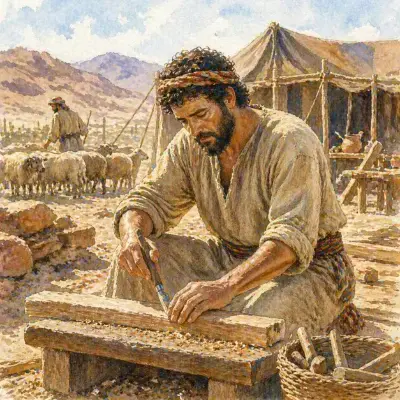
Exodus 31 brings the tabernacle instructions to a close by identifying the men Yahweh has chosen and equipped to build His dwelling, establishing the Sabbath as the covenant sign that governs Israel’s time, and concluding with the tablets of stone written by His own finger. The chapter shows that the work, the rhythm of life, and the covenant itself all come from Yahweh. His dwelling is built by those He appoints, His people are marked by the Sabbath, and His law stands fixed by His own hand.
Exodus 31 Explained: The Appointed Craftsmen, the Sabbath Sign, and the Tablets of the Covenant
Exodus 31 closes the long section of tabernacle instructions that began in Exodus 25. It turns from the structure itself to the men who will build it, then from the work to the covenant sign that governs Israel’s time, and finally to the tablets of stone written by the finger of God.
The chapter begins with Yahweh saying, “See, I have called by name Bezalel.” The wording is precise. Yahweh does not simply say that Bezalel is skilled. He says that He has called him by name. This places Bezalel in the pattern of men whom Yahweh appoints for specific roles in His purposes.
Noah was called to build the ark. Abraham was called to leave his land. Moses was called to lead Israel out of Egypt. Aaron and his sons were called to the priesthood. Now Bezalel is called to build the dwelling place of Yahweh. The tabernacle is not a human project. It is Yahweh’s dwelling, built by the man whom Yahweh has chosen.
Yahweh then says, “I have filled him with the Spirit of God in wisdom, in discernment, in knowledge, and in all kinds of craftsmanship.” The text explains this clearly. The Spirit of God equips Bezalel with the ability to design and build everything according to the pattern shown on the mountain.
This is not presented as natural talent alone. Yahweh says, “I have filled him,” “I Myself have appointed with him Oholiab,” and “in the hearts of all who are wise at heart I have put wisdom.” The repeated emphasis is that the ability comes from Yahweh. The work of building the tabernacle is therefore Yahweh’s work, carried out by men whom He enables.
Scripture has used this language before. Pharaoh recognised that Joseph had the Spirit of God because he had wisdom to interpret dreams and to preserve life during famine. Joshua is later described as being filled with the spirit of wisdom so that he can lead Israel. In each case, the Spirit equips a man for the task Yahweh gives him. Here, that task is the construction of the tabernacle.
There is also a connection back to Genesis. In Genesis 1, the Spirit of God is present as God forms and orders the world. Here in Exodus, the Spirit is present as the tabernacle is constructed. The same God who created the world now establishes His dwelling among His people, and He does so by filling a man with His Spirit so that the work is carried out according to His design.
Yahweh appoints Oholiab from the tribe of Dan to work with Bezalel from the tribe of Judah, and He gives wisdom to all who are wise at heart so that they may make all that He has commanded. The work is large and requires many craftsmen, but the focus remains on Yahweh. He calls, He appoints, He fills, and He gives wisdom.
Verses 7–11 then summarise everything Yahweh has commanded from Exodus 25 onward: the tent of meeting, the ark and the mercy seat, the furniture, the lampstand, the altars, the laver, the priestly garments, the anointing oil, and the incense. This list gathers the entire sanctuary system and marks the end of the instructions. Everything has been spoken and specified.
The chapter then turns to the Sabbath. This is not a random shift. The tabernacle marks sacred space, and the Sabbath marks sacred time. Both declare that Israel belongs to Yahweh.
Yahweh says, “You shall surely keep My sabbaths; for this is a sign between Me and you throughout your generations, that you may know that I am Yahweh who makes you holy.” The Sabbath is therefore not only about rest. It is a covenant sign that marks Israel as a people set apart to Yahweh.
The command is grounded in creation: “For in six days Yahweh made heaven and earth, but on the seventh day He rested and was refreshed.” Israel’s weekly rest is tied directly to Yahweh’s work of creation. Every Sabbath reminds them that Yahweh is the Creator and that they are His people.
The penalty for profaning the Sabbath is death, showing how serious this sign of the covenant is. Even the work of building the tabernacle must stop on the Sabbath. Israel cannot build Yahweh’s dwelling while disregarding His command. The work of God must be done in obedience to God.
The chapter ends with these words: “When He had finished speaking with him upon Mount Sinai, He gave Moses the two tablets of the testimony, tablets of stone, written by the finger of God.” This is the conclusion of Yahweh’s speech on the mountain.
Yahweh has given the instructions for His dwelling, appointed and equipped the craftsmen, established the sign of the covenant, and now gives the covenant itself, written in stone by His own finger. The covenant is His word, His law, and His testimony.
Exodus 31 closes the instructions given on the mountain. Yahweh has revealed how He will dwell among Israel, how He is to be approached through sacrifice and priesthood, how the sanctuary is to be built, and how the Sabbath will mark Israel as His people. The men who will build the sanctuary have been named and filled with the Spirit of God so that everything is made according to His command.
At the end of these instructions, Yahweh gives Moses the two tablets of the testimony, written by His own finger. Before a single curtain is woven or a single sacrifice is offered, the whole pattern for life with Yahweh dwelling among His people has been spoken by God and written in stone.