
Exodus 23
Exodus 23 brings Yahweh’s covenant judgments toward their conclusion by shaping how His people speak, judge, act, and worship. Truth must not bend to pressure, justice must not be corrupted, and even enemies must be treated rightly. Yahweh orders Israel’s time through sabbath and feasts, and calls them to exclusive worship as He promises to go before them into the land. In every command, He prepares a people who can live under His presence without turning aside into sin.
Exodus 23 Explained: Truth, Justice, and Life Under Yahweh’s Rule
Exodus 23 continues directly from the judgments Yahweh has been setting before Israel. The Ten Commandments have already been spoken, and chapters 21 and 22 have shown how those commands govern ordinary life. This chapter continues these judgments, preparing Israel for life in the land Yahweh is about to give.
The chapter opens with speech and truth, expanding and explaining the ninth commandment. Israel must not spread false reports or join with the wicked to become a malicious witness. A lie rarely succeeds on its own. It grows through repetition, agreement, and silence. Anyone who passes it on, supports it, or refuses to resist it participates in the lie.
Truth must not bend to numbers or pressure. Israel must not follow the crowd into wrongdoing or testify in a way that twists justice simply because many do so. Right and wrong do not change because a majority agrees on something else. Even sympathy cannot be allowed to distort judgment. Showing favour to the poor in a case may feel compassionate, but it still turns justice aside. Justice that bends is no longer justice.
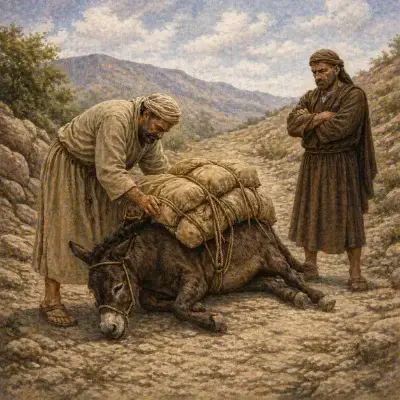
Immediately after these commands comes a surprising instruction. If a man encounters his enemy’s ox or donkey wandering away, he must return it. If he sees the donkey of one who hates him collapsed under its load, he must stop and help lift it. The law moves straight from testimony to action, from the court to the road.
The placement matters. The person a man is tempted to lie about, accuse falsely, or judge unfairly is often the same person he resents or hates. The law refuses to let hostility govern behaviour in either place. Truth is required when the enemy stands accused. Help is required when the enemy’s animal lies helpless. The command against false witness is only the beginning. Obedience extends to doing good, even to enemies.
Hatred does not cancel responsibility. An enemy does not cease to be a neighbour. The animal must still be looked after and returned. This is the natural extension of the ninth commandment.
The law then returns to the courts. Justice due to the needy must not be turned aside. False charges must be kept far away. The innocent and the righteous must not be killed. These commands rest on a simple declaration: Yahweh does not justify the guilty. Israel’s courts must reflect the way Yahweh Himself judges. When lies are tolerated or guilt is excused, the court stands against Him.
Bribes are forbidden because they do not merely influence outcomes. They blind judgment. Once money decides what is true, justice ceases to function. A verdict bought is already corrupted.
The section closes with the sojourner. Israel must not oppress him, because they were sojourners in Egypt. Yahweh reminds them of their own history. Forgetting Egypt would mean repeating it.
From justice, the law turns to time and land. Israel may sow and gather for six years, but the seventh year belongs to rest. The land is left uncultivated so the poor may eat, and whatever remains is left for the animals. The land does not belong to Israel absolutely. It remains under Yahweh’s authority.
The weekly sabbath reinforces the same truth. Six days of labour are permitted, but the seventh day is to be a day of rest. That rest extends beyond the household to servants, sojourners, and animals. Time itself falls under Yahweh’s rule, and the pattern of six days of work and one day of rest continually points back to Him as Creator.
Israel is warned to pay close attention to everything that has been spoken. The names of other gods must not even be mentioned. The feasts structure Israel’s year around Yahweh’s deliverance and blessing.
The Feast of Unleavened Bread keeps Israel looking back to the night Yahweh brought them out of Egypt. Harvest marks the firstfruits of their work. Ingathering closes the year when everything has been brought in. Three times a year all males must appear before Yahweh, and none may appear empty-handed.
Sacrificial boundaries are set to guard that worship. Blood must not be offered with leaven. The fat of the feast must not remain until morning. The best firstfruits belong to Yahweh. The prohibition against boiling a young goat in its mother’s milk draws a firm line between Yahweh’s worship and pagan practices. Israel must not worship Yahweh in the ways the nations worship their gods.
At this point the focus shifts from instruction to promise. An angel will go before Israel to guard the way and bring them to the place Yahweh has prepared. Israel must listen to his voice and must not rebel. Rebellion will not be pardoned, because Yahweh’s name is in him.
This is no ordinary messenger. To hear him is to hear Yahweh. To obey him is to obey Yahweh. To resist him is to resist Yahweh Himself. Yahweh does not send guidance at a distance. His own authority goes ahead of His people. The warning is severe because the presence is holy.
Yahweh ties His promises to Israel listening to the voice of His angel and not rebelling. He promises to stand against their enemies and drive the nations out before them. He then turns to the ordinary necessities of life. He will bless their bread and their water. He will remove sickness from among them. He will not allow miscarriage or barrenness to take hold in the land. He will bring their days to their appointed end.
Yahweh explains that He will drive out the inhabitants of the land gradually. Driving them out all at once would leave the land desolate and dangerous.
The chapter closes with a warning. Israel must not cut a covenant with the inhabitants of the land. They must be driven out. If they remain, their gods will become a snare, and Israel will be led into sin against Yahweh.
Exodus 23 brings the covenant judgments to a deliberate close. The law has shown how speech, justice, mercy, rest, worship, and allegiance function together under Yahweh’s rule. Before Israel receives the land, Yahweh shapes them for His presence. He trains them to speak truth, judge justly, do good to enemies, rest under His provision, and worship Him alone. Only a people ordered this way can live with Yahweh going before them. His presence brings blessing, but it does not tolerate rebellion.