
Genesis 21
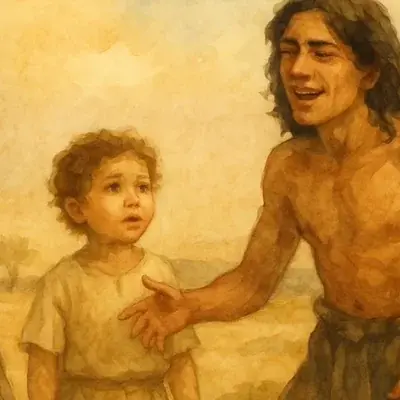
Genesis 21 marks a decisive moment in God’s covenant plan. Isaac—the long-promised son—is finally born to Abraham and Sarah, revealing Yahweh’s faithfulness after decades of waiting. Yet joy is mingled with sorrow as Hagar and Ishmael are sent away, highlighting the separation between the promised seed and the son of the flesh.
The Birth of Isaac, the Banishment of Ishmael, and a Covenant
Genesis 21 opens with the long-awaited fulfilment of Yahweh’s word. The promise first spoken in Genesis 12, reaffirmed in chapters 15, 17, and 18, has finally arrived.
Yahweh visits Sarah, just as He had said. The repetition of “as He had said… as He had spoken… at the appointed time” is deliberate.
It underlines the central point: this is not the result of human initiative, biological probability, or clever planning. This is divine fulfilment. Yahweh, the covenant God, has done what only He could do.
Abraham names the child Isaac and circumcises him on the eighth day, exactly as God commanded. The careful observance of these covenant instructions ties the miracle birth to the sign of the covenant.
This child is not only born by promise, but marked as belonging to the covenant line.
There is no ambiguity about his identity. He is Abraham’s seed through Sarah, born by God’s direct intervention, and received in faith.
Sarah’s laughter, previously of doubt in chapter 18, now overflows with joy.
She declares, “God has made laughter for me; everyone who hears will laugh with me.”
What once marked her unbelief now becomes a public testimony to Yahweh’s mercy. The name Isaac, “he laughs,” now carries a different tone. Her laughter is joyful, and shared.
Everyone who hears of Yahweh’s work will laugh with Sarah.
The New Testament picks this up to highlight Abraham and Sarah’s faith, not in their ability to produce life, but in the God who gives it.
Paul writes in Romans 4 that Abraham “did not weaken in faith when he considered his own body… or the barrenness of Sarah’s womb.”
Hebrews 11 says Sarah “considered Him faithful who had promised.” That is the heart of Genesis 21: Yahweh has done what He promised, and His people have received it by faith.
But with the arrival of the promised son comes tension.
The presence of Hagar and Ishmael, Sarah and Abraham’s previous attempt to secure the promise through the flesh, now becomes a threat to the true heir.
When Sarah sees Ishmael “laughing” at Isaac, mocking him, the word used suggests ridicule, even hostility. Isaac’s name symbolises joy, but Ishmael’s laughter is not joyful.
Paul later reads this in Galatians 4 as persecution: “the son of the flesh persecuted the son of the Spirit.”
Sarah demands that Abraham cast them out.
“Drive out this maidservant and her son! The son of this maidservant shall not be an heir with my son, with Isaac.”
On the surface, this seems very harsh. And Abraham is deeply troubled. After all, this is his son.
Yet God affirms the decision, not because of Sarah’s reasoning, but because of His covenant plan.
“Do not be distressed because of the boy and your maidservant; whatever Sarah tells you, listen to her voice, for through Isaac your seed shall be named.”
Here, Abraham is told by God to listen to the voice of his wife. This is a deliberate reversal of Eden, where Adam listened to the voice of his wife and fell into sin.
There, obedience to his wife meant disobedience to God. Here, obedience to his wife is commanded by God. The difference is not in the woman’s voice, but in whose word governs the action.
In Eden, the voice of the wife drew the man away from God’s word. In Beersheba, the voice of the wife is upheld by God’s word.
The covenant line cannot be shared. This is not about Sarah’s personal jealousy, but about God’s promise. The covenant promise is through Isaac.
And yet, Yahweh does not abandon Hagar and Ishmael. He reassures Abraham that He will make a nation of Ishmael as well, for the sake of Abraham.
This tension between exclusion and compassion mirrors Genesis 17, where the covenant is sharply drawn around Isaac, but God still promises to bless Ishmael.
Yahweh’s faithfulness to His promises does not cancel out His mercy to those outside the covenant.
The wilderness scene at Beersheba recalls Genesis 16, but this time the danger is greater.
Hagar lays her son under a bush and distances herself: “Let me not see the boy die.” It is a moment of total despair.
But God acts.
The text does not say He hears Hagar. It says He hears the voice of the boy. This is unexpected, and significant. Ishmael, whose name means “God hears,” is heard again.
God opens Hagar’s eyes, and she sees a well. The God who gives Isaac to Sarah now gives water to Hagar. Life flows from His mercy, even outside the covenant.
Ishmael grows up in the wilderness, becomes an archer, and marries an Egyptian.
Each detail points away from the line of promise. The mention of Egypt foreshadows future tension. Later, the Ishmaelites will sell Joseph into slavery in Egypt, working directly against the covenant people.
Though not always named, their descendants often appear aligned with opposition to Israel. What begins here as rivalry in Abraham’s house will echo through generations.
The final section of the chapter returns us to Abraham’s position in the land. Abimelech reappears, this time not in confrontation, but accompanied by the commander of his army, signalling a mixture of diplomacy and caution.
His opening words are striking: “God is with you in all that you do.” Even the native king of the land can see that God is with Abraham in all he does.
The treaty they form is not just political. It marks Abraham’s growing stability and influence in the land of promise.
He is no longer just passing through. Abraham plants a tree, swears an oath, and names a well: Beersheba, “well of the oath.”
Like earlier altars and trees in Genesis 12 and 13, it marks a place of worship and permanence. Abraham calls on the name of Yahweh, this time using a new title: El Olam, “Everlasting God.”
This is the first time this title appears in the Bible.
The God who made the heavens and the earth in chapter 1 is now recognised as the God whose promises never fail, whose mercy reaches even to Hagar, whose timing is never late, and whose presence sustains His servant in the land.
The chapter closes quietly: “Abraham sojourned in the land of the Philistines for many days.”
The phrasing is deliberate. Abraham is still a sojourner, but now he has a son. He has a well.
He has planted a tree, and he has peace with his neighbours.
And most importantly, he has called on the name of Yahweh in worship.
The covenant promise is no longer only future. It is unfolding.
Yahweh is doing what He promised.
The land is being secured by Yahweh’s own hand, through covenant faithfulness. And in response, a tree is planted, a well is named, and worship is offered to the Everlasting God.