
Galatians 3
Galatians 3 confronts the attempt to begin by faith in Christ and then seek perfection through works of the Law. Paul shows that Abraham was counted righteous by faith, that the Law exposes every sinner to its curse, and that Christ bore that curse so the promised blessing and Spirit might come to the nations. The chapter calls believers to rest in Christ alone rather than in religious effort.
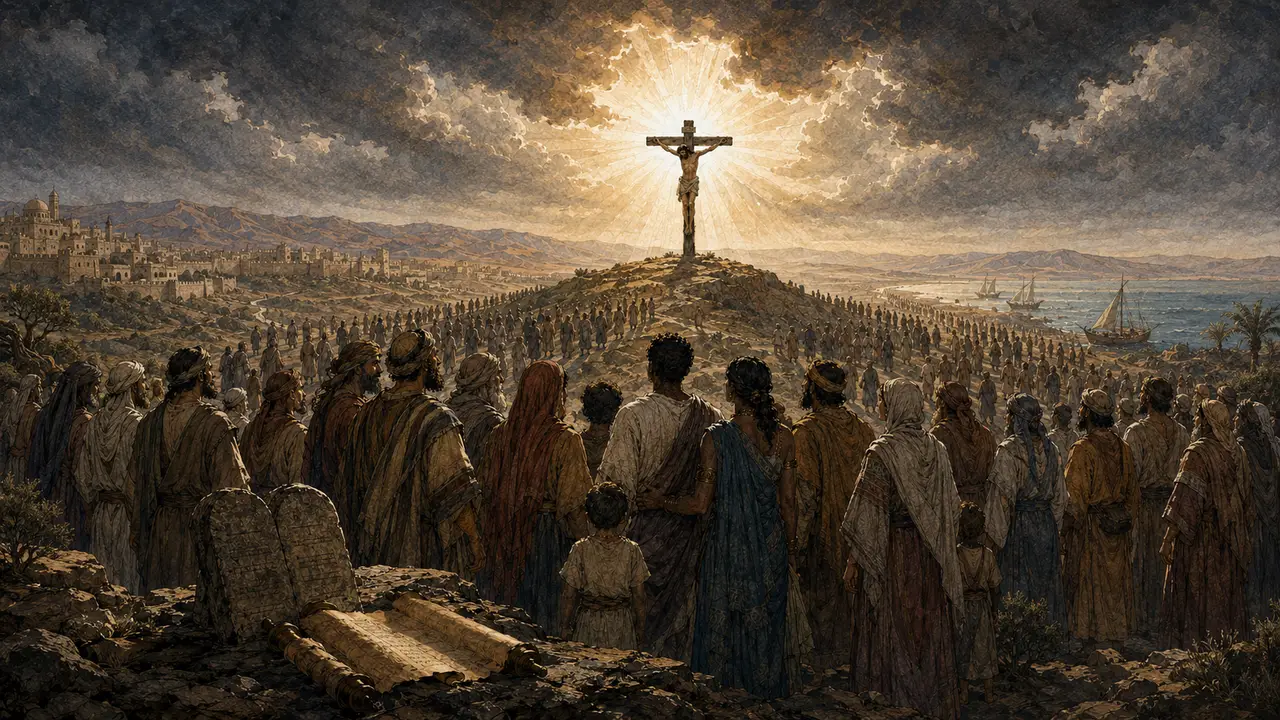
Galatians 3 Explained: The Curse of the Law and the Promise of Faith
Galatians 3 begins with one of the strongest rebukes in the letter, but the rebuke itself shows that Paul has not written the Galatians off as a lost cause. He says, “O foolish Galatians, who bewitched you, before whose eyes Jesus Christ was publicly portrayed as crucified?” Paul is severe because the danger is severe. He does not speak this way because he despises them. He speaks this way because they are drifting from the gospel they first received.
They have not misunderstood a small point of doctrine. They are being drawn toward a way of righteousness that would pull their confidence away from the cross of Christ. Christ had been publicly portrayed before their eyes as crucified. That does not mean they physically saw the crucifixion. It means the preaching of Christ crucified had been set before them with clarity. The crucified Christ had been proclaimed to them as the full ground of their righteousness before God, and now they are being persuaded to seek completion through the works of the Law.
Paul then asks the question that exposes the whole error: “This is the only thing I want to learn from you: did you receive the Spirit by the works of the Law, or by hearing with faith?” The answer is obvious. They received the Spirit by hearing with faith. They did not receive the Spirit by circumcision, food laws, calendar observance, or by coming under the Mosaic covenant. God gave them the Spirit when Christ was preached and they believed.
Paul starts with their own experience because it proves that the gospel already bore the mark of God’s approval among them. The Spirit was not given as a reward after Law-keeping. The Spirit was given through the hearing of faith. That means the Christian life began for them by God’s gracious act, through the preached gospel, received by faith in Christ.
That is why Paul presses the question further: “Are you so foolish? Having begun by the Spirit, are you now being perfected by the flesh?” The Galatians are acting as though the Spirit was enough to begin the Christian life, but not enough to bring it to maturity. They are treating faith in Christ as the entry point, while imagining that the flesh can now complete what the Spirit began.
In this context, “flesh” does not only refer to immoral behaviour. It includes human religious effort when that effort is used as the basis for standing before God. The flesh can appear outwardly respectable. It can be circumcised, disciplined, zealous, and religious. But if it seeks righteousness before God apart from Christ, it remains flesh. Paul’s point is this: the Spirit begins the Christian life, and the Spirit brings the Christian life to completion. God does not justify by faith and then perfect by Law.
Paul then asks, “Did you suffer so many things for nothing, if indeed it was for nothing?” Their suffering as believers was not meaningless when it was endured for Christ. But if they abandon the gospel for Law-based righteousness, they show that they are willing to throw away the very truth for which they had already suffered. The danger is not that they will become slightly confused Christians with a few wrong practices. The danger is that they will continue down a road that leads away from Christ.
Later Paul says, “You have been severed from Christ, you who are being justified by law; you have fallen from grace.” That is the seriousness already present here. If they seek to be completed by the flesh, they will have suffered for a gospel they are now forsaking.
Paul then repeats the same basic question in another form: “So then, does He who provides you with the Spirit and works miracles among you, do it by the works of the Law, or by hearing with faith?” Paul is not only speaking about how they first received the Spirit. He is also speaking about God’s ongoing supply of the Spirit among them. The same God who gave them the Spirit continues to work by the same gospel they believed at the beginning.
They are not meant to move from faith to Law, from Spirit to flesh, from Christ crucified to covenant badges under Moses. They received the Spirit by hearing with faith, and God continues to provide the Spirit by hearing with faith. The whole life of the church rests on Christ crucified, preached and believed.
From there Paul turns to Abraham, because the false teachers were likely using Abraham against the Galatians. If Gentile believers wanted to belong to Abraham’s family, they were being told they needed circumcision and the works of the Law. Paul answers by going back to Scripture itself: “Just as Abraham believed God and it was counted to him as righteousness.” Here Paul quotes Genesis 15:6.
Abraham was counted righteous because he believed God’s promise. This happened before circumcision was given in Genesis 17, and centuries before the Law was given through Moses. Abraham’s righteousness before God was not grounded in the works of the Law. It was counted to him through faith. Paul is not saying Abraham believed in a vague religious way. Abraham trusted the God who promised him seed, blessing, and inheritance, and Paul now shows that this promise reaches its fulfilment in Christ.
Paul draws the conclusion plainly: “So know that those who are of faith, those are sons of Abraham.” The sons of Abraham are not defined by flesh, circumcision, or ethnic descent as the ground of inheritance. They are defined by faith. This does not erase the real history of Israel or the real promises God made in the Old Testament. It explains how those promises reach their intended goal.
Abraham believed God’s promise, and those who share Abraham’s faith are Abraham’s sons. The Galatians do not need to become Jews under Moses in order to belong to Abraham. They need to believe the God who has fulfilled the promise in Christ.
Paul then shows that the inclusion of the Gentiles was never an afterthought. He says, “And the Scripture, foreseeing that God would justify the Gentiles by faith, proclaimed the gospel beforehand to Abraham, saying, ‘All the nations will be blessed in you.’” This reaches back to Genesis 12, where Yahweh called Abraham and promised that all the families of the earth would be blessed in him.
Paul calls that promise the gospel beforehand. The gospel was not invented after Israel failed. God announced beforehand that the blessing given through Abraham would reach the nations. The Gentiles would not be justified by becoming Jews under the Law, but by faith. God’s promise to Abraham always had the nations in view, and Christ is the One through whom that blessing comes.
Paul summarises the point: “So then those who are of faith are blessed with Abraham, the believer.” The blessing belongs to those who are of faith. Abraham is called “the believer” because faith is central to his relationship with God. The issue, then, is not whether Gentiles can attach themselves to Abraham by taking on the works of the Law. The issue is whether they believe the promise fulfilled in Christ. Those who are of faith are blessed with Abraham because they stand before God on the same principle by which Abraham himself was counted righteous.
Paul then turns the argument over and shows the other side: “For as many as are of the works of the Law are under a curse.” This is the blessing and curse contrast at the heart of the chapter. Those who are of faith are blessed with Abraham. Those who are of the works of the Law are under a curse. Paul proves this by quoting Deuteronomy: “Cursed is everyone who does not abide by all things written in the book of the law, to do them.”
The Law does not demand partial obedience. It does not accept sincere effort as righteousness. It requires that everything written in it be done. Therefore, if a man seeks righteousness by the Law, he must keep the whole Law. Since sinners do not keep the whole Law, the Law pronounces the curse.
This is why Law-based righteousness is fatal. The problem is not that the Law is evil. The problem is that sinners are guilty. The Law reveals God’s righteous standard, but it does not give life to those who have already broken it. It exposes sin, defines transgression, and pronounces judgment.
To return to the works of the Law as the ground of righteousness is to place oneself under a covenant demand one cannot fulfil. The same principle applies wherever sinners seek to earn standing before God by their own works. If righteousness depends on our obedience, then our obedience must be complete. But because all have sinned, that road ends in condemnation.
Paul continues, “Now that no one is justified by the Law before God is evident, for ‘The righteous shall live by faith.’” He quotes Habakkuk 2:4 to show that justification by faith is not a departure from the Old Testament. The Scripture itself teaches that the righteous shall live by faith. True life before God has always rested on faith in God’s promise. It has never rested on human merit.
The Law says, “He who does them shall live by them,” but that only intensifies the problem for sinners. If life is sought by doing, then the doing must be complete. But if life comes by faith, then the sinner receives what God promises. Paul is not setting Christ against the Old Testament. He is showing that the Old Testament itself bears witness to the way of faith.
Then Paul brings the argument to Christ: “Christ redeemed us from the curse of the Law, having become a curse for us.” This is the centre of the gospel logic in the chapter. Christ did not only teach about the curse. He bore it. He redeemed His people from the curse by becoming a curse for them. Paul again quotes the Law: “Cursed is everyone who hangs on a tree.”
In Deuteronomy, the man hanged on a tree is displayed as one under God’s curse. Paul sees in that text the meaning of the cross. Christ’s death was not only shameful in the eyes of men. It was curse-bearing before God. The Son of God stood in the place of cursed sinners and bore what the Law pronounced against them.
This is why the blessing of Abraham can come to the Gentiles without God ignoring sin. Paul says Christ became a curse “in order that in Christ Jesus the blessing of Abraham might come to the Gentiles, so that we would receive the promise of the Spirit through faith.” The blessing comes through the curse-bearing Redeemer. The Law’s curse is not bypassed. It is borne by Christ.
The righteousness of God is not lowered. It is satisfied in the death of His Son. The Gentiles receive the blessing promised to Abraham because Christ has redeemed His people from the curse of the Law. That blessing includes justification, sonship, inheritance, and the promised Spirit. The Spirit is not a sign that the Law must now be added to Christ. The Spirit is proof that the promise has come through Christ and is received by faith.
Paul then moves from the curse of the Law to the priority of the promise. He says, “Brothers, I speak in human terms: even though it is only a man’s covenant, yet when it has been ratified, no one sets it aside or adds conditions to it.” Even at a human level, once a covenant has been ratified, it cannot simply be rewritten by another party. You cannot say, “I have altered the arrangement; pray I do not alter it any further,” and then pretend you are acting justly.
Paul uses that ordinary principle to make a much greater point about God’s covenant with Abraham. God gave a promise. God ratified it. Therefore the later Law cannot be treated as though it cancels or rewrites what God had already sworn.
Paul then says, “Now the promises were spoken to Abraham and to his seed. He does not say, ‘And to seeds,’ as referring to many, but rather to one, ‘And to your seed,’ that is, Christ.” Paul identifies Christ as the promised Seed of Abraham. The promise certainly involved Abraham’s descendants in the history of Israel, but Paul shows that the promise reaches its final and decisive fulfilment in one Seed, Christ.
This is essential for the whole chapter. The inheritance does not come through the Law as a separate path. It comes through the promised Seed. Those who belong to Christ are joined to the One in whom Abraham’s promise is fulfilled.
Paul makes the timing explicit: “And what I am saying is this: the Law, which came 430 years later, does not invalidate a covenant previously ratified by God, so as to abolish the promise.” The Law came later. The promise came first. Moses does not cancel Abraham. Sinai does not abolish the covenant already ratified by God. If the inheritance came by Law, then it would no longer come by promise.
But Paul says, “God has granted it to Abraham through promise.” That word “granted” is important. The inheritance is not wages. It is not earned by Law-keeping. It is given because God keeps His promise. The Judaisers are therefore overturning the order of Scripture. They are treating the Law as though it can add conditions to the promise, but Paul says the promise was already ratified by God long before the Law was given.
The natural question then follows: “Why the Law then?” If the Law does not justify, if it does not give the inheritance, and if it does not annul the promise, why did God give it? Paul answers, “It was added because of trespasses, having been ordained through angels by the hand of a mediator, until the seed would come to whom the promise had been made.”
The Law had a real purpose, but it was a temporary purpose within God’s larger plan. It was added because of trespasses. It exposed sin. It defined transgression. It placed Israel under a guarded covenant order until the promised Seed came. The Law was never given as the final means of life. It was given until Christ.
Paul then adds, “Now a mediator is not for one person only, whereas God is one.” The wording is dense, but the contrast appears to be between the mediated character of the Law and the direct promise of God. The Law came through a mediator. The promise rested on God Himself, who is one. Paul’s main point is not to diminish the Law as though it were false. His point is to preserve the priority and certainty of the promise. The Law has its place, but it does not stand above the promise, and it cannot alter the promise God made to Abraham.
Paul anticipates another possible misunderstanding: “Is the Law then contrary to the promises of God? May it never be!” The Law is not against God’s promises. The Law and the promise do not compete as though God contradicted Himself. The problem is that the Law cannot do what the promise does. Paul says, “For if a law had been given which was able to impart life, then righteousness would indeed be by law.” If God had given a law that could make sinners alive, then righteousness would come that way. But the Law cannot impart life. It can command, expose, restrain, and condemn, but it cannot raise the dead. Sinners do not need only instruction. They need life. They need the promise fulfilled in Christ.
Then Paul states the matter with great force: “But the Scripture has shut up everyone under sin, so that the promise by faith in Jesus Christ might be given to those who believe.” This verse deserves careful attention. Scripture shuts everyone under sin. Jew and Gentile are both imprisoned under guilt.
The Law does not create a righteous class of Law-keepers who stand above sinful Gentiles. It proves that all are sinners before God. The purpose is not despair as an end in itself, but that the promise by faith in Jesus Christ might be given to those who believe. God shuts every door of boasting so that salvation may be received only by faith in Christ. Justification cannot possibly be by works, because Scripture has already shut everyone under sin.
Paul then describes the Law’s temporary custody: “But before faith came, we were held in custody under the Law, being shut up for the coming faith to be revealed.” Before Christ came and the faith was openly revealed in Him, Israel was held under the Law’s guardianship. The Law enclosed, guarded, and restrained.
It kept the people under custody until the time of fulfilment. Paul is not saying no one believed God before Christ came. Abraham believed. The righteous lived by faith. But “faith” here speaks of the full arrival of the Christ-centred fulfilment of the promise. Before that fulfilment came, the Law held Israel in custody.
Paul explains this with the image of a tutor: “Therefore the Law has become our tutor unto Christ, so that we may be justified by faith.” A tutor had a temporary supervisory role. He was not the heir’s final status. He guarded and disciplined until the appointed time. So the Law functioned as a tutor unto Christ.
It exposed sin, restrained transgression, preserved Israel, and pointed beyond itself to the need for righteousness by faith. The Law did not exist so that sinners might boast in their obedience. It existed so that sinners might be brought to see their need for Christ.
Then comes the decisive change: “But now that faith has come, we are no longer under a tutor.” Christ has come. The promised Seed has come. The curse has been borne. The blessing has come to the nations. The Spirit has been given. Therefore believers are no longer under the Mosaic Law as the covenant tutor. This does not mean believers are lawless. It means the old covenant administration has fulfilled its temporary role. To go back under the tutor as the basis for righteousness is to deny that the promised Son has come.
Paul now moves from custody to sonship: “For you are all sons of God through faith in Christ Jesus.” This is a major shift. Believers are not children under supervision, waiting for the inheritance as though Christ had not come. They are sons of God through faith in Christ Jesus. Sonship means full covenant standing and inheritance.
The Galatians are being tempted to seek a higher status through the Law, but Paul says they already have the status that matters most. They are sons of God through faith in Christ. To go back under the tutor would not be progress. It would be a denial of the maturity given in Christ.
Paul then says, “For all of you who were baptized into Christ have clothed yourselves with Christ.” Baptism visibly marks union with Christ. Paul is not separating baptism from faith, because he has just said they are sons of God through faith in Christ Jesus. Baptism points to the believer’s identification with Christ.
To be clothed with Christ means that Christ Himself is the believer’s covering before God. The believer does not stand before God clothed in circumcision, Jewish identity, social rank, moral achievement, or religious performance. He stands clothed in Christ. Christ is his righteousness, his covenant standing, his acceptance, and his hope.
Paul then draws out the unity created by union with Christ: “There is neither Jew nor Greek, there is neither slave nor free man, there is no male and female, for you are all one in Christ Jesus.” This verse must be handled carefully. Paul is not erasing the created distinction between male and female, nor pretending that social realities did not exist.
He is speaking about standing before God and inheritance in Christ. Jew and Greek do not have different paths into the promise. Slave and free man do not have different ranks before God. Male and female do not have different levels of access to Christ. All who are in Christ share the same saving union with Him. The Judaisers’ claim collapses at this point. If Gentile believers are already sons of God, already clothed with Christ, already one in Christ, and already heirs, then circumcision cannot lift them into a higher covenant status.
The chapter ends with the conclusion toward which Paul has been moving from the beginning: “And if you belong to Christ, then you are Abraham’s seed, heirs according to promise.” This sentence gathers the whole chapter together. Christ is Abraham’s Seed. Those who belong to Christ are Abraham’s seed in Him.
Therefore they are heirs according to promise. The Galatians do not need the Law in order to become Abraham’s family. They already belong to Christ by faith, and therefore they already possess the promised inheritance. The Law cannot give them what Christ has already given. The flesh cannot complete what the Spirit began. The works of the Law cannot secure what God granted by promise.
Galatians 3 teaches that the promise came first, the Law came later, and Christ has now come as the promised Seed. The Spirit is received by hearing with faith. Abraham was counted righteous by faith. The Law pronounces a curse on all who fail to keep everything written in it. Christ redeemed His people by becoming a curse for them. The promise given to Abraham now comes to the Gentiles in Christ Jesus, so that all who believe receive the promised Spirit.
The Law served its temporary purpose as tutor until Christ, but now that Christ has come, believers are sons of God through faith, clothed with Christ, one in Christ, Abraham’s seed, and heirs according to promise. Paul’s warning is therefore severe because the gospel is precious. To seek righteousness through the Law is to move away from Christ crucified. To receive the promise by faith is to stand where Abraham stood, trusting the God who justifies sinners through His promised Son.