
Exodus 6
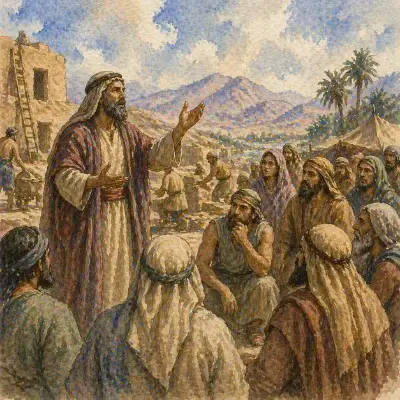
Exodus 6 answers Moses’ complaint by shifting the focus from human weakness to Yahweh’s identity and promise. Yahweh declares His name, recalls His covenant with Abraham, Isaac, and Jacob, and sets out what He Himself will do to deliver Israel. The chapter establishes that the rescue from Egypt rests entirely on Yahweh’s word, not on the strength of His people.
Exodus 6 Explained: Yahweh Declares His Name and Reaffirms His Covenant
Exodus 6 opens with Yahweh’s direct answer to the cry Moses released at the end of the previous chapter.
Moses had looked at the rising oppression and said, “You have not delivered Your people at all.” Yahweh responds without explanation or defence.
He simply declares, “Now you will see what I will do to Pharaoh.” The timing belongs to Him.
The deliverance rests on God alone, not Moses’ own judgment of how events should unfold.
From this point forward the chapter becomes Yahweh’s own interpretation of Israel’s suffering and the certainty of His covenant action.
Yahweh begins by grounding Moses in His identity. “I am Yahweh.”
He is the same God who appeared to Abraham, Isaac, and Jacob, the same God who established His covenant and swore to give their descendants the land of Canaan.
The hardship in Egypt does not contradict that promise. It prepares for its fulfilment.
When Yahweh says, “By My name Yahweh I was not known to them,” He is not denying that the patriarchs used the divine name or that they saw His saving power.
Abraham experienced deliverance in Egypt and protection from foreign kings. Isaac saw Yahweh restrain Abimelech and shield his household.
Yet none of them saw Yahweh redeem a nation with great judgments. What is new in Exodus is not the character of Yahweh but the scale and clarity of the revelation.
The patriarchs knew promises and personal rescues. Israel will know Yahweh as Redeemer acting openly against a kingdom to claim a people for Himself.
Yahweh then speaks seven promises that form the centre of the chapter.
He will bring Israel out from under their burdens. He will deliver them from slavery. He will redeem them with an outstretched arm and great judgments. He will take them for His people and be their God. He will bring them into the land He swore to the patriarchs. He will give it to them as an inheritance.
These “I will” statements form a complete covenant arc: rescue, relationship, and the promised land and they are unconditional.
They are declarations of what Yahweh Himself will accomplish, and neither Israel’s collapse of spirit nor Pharaoh’s defiance can stop him.
Moses speaks these words to Israel, but they do not listen.
Their suffering has drained their capacity to hear Yahweh’s promise, and they do not believe that he can rescue them.
The chapter does not call their response rebellion but rather the exhaustion of a people crushed under the oppression of slavery.
Their spiritual weakness and crushed spirit prepares the ground for Yahweh’s deliverance which does not depend on their strength. In fact, they don’t have to do anything.
Yahweh commands Moses again to speak to Pharaoh, and Moses responds with the objection that shapes the tension of the chapter: “I am of uncircumcised lips.”
This is not a renewed claim of poor speech. He has already raised that concern earlier. Here he speaks of spiritual unfitness.
Circumcision marks what is set apart to God. To call his lips uncircumcised is to call them unclean, unworthy to bear Yahweh’s word before the king.
Moses measures himself by holiness, not eloquence. But Yahweh does not cleanse Moses’ lips as He later does for Isaiah. He simply commands him to speak.
The success of the mission does not rest on the condition of Moses’ lips but on Yahweh’s authority and covenant purpose. “I am Yahweh; speak all that I say to you.”
Between Moses’ objections the narrative inserts a genealogy framed by the repeated statement, “These are the heads of their fathers’ households.”
This selective list is not a pause or digression. It grounds Moses and Aaron within the real history of Israel.
The text names the tribes of Reuben and Simeon, and then narrows deliberately through Levi’s line to Kohath, Amram, and finally Moses and Aaron.
The genealogy is selective because it serves a specific purpose: it identifies the line Yahweh has chosen for both deliverance and worship.
The same tribe through which Yahweh brings Israel out is the tribe through which He will establish the priesthood.
Aaron and his sons, named here, will later bear the garments of the sanctuary and minister before Yahweh.
The genealogy, therefore, ties the exodus and the future worship of Israel to the same covenant line, showing continuity between rescue and worship.
The repeated phrase, ‘These are the heads of their fathers’ households,’ frames the genealogy as a self-contained section that establishes Moses and Aaron within Israel’s history.
The chapter closes by returning to Moses’ earlier objection, ‘I am of uncircumcised lips.’
This repetition functions as a framing device: the genealogy has now done its work, grounding Moses and Aaron in Israel’s history, and the chapter resumes its movement toward Yahweh’s command to confront Pharaoh.
Moses calls his lips uncircumcised, and Yahweh does not deny it or purify him. He simply commands him to go. The closing names show that Yahweh’s call depends on His decision, not on his messenger’s holiness.
Exodus 6 prepares us for the confrontation between Yahweh and the gods of Egypt by shifting our focus from human weakness and despair to divine certainty.
The chapter makes clear that the rescue from Egypt rests on Yahweh’s identity and His covenant, not on the strength of Israel, the readiness or holiness of Moses, or the willingness of Pharaoh.
The stage is now set for Yahweh to reveal His name through acts the patriarchs had not seen and to redeem His people with great judgments, just as Yahweh had said.