
Genesis 16
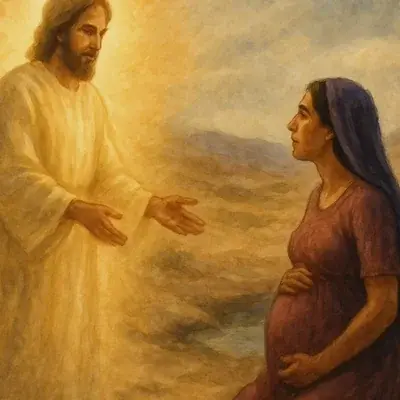
Abram and Sarai act in unbelief by seeking an heir through Hagar. The result is strife and sorrow, yet Yahweh shows mercy to the afflicted slave and names her son Ishmael.
Sarai, Hagar, Ishmael, and the God Who Sees
Genesis 16 opens with the problem first mentioned in Genesis 11: Sarai is barren.
In Genesis 15, Yahweh had made a covenant promise to Abram of countless descendants. Abram believed Him, and it was counted to him as righteousness.
However, in Sarai’s eyes, the promise seems to have stalled.
Sarai sees she is old and no longer believes she can have a child. So Sarai devises a plan to build a house by her own means.
Sarai’s plan is simple and not uncommon in the ancient world. If a wife was barren, she could give her servant to her husband as a surrogate. Sarai takes Hagar, her Egyptian servant, and gives her to Abram, hoping to obtain children through her.
The language here is striking. Sarai says, “Perhaps I will be built up through her,” echoing the self-reliance of Genesis 11. She is not trusting Yahweh to build the house. She is building it herself.
And so, like Eve, who took and gave to her husband, Sarai takes Hagar and gives her to Abram, and Abram listens to the voice of his wife, just as Adam did.
The results are immediate and destructive. Hagar conceives, and her status shifts. She now sees herself as superior to her barren mistress, and Sarai is humiliated.
What began as an attempt to resolve barrenness without faith has produced rivalry and resentment.
Sarai blames Abram, though it was her idea, and Abram abdicates all responsibility, telling Sarai to deal with Hagar however she pleases.
So Sarai afflicts her. The Bible does not mention what she did, but it must have been severe, because Hagar flees.
Yahweh sees Hagar’s mistreatment and directly intervenes.
The Angel of Yahweh finds Hagar by a spring in the wilderness. This is the first time the phrase “the Angel of Yahweh” appears in Scripture, and it marks a significant moment.
While God has spoken to patriarchs and intervened in key events before, here He appears to an Egyptian slave woman, alone and pregnant in the desert.
The Angel speaks as Yahweh, promises as Yahweh, and receives worship as Yahweh. Later passages will confirm that the Angel of Yahweh always speaks and acts as God Himself.
This encounter reveals that God is not far off. He draws near, speaks, and acts, especially on behalf of the afflicted and mistreated.
The Angel calls her by name, “Hagar, servant of Sarai,” acknowledging both her identity and her painful place in the household. Then He asks, “Where have you come from, and where are you going?” These are not for His information but for hers. She answers only the first. She is fleeing from Sarai. She does not know where she is going.
Then comes the unexpected command: return. But it is not a bare command. It is accompanied by promise. Yahweh will multiply her seed so greatly that they will be uncountable, a clear echo of the promises made to Abram himself.
This child she carries will be called Ishmael, which means “God hears,” for Yahweh has heard her affliction. Even in the wilderness, even in rejection, God sees and hears.
The Angel describes Ishmael’s character in language that is both realistic and dignifying. He will be a wild donkey of a man, free, untamed, and independent. He will not be a slave. He will live in tension with his brothers, but he will not be under them.
This moment transforms Hagar. She names Yahweh as “the God who sees me,” and names the well Beer-lahai-roi, which means “the well of the Living One who sees me.”
Hagar is the first person in Scripture to name God in this way. She is also the only person in the Old Testament who gives God a name in response to a personal encounter.
She returns, not in defeat, but in obedience and faith. In fact, Hagar’s obedience surpasses Abram’s at this point in the narrative. While Abram and Sarai sought to force God’s hand, Hagar hears God’s word and submits. The oppressed servant responds to Yahweh with greater faith than the covenant couple.
The literary structure of the chapter reinforces this movement. It begins with Sarai seeking to build her house and ends with Yahweh preserving both Hagar and her child.
The word “servant” is repeated throughout, underscoring Hagar’s lowly status, and yet she becomes the recipient of divine promise and personal attention.
The central pivot of the chapter lies in verses 7–14, where Yahweh finds, names, and blesses the one whom Sarai afflicted.
God is not only the God of the covenant family. He is the God who hears the afflicted, who sees the invisible, and who names the fatherless.
This reversal is significant. Sarai, though a member of the covenant line, acts without faith and inflicts harm. Hagar, though outside the covenant and socially powerless, is seen, heard, and protected.
The naming of Ishmael marks divine initiative. Just as Yahweh named Isaac before his birth, so here He names Ishmael, asserting His authority and care.
Naming in Genesis is not a minor detail. It reflects rule, identity, and destiny. God’s naming of this child affirms that He is sovereign over all nations, not just Israel.
Hagar’s wilderness encounter with Yahweh foreshadows future events. Her affliction by the Hebrew woman is later reflected by Israel’s affliction by the Egyptians.
The God who heard Hagar’s affliction will later say, “I have surely seen the affliction of My people,” in Exodus 3:7.
The Angel of Yahweh who speaks with her will appear again in Genesis 22, in Exodus 3 from the burning bush, and in many places later on. In all of these places, the Angel of Yahweh speaks and acts as God Himself.
One very important takeaway from this chapter is that God cares for the weak, the mistreated, and the outsider. His concern is not restricted to one ethnic line.
In fact, as we saw in Genesis 12, the blessing of the line of Abram was always intended to overflow to be a blessing to the entire world.
While Ishmael is not part of the covenant line, he is still blessed, still named, still seen, and cared for by God. Yahweh is not limited by ethnic lines or human plans. He is free to show mercy to whomever He will.
Genesis 16 therefore continues the theological tension introduced in earlier chapters. Salvation is not by works, so that no one may boast.
The promised seed will not come by effort or cleverness, but by God’s power. Sarai must learn what Abram is still learning: that Yahweh alone will build the house, and that His promises are fulfilled in His time.
Hagar’s encounter reminds us that faith does not always come from the expected places, and that Yahweh is near to the broken. In the barren places, in the wilderness, in affliction, He sees, He hears, and He blesses.