
Exodus 21
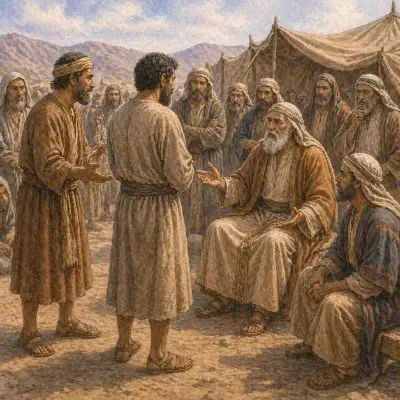
Exodus 21 shows how Yahweh’s law governs everyday life among His redeemed people. After declaring the Ten Commandments, He sets out judgments that regulate authority, protect the vulnerable, and uphold the value of life. Slavery is limited, marriage is guarded, and justice is measured and proportionate. In every case, Yahweh places clear boundaries so that sin does not take root and His people reflect His righteousness in ordinary life.
Exodus 21 Explained: Yahweh’s Law Applied to Life, Justice, and Covenant Responsibility
Exodus chapter 21 follows directly from Yahweh’s spoken law in chapter 20. The Ten Commandments were proclaimed by Yahweh Himself directly to the whole congregation, but now He instructs Moses to set these judgments before the people. Yahweh moves from declaring His law to showing how it governs ordinary life.
The first subject Yahweh addresses is slavery. Israel has just been brought out of the house of slavery, and Yahweh immediately regulates servitude among His people so that nothing resembling Egypt can take root. A Hebrew slave serves six years and must go free in the seventh without payment. The limit is fixed and non-negotiable. No Israelite may be owned indefinitely. Time itself belongs to Yahweh, and the pattern reflects His ordering of work and rest.
The law then addresses household situations. If a man enters slavery alone, he leaves alone. If he enters with a wife, she leaves with him. If the master provides a wife during the period of service and children are born, the wife and children remain with the master’s household when the man goes free. The next case addresses the moral tension this arrangement creates.
If the slave openly declares that he loves his master, his wife, and his children, and refuses freedom, the law provides a formal and irreversible process. He is brought before God, taken to the door or doorpost, and his ear is pierced with an awl. An awl is a sharp tool used to pierce leather or wood. The act is painful, public, and permanent. The mark cannot be hidden and cannot be undone. He bears it for the rest of his life.
The Bible says he is to be brought before God, which makes the act covenantal. Yahweh stands as witness. The piercing takes place at the doorway, the boundary that marked a household as Yahweh’s in Egypt and now marks this servant’s permanent attachment to a household. The mark left by the piercing is permanent. The man binds himself to lifelong service by choice, and the law treats that choice as final. No later release is provided, because covenant commitment is not reversible.
The law then turns to female slaves and gives extended instruction. Yahweh devotes more detail here because their vulnerability is greater. A daughter sold into service is not treated as expendable labour. Her position is bound up with marriage, inheritance, and the future of a household. If her master chooses her for himself and then rejects her, the text names this as treachery. He may not sell her to a foreign people. His authority over her does not permit betrayal.
If he chooses her for his son, he must treat her according to the custom of daughters. The law does not permit a second-class status. She is to be received with the standing and protections of a wife, not reduced to household labour.
Verse 10 stands at the centre of this section. If the man takes another woman, he may not reduce her food, her clothing, or her conjugal rights. These are not expressions of generosity. They are obligations owed to her. Food sustains life. Clothing preserves dignity. Conjugal rights preserve the marriage itself.
In Israel, inheritance ran through sons, beginning with the firstborn. A wife had a right to the chance to bear children, and with it a future in the household. By withholding conjugal rights, a husband would deny her that chance. He would cut her off from the possibility of bearing a firstborn and securing any lasting claim. Yahweh’s law forbids this. A man may not keep a wife under his authority while removing the very rights by which marriage secured her future.
If these obligations are not met, she goes free without payment. The law does not trap her in a household where her husband has abandoned his covenant role. He does not get to choose which wife will bear his firstborn. Freedom for the abandoned wife gives her the possibility of building a family elsewhere, and she is assigned no guilt.
The chapter then moves to cases of personal injury, and the sanctity of life comes into sharp focus. A man who strikes another so that he dies must be put to death. The law states this without qualification. Life is not negotiable.
However, accidental killing is treated differently. If the death was not premeditated, Yahweh Himself appoints a place of refuge. The law distinguishes between intent and outcome without excusing responsibility.
Premeditated murder, however, finds no protection, not even in worship. A man who kills his neighbour deceitfully must be taken even while he is worshipping at Yahweh’s altar.
The law then enforces the fifth commandment with severity. Striking or cursing one’s father or mother carries the death penalty. Parental authority is not merely social. It is delegated authority under God. Contempt for parents is treated as rebellion against the order Yahweh has established.
The injury laws that follow show restraint rather than excess. If a man is injured but recovers, the offender is not executed or mutilated. He must compensate for lost time and ensure full healing. The law aims at restoration where life is preserved.
This principle governs the rule later stated as, “an eye for an eye and a tooth for a tooth.” The law limits punishment and prevents escalation. Damage must not exceed damage done, and justice must remain proportionate.
These protections also extend to slaves. Although the law uses property language in a narrow legal sense, bodily harm always overrides ownership. If a master beats a slave to death, he is to be punished. If the slave survives briefly, the law recognises the loss to the master but does not permit further violence. If a master permanently injures a slave by destroying an eye or knocking out a tooth, the slave must be released.
The case involving a pregnant woman makes the value of life explicit. When men fight and strike a woman so that her children come out, the outcome determines the judgment. The language describes premature birth, not miscarriage. If there is no injury to the children, a fine is imposed. However, if injury follows, the penalty is life for life.
The text treats the children as lives under Yahweh’s protection. Harm to the mother or the child brings full retribution. The unborn child stands within the same moral framework as any other person. The law does not downgrade life because it is not yet born.
The chapter closes with laws concerning animals and negligence. If an ox kills a person, the ox is destroyed and its flesh not eaten. No benefit may come from bloodshed. If the ox was known to be dangerous and the owner failed to restrain it, the owner bears responsibility. Knowledge increases accountability.
The same principle applies to uncovered pits and unrestrained animals. The one who creates the danger or fails to prevent it must make restitution. The law does not allow harm to be treated as an unfortunate accident without asking who failed to act.
Exodus 21 shows what the Ten Commandments look like when applied to ordinary life. Yahweh begins with slavery because Israel has just come out of slavery, and He sets firm limits so that power cannot become oppressive again.
The chapter repeatedly protects those most vulnerable to abuse: slaves, women, children, and the unborn. It treats life as sacred, restrains authority, and insists that responsibility follows knowledge and action. In every case, Yahweh places limits on authority so that life is guarded and injustice cannot take hold among His redeemed people.