
Exodus 24
Exodus 24 brings Yahweh’s covenant to its formal conclusion at Sinai. The law is not only spoken but written, sworn, and sealed with blood. Israel binds itself to obey all that Yahweh has commanded, fully aware that the cost of disobedience is death. At the same time, Yahweh grants a limited but real access to His presence, as the covenant is confirmed through sacrifice and a shared meal. The chapter sets before Israel both the privilege of belonging to Yahweh and the weight of the obedience He requires.
Exodus 24 Explained: The Covenant Confirmed by Blood and Bound by Obedience
Exodus 24 completes what Yahweh began at Sinai in chapter 20. The law has been spoken and explained, and now it is formally received, sworn, and sealed. Having heard the law, Israel binds itself to it and to the consequences that follow if it is broken.
Yahweh, in His mercy, permits Moses, Aaron, Nadab, Abihu, and seventy of Israel’s elders to come up the mountain. Clear limits are set at once. Moses alone may come near Yahweh. The others may ascend but must remain at a distance, and the rest of Israel is not permitted to ascend the mountain. The covenant does not erase the difference between Yahweh and Israel. It establishes a relationship, but it also establishes boundaries. Access to God is real, but it is defined by the covenant Yahweh is establishing, with clear limits on who may approach and how near they may come.
Moses returns to the people and recounts all the words of Yahweh and all the judgments. This includes the Ten Commandments and the detailed case laws of chapters 21–23. These laws reach into everyday life. They address violence, negligence, justice, worship, and responsibility for others. Guilt is not limited to deliberate rebellion. Carelessness can also bring condemnation. The law demands a standard that leaves little room for confidence that Israel will be able to uphold their side of the covenant.
When the people hear it all, they respond with one voice, “All the words which Yahweh has spoken we will do.” They are not agreeing to vague principles or ideals. They are submitting themselves to the comprehensive judgments Yahweh has just spoken.
Moses writes down all the words of Yahweh. The covenant is fixed in writing before it is ratified. Early the next morning he builds an altar at the foot of the mountain and sets up twelve pillars, one for each tribe of Israel. The altar marks Yahweh’s side of the covenant as the Lord who receives the sacrifice, and the pillars represent the whole people who are binding themselves to Him. The manner of the altar’s construction, earth and uncut stone, has already been commanded in chapter 20, and Moses now acts in obedience to that word.
Young men offer burnt offerings and peace offerings. Moses collects the blood, placing half on the altar and keeping half in basins. He then reads the book of the covenant aloud in the hearing of the people. They answer again, “All that Yahweh has spoken we will do, and we will listen.” In Scripture, listening and obeying belong together. To hear Yahweh truly is to submit to Him.
Only after this second confession does Moses sprinkle the blood on the people and say, “Behold the blood of the covenant, which Yahweh has cut with you in accordance with all these words.” The blood is not decorative. It declares the cost of covenant breach. Life is forfeit if the covenant is broken. Israel knowingly and willingly places itself under that reality. The covenant is not a bundle of separate rules. It is a single bond of loyalty to Yahweh. To break it at any point is to break it entirely.
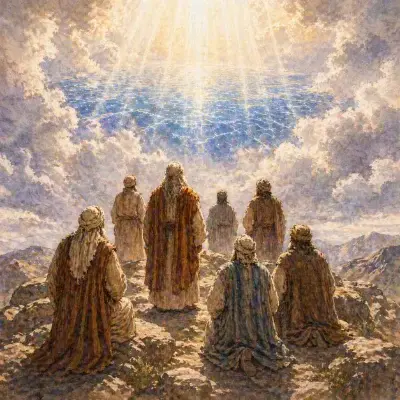
Only then do Moses, Aaron, Nadab, Abihu, and the seventy elders go up the mountain, and they see the God of Israel. The text does not describe God Himself. It describes what lies beneath His feet, something like a pavement of sapphire, clear as the sky. The sky itself appears as the floor. Yahweh is not confined to Sinai. He rules over heaven, and what Israel is permitted to see is a glimpse of His exalted rule rather than His form.
The text then stresses what does not happen. Yahweh does not stretch out His hand against the leaders of Israel. They see God, and they live. They even eat and drink in His presence. This is a covenant meal. In the ancient world, such a meal confirmed peace between covenant partners. The blood sprinkled on them earlier declares the cost of covenant breach. Having cut the covenant, Yahweh allows Israel’s representatives to share a meal in His presence.
After this, Yahweh calls Moses up the mountain once more. He promises stone tablets with the law and the commandment written by His own hand for Israel’s instruction. The covenant is not limited to those standing at Sinai. It must be carried forward. Stone symbolises permanence. What Yahweh has spoken and what Israel has sworn to obey will confront every future generation with the same unchanging law.
Moses goes up with Joshua as his attendant. He instructs Aaron and Hur to handle disputes while he is gone. The cloud covers the mountain, and the glory of Yahweh settles on Sinai. To the people below, the glory appears like a consuming fire. Moses enters the cloud and remains on the mountain forty days and forty nights.
Israel has bound itself to a covenant that demands full obedience. The judgments have already shown how exacting that obedience is. Guilt follows even a single breach. The blood has already demonstrated the cost. The chapter therefore leaves a pressing question: how can Israel keep the covenant they have just agreed to?