
Exodus 5
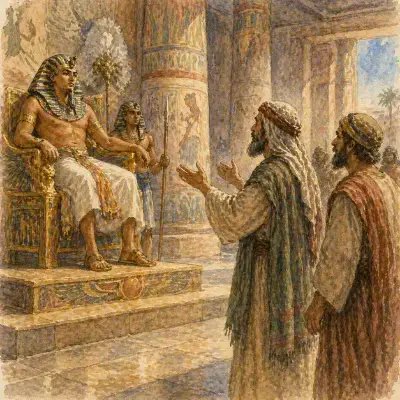
Exodus 5 records the first confrontation between Moses and Pharaoh, and the result is not relief but greater suffering. Pharaoh rejects Yahweh’s command, increases the burden on Israel, and turns the people against Moses and Aaron. What follows exposes how quickly faith can collapse when obedience leads to hardship.
Exodus 5 Explained: Obedience Leads to Suffering and Israel’s Faith Falters
Exodus chapter 5 begins the confrontation Yahweh described in chapter 3 verse 19 and chapter 4 verse 21.
He had said that the king of Egypt would not let the people go except by a strong hand.
He had said that He Himself would harden Pharaoh’s heart. Now the chapter shows the first round of the conflict between Yahweh and the gods of Egypt.
The chapter moves through four clear moments: the messengers’ speeches, Pharaoh’s escalation, Israel’s despair, and Moses’ prayer.
Moses and Aaron go in to Pharaoh, however they do not repeat Yahweh’s wording from chapter 3.
Instead they say, “Thus says Yahweh, the God of Israel, ‘Let My people go, that they may hold a feast to Me in the wilderness.’” It is not a request but a royal decree from one King to another.
Yahweh had told Moses to say, “Yahweh, the God of the Hebrews, has met with us. Please let us go a three-days’ journey into the wilderness that we may sacrifice to Yahweh our God.”
They give the right God and the right purpose, but not the words Yahweh actually gave them.
They obey in going and speaking, but they do not yet speak with precise obedience.
They are still learning to let Yahweh’s word, and not their own formulation, set the terms of the confrontation.
Pharaoh’s reply exposes the real issue.
“Who is Yahweh that I should listen to His voice to let Israel go? I do not know Yahweh, and I will not let Israel go.”
He rejects the God he does not know, and so he rejects the command that God gives.
He knows the gods of Egypt, but he has never been confronted by the God who appeared to Moses and claimed Israel as His own.
He sits on a throne shaped by the belief that he speaks for the gods.
To listen to Yahweh would place him under another King, so he will not listen.
Moses and Aaron speak again.
This time they follow Yahweh’s instruction from chapter 3 verse 18 exactly.
Their second speech shows a growing obedience to the exact words of God, correcting their mistake from verse 1.
Moses and Aaron must learn to speak what Yahweh has spoken, and not adjust the message.
Pharaoh refuses to let the people go, just as Yahweh had said.
In his eyes the words of Aaron and Moses are a pretext, drawing the people away from their work.
He will not reconsider his position, and he will not recognise Yahweh’s authority.
Pharaoh then answers Yahweh’s word by increasing the oppression.
He commands the taskmasters to stop giving straw to the people.
The quota of bricks must stay the same, even though the supply has been removed.
The people scatter through Egypt gathering stubble, trying to prop up an impossible demand.
When they fall short, the Egyptian taskmasters beat the Israelite foremen.
Pharaoh’s response to the voice of Yahweh is to crush those who want to obey it.
He sums up his attitude in verse nine: “Let their slavery be hard on the men, and let them work at it so that they will have no regard for false words.”
He labels Yahweh’s truth “false words” and escalates the oppression on God’s people so they will know who’s in charge.
This is how evil responds when God speaks: it calls His word a lie and increases suffering rather than bowing the knee.
The Israelite foremen go to Pharaoh and cry out saying, “Why do you deal this way with your slaves?”
They tell him that no straw is given and yet the demand stays the same.
They rightly point out that the fault lies with Pharaoh’s own people, not with Israel.
Pharaoh does not change.
He repeats his charge of laziness and sends them back to work under the same burden.
The king who “does not know Yahweh” refuses to hear justice and refuses to fear God.
The foremen leave Pharaoh and confront Moses and Aaron.
They say, “May Yahweh look on you and judge, because you have made us stink in the sight of Pharaoh and his servants, to put a sword in their hand to kill us.”
The people who believed and worshiped at the end of chapter 4 now turn against Yahweh’s servants.
They blame Moses and Aaron for provoking Pharaoh and making things worse.
Obedience to Yahweh has only brought greater suffering, and they have quickly forgotten His promise.
Moses then turns to Yahweh.
He does what Israel does not do: he brings his complaint to God.
“O Lord, why have You done evil to this people? Why did You ever send me?”
He says, “Since I came to Pharaoh to speak in Your name, he has done evil to this people, and You have not delivered Your people at all.”
Moses speaks from his heart, but he has apparently forgotten the words Yahweh had spoken at the burning bush.
Yahweh had already told him that Pharaoh would not let the people go except by a strong hand.
And Yahweh had told him that He would harden Pharaoh’s heart.
He never said that one visit and one speech would bring freedom.
Moses’ prayer reveals he has mistaken the delay for failure and the increase of suffering for the collapse of God’s plan.
He sees the present evil clearly; he does not yet see how Yahweh is using it to prepare a greater deliverance.
There are several themes in the chapter that stand out.
First, Yahweh’s servants are learning obedience.
Moses and Aaron go where God sends them, but they didn’t get the message right the first time. They had not spoken exactly what Yahweh had commanded.
However, in their second speech they do follow His words.
The prophet must learn to speak God’s word with precision, not adjusting it according to his own sense of what might work.
Second, Pharaoh’s response reveals the nature of rebellion.
He does not know Yahweh, refuses to listen to His voice, and brands His words as false.
He answers God’s command by strengthening oppression and attacking God’s people.
When faced with the true God, he doubles down on his own rule.
Third, the promise of deliverance does not take effect immediately.
Yahweh has promised to bring Israel out with a strong hand, but the first step of that promise looks like a setback.
The slavery grows harsher.
The people turn against God’s servants.
The king appears to win.
All these setbacks are not failure; it is the exact path Yahweh described, even if Moses cannot see it.
Fourth, the chapter exposes the struggle of faith.
Israel believes when they hear that Yahweh has seen their affliction, but they crumble when Pharaoh increases their burden.
Moses obeys and speaks in Yahweh’s name, but when evil seems to triumph he questions the whole mission.
The God who “knows their sufferings” in chapter 3 now allows those sufferings to deepen in chapter 5.
He is not absent; He is preparing to act in a way that will leave no doubt who Yahweh is.
Exodus 5 therefore leaves us on the edge of a question.
Pharaoh has said, “I do not know Yahweh.”
The people have said, “You have made us stink in Pharaoh’s sight.”
Moses has said, “You have not delivered Your people at all.”
How will Yahweh answer these words?
How will He make Himself known to the king who defies Him and to the people who doubt Him?
The next chapter will begin to answer, when Yahweh speaks again and declares His name and His covenant with a force no king of Egypt can resist.
Despite the defiance of Pharaoh, the unbelief of the people, and the doubts of Moses, the success of God’s plan rests entirely on His sovereign purpose and His mighty hand.