
Genesis 38
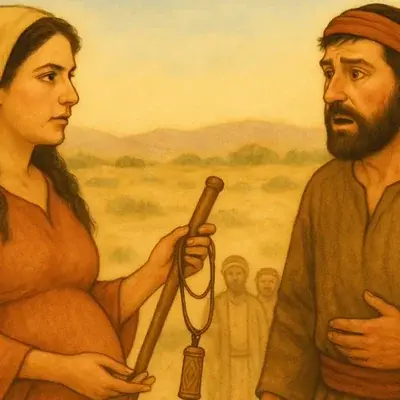
Genesis 38 explains the story of Judah and Tamar, one of the most unexpected and important chapters in the book of Genesis. While Joseph is taken down to Egypt, Judah goes down to live among the Canaanites. His sons Er and Onan fall under God’s judgment, Tamar is left abandoned, and the covenant line seems to hang by a thread.
Judah and Tamar and God’s Covenant Faithfulness
Genesis 38 deliberately interrupts the story of Joseph. We are left wondering what has happened to him while the story turns to Judah. This might seem like an unrelated account, but it is an important part of the covenant story.
As Joseph is brought down to Egypt under Yahweh’s hand, Judah goes down from his brothers and settles among the Canaanites. This should be a marker to us that Judah is not acting in faith. Judah marries the daughter of a Canaanite man, and three sons are born to him. As a member of the covenant household, he should know better than to intermarry with the Canaanites. Yet this is the direction he chooses.
And as we shall see, this will be the first occasion where a Canaanite woman proves more faithful than the covenant household. Tamar stands at the head of a line that will later include Rahab and Ruth.
The crisis comes quickly. Judah gives Tamar as wife to his firstborn. But Er is wicked in the sight of Yahweh, and Yahweh puts him to death. No explanation is given, for none is needed. The covenant line cannot continue through one who despises Yahweh.
Judah then tells his second son Onan to raise up offspring for his brother. This duty, later written into the law of Moses, was already known as a family responsibility. It preserved the brother’s name and inheritance. But Onan refuses. He takes Tamar for himself, but deliberately prevents conception, knowing the child would not be counted as his own. His sin is pride, selfishness, and covenant neglect. And Yahweh strikes him down as well.
By this point, Judah should have seen that Yahweh’s judgment fell on his sons for their own wickedness. Instead, he blames Tamar. He withholds Shelah, his last remaining son, and sends her back to her father’s house as a widow. She is left bound to Judah’s household, but cut off from any way of carrying it forward. His decision almost extinguishes his own line.
Years pass, and Judah’s wife dies. This detail matters because with her gone, Judah himself could have provided seed for Tamar and a continuation of his family line. Yet he too refuses his responsibility.
When the season of sheep-shearing comes, he travels with his friend Hirah to Timnah, a time known for feasting and looseness. Tamar sees that Shelah has grown but has not been given to her. She lays aside her widow’s clothes, veils herself, and waits by the road.
Judah sees her, assumes she is a prostitute, and goes in to her. He promises her a young goat, and she asks for a pledge until it comes. Judah gives her his seal, cord, and staff, the very signs of his identity and authority. The one who denied Tamar her rightful place now puts into her hands the proof that he himself will be father to her child. She conceives, and then she disappears.
When Judah sends Hirah with the goat, the men of the place deny that any prostitute was there. Judah lets the matter drop, unwilling to risk public shame. He does not realise that what he gave away will return to expose him.
Three months later, he hears that Tamar is pregnant by immorality. He calls for her to be burned to death. His judgment is severe and exposes his hypocrisy. The very man who went to a prostitute now condemns her.
But as she is brought out, she sends him the pledge, saying, “Please recognise.” These are the same words Judah had spoken to his father in chapter 37 when he showed him Joseph’s torn robe: “Please recognise.” Back then he deceived his father with a garment that identified Joseph, and now he is unmasked by the seal, cord, and staff that identify him.
At this point, his sin is uncovered, and he confesses, “She is more righteous than I, since I did not give her to my son Shelah.” Tamar is vindicated. She was not seeking immorality, but the continuation of the seed Judah had denied. She did what Judah should have done. And it is clear that Yahweh is not blessing the covenant house because of their righteousness, but because of His own faithfulness.
The story closes with the birth of twins. As Tamar labours, one child stretches out his hand, and the midwife ties a scarlet thread to mark him as firstborn. But he draws back, and his brother Perez breaks through instead. His name means breach or breaking through.
Against the deaths of Judah’s sons, his withholding of Shelah, his hypocrisy, and Tamar’s near execution, the covenant seed breaks through from Perez. The line will continue through David, and in time to the Messiah.
Therefore, Genesis 38 is not a digression. It is the record of Yahweh preserving His covenant promise. When Judah fails, Judah acts like an outsider, while Tamar, the outsider, proves more faithful to the covenant than he does.
Judah is humbled and exposed. Yet from his line the kings of Israel will come, and Perez’s breaking through declares the truth of the chapter. Yahweh’s promise cannot be stopped. Through sin, weakness, and injustice, Yahweh preserves the seed and carries His covenant forward.