
Genesis 30
We continue our journey through Genesis with one of the strangest and most chaotic chapters so far. Genesis 30 is filled with jealousy, superstition, bargaining—and yet Yahweh’s hand is not absent. From mandrakes to striped rods, this chapter shows a covenant family grasping for blessing in all the wrong ways. And still, Yahweh gives.
Mandrakes, Striped Rods, and the Sovereignty of Yahweh
Genesis 30 records a family shaped by jealousy, superstition, and relentless striving. A bitter rivalry between Rachel and Leah deepens as the question of children becomes the battleground for affection and status. Yet once again, Yahweh moves His promise forward, not because of the family’s faith, but in spite of their dysfunction.
The chapter opens with Rachel’s desperate cry: “Give me children or I perish.” But instead of pleading with Yahweh, she turns to Jacob, demanding from him what only God can give. His reply is sharp and theologically sound: “Am I in the place of God, who has withheld from you the fruit of the womb?” Jacob cannot open the womb. Life belongs to Yahweh. But neither sister seeks Him. They take matters into their own hands.
Rachel gives her servant Bilhah to Jacob, hoping to obtain children through her maid. The move recalls Sarah’s decision with Hagar, but here the conflict is deeper because it unfolds within an already divided household. Bilhah bears two sons. Rachel names the first Dan, saying, “God has judged in my favour,” and the second she names Naphtali: “With mighty wrestlings I have wrestled with my sister and I have prevailed.” These names are not expressions of humble gratitude to God. They are claims of victory. Rachel credits God with the result, but her words are framed by rivalry rather than praise and worship of God.
Leah, having ceased bearing children, does the same. She gives her servant Zilpah to Jacob, and Zilpah bears two sons. The first she names Gad, meaning fortune, and the second Asher, meaning happy. But the happiness she expresses is not the joy of covenant fulfilment. It is the satisfaction of having beaten her sister.
In all this, Jacob remains passive. He is a participant in the household schemes, but not a spiritual leader. And the rivalry continues.
One day, Reuben, Leah’s son, finds mandrakes in the field, plants long associated with fertility. Rachel, still barren, asks for them. Leah replies with bitterness: “You took my husband, and now you want my son’s mandrakes, too.” The sisters strike a deal. Rachel will give up a night with Jacob in exchange for the mandrakes. That night, Leah meets Jacob in the field and declares, “You must come into me, for I have surely hired you.” Jacob is no longer sought as a husband, but bartered like a hired man. The household is not seeking Yahweh. It is chasing blessing by whatever means seem available.
The text does not honour the mandrakes. Rachel remains barren. But in His mercy, Yahweh acts. He listens to Leah, and she conceives again. She bears Issachar, saying, “God has given me my wages,” and then Zebulun, saying, “God has gifted me a good gift.” Leah’s words still reach for Jacob’s affection, but it is Yahweh who sees her, remembers her, and gives. Later, she bears a daughter, Dinah, the only daughter named in the generation. Though Jacob remains silent through all this, Yahweh continues to bless.
Finally, we read, “God remembered Rachel.” This does not mean God had forgotten about Rachel. It is rather a sovereign decision to act. Yahweh opens her womb. She conceives and bears a son, saying, “God has taken away my reproach.” Then, for the first time, she speaks His covenant name: “May Yahweh give me another.” The beloved wife is no longer barren. She too becomes a mother in the covenant line.
With Joseph’s birth, Jacob turns to Laban: “Send me away, that I may go to my own place and to my own land.” His service is complete, and he longs to return. But Laban wants to bargain. “I have seen that Yahweh blesses me because of you,” he says. Laban knows Jacob’s presence brings divine favour, so he urges him to stay and name his price.
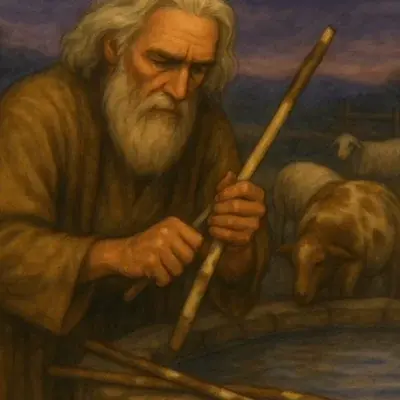
Jacob proposes a simple plan. He will keep the speckled and spotted animals from the flock. Laban agrees, then immediately removes those very animals and hides them with his sons. Once again, deception marks the relationship. Jacob responds with a strange method. He peels branches of poplar, almond, and plane trees, setting them in the water troughs where the flocks breed. He believes the rods will influence the outcome.
It is not just an odd practice. Like the mandrakes earlier, it reveals a deeper problem: trying to secure blessing through superstition rather than trust. It is not outright idolatry, but it rests on the same impulse to control what only Yahweh gives. Yet despite his superstitious actions, Yahweh blesses him. The strong animals bear speckled and spotted offspring, and Jacob’s wealth increases. Not because the rods worked, but because Yahweh willed it. Jacob himself will later admit this. The blessing comes not through superstitious rituals, but through the faithful hand of God.
By the end of the chapter, the covenant family has multiplied. Jacob arrived with only a staff. Now he has two wives, two maidservants, twelve children, and great wealth. The promise of multiplication is beginning to take visible shape. Yahweh has not forgotten His word.
And in the midst of it all, Joseph is born, the first son of the wife Jacob loves. Joseph is the gift of God who blesses abundantly despite human faithlessness.
Genesis 30 shows a family striving in every direction, grasping for blessing through bargaining, envy, and superstition. But Yahweh remains the one who gives. He listens, He remembers, and He provides. Yahweh continues to be faithful to His promises, not because His chosen family is faithful, but because He is.