
Genesis 25
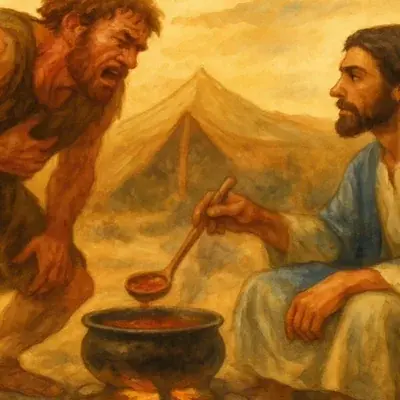
Genesis 25 is a chapter about separation. Abraham has many sons, but only one inherits the covenant. Isaac has two sons, but only one is chosen. This episode traces how God’s promise moves forward—not through birth order or human effort, but by Yahweh’s sovereign choice.
God’s Sovereign Choice and the Birth of Jacob and Esau
Genesis 25 is a chapter about separation.
God distinguishing the line of promise from those who will not carry it forward.
Many sons are named, but only one is chosen. The chapter teaches us that the promise doesn’t move forward by bloodline or human effort, but by God’s sovereign choice.
Abraham marries Keturah and fathers six more sons. These names, Zimran, Jokshan, Medan, Midian, Ishbak, and Shuah, are not irrelevant.
They form tribes and nations that will appear later in the biblical story, some of them as adversaries of Israel.
Names like Midian foreshadow future trouble, nations descended from Abraham but set against the covenant people.
But the key verse is verse 5. Abraham gave all that he had to Isaac. There is no division of inheritance.
Abraham recognises what God has made clear. Only Isaac carries the promise.
The others are given gifts and sent away. Verse 6 notes that Abraham sent these sons eastward.
We shouldn’t overlook the symbolism here. In Genesis, moving east often signals distance from Yahweh’s presence and purposes.
Adam and Eve were sent east of Eden.
Cain settled east of Eden, and the builders of Babel migrated eastward in rebellion.
Abraham’s sons by Keturah followed the same path, eastward and away from the presence of God.
Verses 7 to 11 bring Abraham’s life to a close. He dies at a good old age, full of years, just as Yahweh promised in chapter 15.
Isaac and Ishmael bury him together in the cave of Machpelah, the same field Abraham purchased in faith and the only land he ever owned in Canaan.
But the Bible doesn’t dwell on Abraham’s burial. What matters now is what follows.
After the death of Abraham, God blessed his son Isaac.
The covenant continues beyond Abraham’s life. Yahweh remains faithful, and the promise lives on, not with all of Abraham’s children, but with Isaac alone.
Verses 12 to 18 record the generations of Ishmael. His 12 sons fulfil God’s earlier promise to Hagar in chapter 17.
They become princes and form nations just as God said. But this line too is sealed off.
Ishmael dies in the presence of all his brothers, fulfilling the prophecy of Genesis 16:12.
He is not part of the covenant line, and the story moves on without him.
Like the sons of Keturah, Ishmael’s line is descended from Abraham, but does not carry the promise forward.
God’s sovereign choice creates clear lines of separation.
Many sons are born, but only one is chosen. Others are sent away, their stories closed off, not by accident, but by God’s own decision.
The central section of the chapter, verses 19 to 26, shifts to Isaac.
It opens with the familiar phrase, “These are the generations of Isaac.” And here the theological heart of the chapter is revealed.
Like Sarah before her, Rebekah is barren. The promise is once again under threat.
But this time, Isaac prays, and Yahweh responds. Within the same verse, Rebekah conceives twins.
There’s no long delay like there was with Sarah. The covenant line will move forward because Yahweh is faithful.
But there is a problem. Even in the womb, the struggle begins.
Rebekah feels the children contending within her and seeks Yahweh’s wisdom.
He answers immediately, “Two nations are in your womb, and two peoples will be separated from your body, and one people shall be stronger than the other, and the older shall serve the younger.”
This prophecy is the centre of the chapter.
God declares that the twins will not walk the same path. They are separated from the beginning.
Their futures are not shaped by birth order, but by God’s word.
The older shall serve the younger.
This is not a comment on personality or behaviour. It is a divine decree.
Yahweh’s choice is sovereign and does not follow human customs or expectations.
The birth confirms the struggle. Esau comes first, red and hairy, details that will become important later.
Jacob follows, grasping his brother’s heel.
This act is more than symbolic. It is the first sign of Yahweh’s word being fulfilled.
The prophecy of verse 23 explains why Jacob, not Esau, will carry the promise forward.
The final verses, verses 27 to 34, confirm this divine choice through human action.
Esau grows into a man of the field, while Jacob remains near the tents.
Esau returns exhausted and demands food. “Red stuff, red stuff, I am famished.”
His appetite rules him.
Jacob offers the stew in exchange for the birthright, and Esau agrees.
The birthright, which includes the covenant inheritance, means nothing to him.
The text concludes, “Thus Esau despised his birthright.”
Esau’s rejection confirms what Yahweh had already declared.
The separation between the brothers was set by God’s word before they were born.
And it is Jacob who will carry the promise forward.
Genesis 25 is about Yahweh drawing lines.
It opens with the separation of Keturah’s sons, closes off the line of Ishmael, and ends with Esau’s rejection.
All framing the central truth: the covenant moves through Isaac, not Ishmael, through Jacob, not Esau, not because they earned it, but because of God’s sovereign choice.
The promise continues not by strength, culture, or birth order, but by Yahweh’s decision.
And that line, narrowed, preserved, and chosen, leads ultimately to the seed who will bless the nations.