
Genesis 14
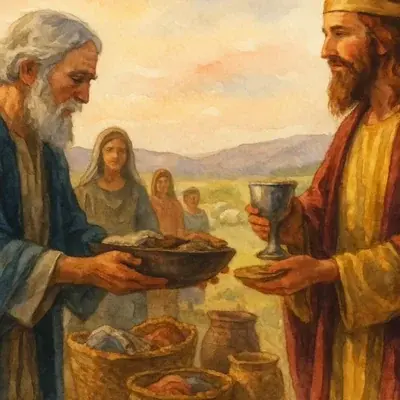
Abram rescues Lot from a coalition of eastern kings who plunder Sodom and its neighbours. Returning victorious, he meets Melchizedek, king of Salem and priest of God Most High, who blesses him. This encounter reveals Yahweh’s priest-king and anticipates a greater priesthood that endures forever.
Abram, Melchizedek, and the Unseen Hand of God
In Genesis 13, we saw Lot—compromised by wealth—part ways with Abram, the man God had promised to bless.
By allowing wealth to shape his decisions, Lot was led eastward—away from the land of promise and toward the land of wickedness. In contrast, Abram remained in the land Yahweh had given him and once again built an altar.
In chapter 14, we see how those decisions unfold.
The opening twelve verses recount a war among nations. Chedorlaomer, king of Elam, had long held sway over the kings of the Jordan Valley. For twelve years they served him; in the thirteenth, they rebelled.
So in the fourteenth year, Chedorlaomer and his allies launched a campaign against the rebel kings. Lot—who by this time had moved into the city of Sodom—was taken captive.
The sudden shift from chapter 13 to chapter 14 can feel jarring. These verses are filled with previously unmentioned kings and unfamiliar places. Once again, the name of Yahweh is entirely absent.
This is the world without God. And Lot—because of his decision to separate from Abram—becomes collateral in the power struggle of pagan kings. The empires war with one another, and Lot is swept up in the chaos.
A fugitive arrives and tells Abram what has happened. The man of promise has been dwelling by the oaks of Mamre—a place already associated with faith and the worship of Yahweh.
Here, the text calls Abram a Hebrew, marking him out from the people around him: Mamre, Eshcol, and Aner. Though Abram is in covenant with them, he is not one of them.
Abram takes 318 men—a relatively small fighting force, all born in his house—devises a strategy to strike at night, and rescues Lot. All of this is told in the space of just two verses.
It’s worth noting how many verses are devoted to the kings’ war compared with the space given to Abram’s rescue mission.
The writer gives eleven verses to the clash of kings, but only two to Abram. This imbalance should draw our attention away from the spectacle of human power and toward the quiet providence of God.
Abram’s night assault—and its success—suggests something more than strategy. This is not the story of a hero’s tactics, but of a man walking by faith, acting in covenant, and delivering the one who had strayed.
This victory, like many in the Bible to come, belongs not to the sword but to the sovereign hand of God. The divine name may not be mentioned in the battle, but His providence is unmistakable.
Abram’s actions are not merely those of a faithful uncle—they are the actions of a covenant-bearer. He risks himself and becomes a blessing to his kinsman, acting in line with the promise of Yahweh: to be a blessing.
Lot is not rescued because he deserves it, but because Yahweh is faithful. The promise to bless all the families of the earth begins to unfold here—through Abram.
After striking down Chedorlaomer, Abram is met by the king of Sodom and Melchizedek, the king of Salem.
The appearance of Melchizedek is startling. He appears out of nowhere and yet he speaks with the authority of God Most High.
His presence reminds us that Yahweh is not bound to one location or one line—there are other servants, other worshippers besides Abram. The blessing he speaks confirms what has been unsaid up to this point: Yahweh is the One who delivered Abram’s enemies into his hand.
Melchizedek brings out bread and wine and blesses Abram:
“Blessed be Abram of God Most High,
Possessor of heaven and earth;
And blessed be God Most High,
Who has delivered your enemies into your hand.”
In response, Abram gives him a tenth of everything.
Abram’s gift of a tenth to Melchizedek is the first tithe in the Bible, and it comes without any divine command.
Abram recognises in Melchizedek a true priest of the living God and responds freely, acknowledging that the victory was Yahweh’s.
The tithe, in this context, is not an obligation but a confession that the battle belonged to Yahweh, and it was Yahweh who brought victory.
The title “God Most High, Possessor of heaven and earth” appears three times in this chapter—on Melchizedek’s lips and then on Abram’s.
It is not the covenant name Yahweh, but a more universal title: El Elyon. In a chapter dominated by pagan kings and distant empires, this title reminds us that Yahweh is not a tribal god.
He rules all.
He is Most High over Elam, Shinar, Gomorrah, and Salem. His promise to bless all the families of the earth is grounded in His universal authority.
Then the king of Sodom speaks. He offers no blessing—only a deal: “Give me the people, and take the goods for yourself.” But Abram refuses to accept anything.
He has raised his hand to Yahweh God Most High and will not allow Sodom to claim credit for his wealth.
His wealth must come from God alone. All he asks for is the share of the spoils owed to those he is in covenant with: the men of Mamre, Eshcol, and Aner who went with him.
Throughout this entire story, Yahweh remains the unseen actor. His name, absent during the turmoil of the kings’ war, returns in the words of Melchizedek and in the oath of Abram.
The victory is not explained by numbers or strategy, but by the hand of Yahweh. The blessing promised in Genesis 12 is now enacted—Abram has become a source of deliverance, not by power but by faith.
Lot had lifted his eyes and chosen the land that seemed rich. But the riches of Sodom could not protect him. The very city that promised security became the place of his captivity.
In seeking to enrich himself he lost everything. He was saved only by the one he had left behind. There is a sharp irony and clear warning here: the path of self-exaltation leads not to blessing but to bondage.
Lot chose with his eyes and ended in captivity. Abram trusted the promise of Yahweh and is blessed by the priest-king Melchizedek.
Through this, we see the true pattern of blessing. Abram acts in trust of Yahweh—he becomes a blessing to others and is himself blessed. In the end, he rescues his nephew but takes nothing for himself, walking away empty-handed, except for the blessing of God that rests upon him.