
Genesis 47
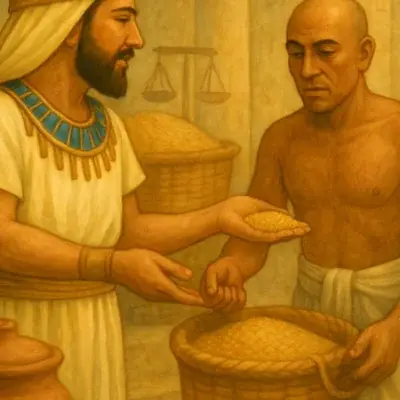
Genesis 47 shows two very different stories side by side. Jacob’s family settles safely in the land of Goshen, kept by God’s covenant promise, while the Egyptians give everything to Pharaoh just to survive the famine.
Israel Blessed in Egypt, Egypt Enslaved to Pharaoh
Genesis 47 picks up where we left off in chapter 46. The chapter shows how Jacob and his family settle in Egypt, contrasting Israel’s blessing and covenant security with Egypt’s dependence on Pharaoh.
Joseph chooses five of his brothers to present before Pharaoh, and just as he had prepared them to do, they identify themselves as shepherds who have come to sojourn in the land because there is no pasture for their flocks. This is important, as they are not presenting themselves as settlers looking to merge into Egyptian life, but as pilgrims seeking temporary refuge during the famine.
Pharaoh responds generously, just as he promised to do in chapter 46, granting them the land of Goshen, the best of the land, and even offering to employ some as overseers of his own livestock. The favour Joseph enjoys spills over onto his family. In the land of Goshen, the covenant people are kept distinct, living separately from the Egyptians in the best of Egypt, but not assimilated, so that they remain marked out for Yahweh’s promises.
When Jacob himself stands before Pharaoh, the scene takes on deeper significance. Jacob blesses Pharaoh, and Pharaoh asks him his age. Jacob answers by saying, “The days of the years of my sojourning are 130. Few and evil have been the days of the years of my life, and they have not attained to the days of the years that my fathers lived during the days of their sojourning.”
He sees his life in covenant terms, not as an accumulation of wealth or honour, but as a pilgrimage marked by hardship and waiting. Jacob blesses Pharaoh again, and in doing so, he assumes the role Yahweh had given Abraham. Jacob is literally blessing the nation of Egypt. At this point, the blessing of the covenant line is greater than the crown of Egypt, and Jacob’s words and actions quietly reassert that Yahweh’s blessing flows to Pharaoh, not the other way around.
Joseph then settles his family in Goshen and provides food for them according to their little ones. This detail highlights his care and provision for his family, but it also raises the question of how they survived through the remaining years of famine. Were they continually supplied out of Egypt’s stores, or was Goshen watered enough to sustain them? The text does not say, and perhaps it deliberately leaves the detail unclear.
What matters is that Jacob’s household never reaches the point of desperation faced by the Egyptians. Yahweh has gone ahead of them through Joseph, and their survival rests on the blessing of God and nothing else.
The Bible then explains what happens to the people of Egypt during the famine. The famine is severe. There is no food, and the Egyptians come to Joseph to buy grain. Joseph gathers all the money, then all the livestock, then the land, and finally the very persons of the Egyptians themselves.
By the end, Pharaoh owns everything and everyone except for the priests, whose allotment preserves their land. Joseph establishes a permanent system whereby a fifth of the produce belongs to Pharaoh, and the Egyptians willingly accept it. They even thank Joseph, declaring, “You have kept us alive.” Far from resenting their servitude, they see it as salvation.
This is crucial. The people do not view their condition as exploitation, but as rescue. Joseph has preserved their lives, and that is how they interpret their subjection to Pharaoh.
The contrast between Egypt and Israel is stark. Egypt is saved through subjugation to Pharaoh, while Israel is saved through the covenant of Yahweh. Both blessings come through Joseph, yet they serve different ends. Pharaoh becomes richer and more powerful. Israel becomes fruitful and multiplies.
The Egyptians are relocated across the land to serve Pharaoh’s purposes, but Israel is given the land provided to them by God. The chapter again fulfils Genesis 28:14, where Yahweh promised Jacob that in his seed all the families of the earth would be blessed.
Egypt’s survival is itself a fruit of the covenant promise. Yet at the same time, Israel’s flourishing is not dependent on Pharaoh, but on Yahweh. Therefore, Israel flourishes under the protection of God while Egypt becomes enslaved to Pharaoh.
The closing verses of the chapter draw the focus back to Jacob. Israel lives in Egypt seventeen years, the same number of years Joseph once lived under his father’s care before his brothers sold him, a symmetry that closes their long separation.
Jacob’s life ends at 147 years, and as his death approaches, he summons Joseph with a solemn request. He insists on being buried not in Egypt, but in the land of his fathers. In swearing this oath, Joseph affirms that the hope of Israel rests not in the fertile country of Egypt, but in the promises of God.
His bowing and worship at the head of the bed signal that this is not simply a family arrangement, but an act of covenant faith. He entrusts himself to the God who called him, blessed him, and will bring his descendants home.
The end of the chapter leaves us with two very different pictures of survival. Egypt lives because it yields itself entirely to Pharaoh, exchanging wealth, land, and freedom for life, but in doing so becomes enslaved.
Israel lives because Yahweh has gone before them, keeping them distinct and fruitful under His covenant hand, and their life remains free because it rests not on Pharaoh, but on promise.
The contrast exposes a deeper reality that runs through all of Scripture. Outside the covenant, man’s preservation always ends in servitude, whether to kings, to systems, or ultimately to sin itself. Inside the covenant, Yahweh’s protection brings life, freedom, and hope.
Jacob’s insistence on burial in the land of his fathers fixes Israel’s gaze beyond Egypt’s abundance to the inheritance God had sworn. In this way, the chapter closes not on Pharaoh’s power, but on Yahweh’s promise, reminding us that true life is never found in subjection to men, but only in the covenant-keeping God who preserves His people in freedom.