
Exodus 19
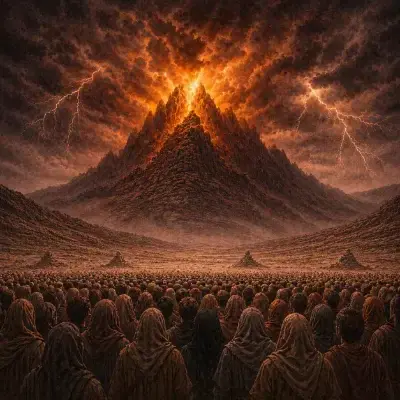
In Exodus 19, Yahweh brings Israel to Mount Sinai and descends in fire, cloud, thunder, and earthquake. This is not spectacle for its own sake. Yahweh is revealing His holiness, defining the terms of His covenant, and publicly confirming Moses as His chosen prophet and mediator.
Exodus 19 Explained: Yahweh Descends in Holiness and Confirms Moses as His Prophet
Exodus 19 brings the first half of the book to its conclusion. Yahweh promised Moses at the burning bush that He would bring Israel out of Egypt and that they would worship Him at this mountain. He now fulfils that promise.
Yahweh hasn’t just delivered Israel from slavery; He has brought them to a specific place for a specific purpose. Redemption has a destination, and that destination is the presence of Yahweh.
This frames everything that follows. Israel hasn’t arrived at Sinai to earn God’s favour. They arrive because Yahweh has already rescued them.
The chapter opens by grounding Israel’s identity in what God has done, not in what they are about to do.
Obedience never forms the foundation of salvation. It always follows salvation.
When Yahweh speaks from the mountain in verses 3–6, He explains the exodus for Israel.
He reminds them that they saw what He did to the Egyptians.
The plagues did not occur as random displays of power; Yahweh executed deliberate judgments that revealed His authority and faithfulness.
He carried Israel on eagles’ wings and brought them to Himself. Redemption therefore had a clear goal. Yahweh did not free Israel simply to improve their circumstances. He freed them in order to bring them into covenant relationship with Him.
Only after establishing this does Yahweh speak of covenant obligation. “If you will indeed listen to My voice and keep My covenant.”
Covenant life requires obedience. Yahweh commands obedience after he rescues Israel. It happens as a result of salvation; it does not create it.
If Israel obeys His covenant, Yahweh will call Israel His treasured possession, a kingdom of priests, and a holy nation. This calling reaches back to the promise given to Abraham, that through his offspring all the families of the earth would receive blessing.
Yahweh’s plan of salvation is not for Israel alone. He sets Israel apart as a kingdom of priests so that the nations may know Him and be blessed.
The people answer with a united voice. “All that Yahweh has spoken we will do.” On the surface, this response sounds right. But we need to remember Israel’s recent history.
These people grumbled at the sea, complained about water, grumbled when they had no food, and tested Yahweh at Massah. Their promise here is sincere, but they have shown lack of faith three times on their journey to Mount Sinai.
Exodus 19 does not praise their resolve. It allows this tension to remain. Good intentions do not equal faithfulness, and strong words alone do not overcome sin.
Yahweh then announces that He will come to Moses in a thick cloud so that the people will hear Him speak and trust Moses forever.
God Himself appoints the mediator. Moses’ authority does not rest on ability, personality, or reputation. Yahweh confirms it publicly.
From this point on, rejecting Moses means rejecting the God who appointed him.
The preparation commands that follow teach Israel a vital truth about holiness. Yahweh commands the people to consecrate themselves, wash their garments, abstain from sex, and wait.
These actions do not function as a ladder to access. They teach that no one approaches God casually. Holiness demands separation and restraint.
However, even after Israel obeys every instruction, Yahweh still bars them from the mountain. He sets firm boundaries and attaches death as the penalty for crossing them.
Here Yahweh presses one of the chapter’s central lessons. Holiness does not arise from effort, discipline, time, or sincerity.
Even careful obedience does not make sinful people safe in the presence of a holy God. Preparation acknowledges God’s holiness, but it does not remove the guilt of sin.
When Yahweh descends on the third day, His presence is overwhelming. Fire, smoke, thunder, lightning, earthquake, and trumpet combine to declare His holiness unmistakably.
The people tremble, and Scripture does not correct them. Fear in the presence of God is the right response. Yahweh does not invite familiarity on human terms, and grace never cancels reverence.
At the height of Yahweh’s revelation, the trumpet grows louder and louder. Moses speaks, and God answers him with thunder.
Yahweh calls Moses up the mountain, yet immediately sends him back down to warn the people again.
He repeats the previous warning to expose the danger. Nearness increases risk.
Even reverent fear does not make unauthorised access safe. Curiosity, desire, or awe never justify crossing God’s boundaries.
Yahweh warns the priests as well. At this point Israel does not yet have an established priesthood, but some men already serve in recognised religious roles among the people, for example, heads of households or firstborn sons who draw near to God in acts of worship.
Yahweh warns them because some among the people are accustomed to approaching Him in worship. Even so, they may not cross the boundary He has set.
If they attempt to draw near beyond His command, He will break out against them. God teaches that religious function does not grant greater access to His holiness.
Moses’ response confirms the lesson. He repeats Yahweh’s own words back to Him. The people cannot ascend because God Himself set the boundary and declared the mountain holy.
The chapter ends with Yahweh on the mountain and the people below. Fire and smoke still mark His presence, and the mountain continues to shake. Israel does not ascend.
They remain at the foot of the mountain because Yahweh has forbidden them to come near. Moses alone goes up, and he does so only because Yahweh calls him. God brings His people to Himself, yet He controls access to His presence.
Exodus 19 brings Israel to the presence of Yahweh, but it also fixes a boundary they cannot cross. Yahweh redeems His people and draws near to them, yet He forbids them to ascend the mountain.
He commands obedience, but even full obedience does not grant access. The chapter leaves the problem unresolved: Yahweh dwells among His redeemed people, yet they cannot approach Him without death.
The chapter completes the movement from slavery to freedom, and the book now turns in a new direction. Israel stands free at the mountain, with Yahweh present in power and holiness. Yet they cannot ascend. From this point, Exodus shifts from the question of deliverance to the question of dwelling: how a holy God can dwell among a sinful people.