
Genesis 48
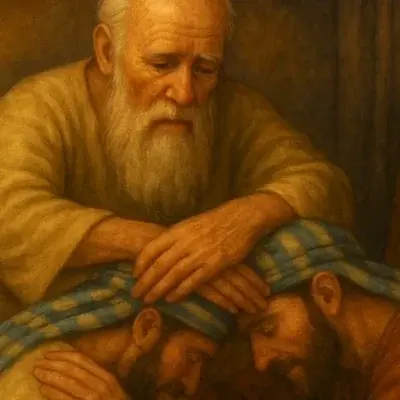
Genesis 48 records Jacob, near the end of his life, blessing Joseph’s sons Ephraim and Manasseh. This is no sentimental scene with children at a deathbed. Ephraim and Manasseh were grown men, adopted as tribal heads and given equal standing with Jacob’s own sons.
Jacob Blesses Ephraim and Manasseh
Genesis 48 opens with Joseph summoned to the bedside of his father, who is now near death. The focus narrows from the entire household to this intimate scene between Jacob, Joseph, and Joseph’s two sons. Jacob is sick. He must strengthen himself to sit up, and his eyes are dim so that he cannot see clearly. Yet in that weakness, he speaks with covenant clarity.
What he is about to do is not merely a personal gesture to his beloved son, but an act of passing on God’s promises, administering the covenant grounded in the words of God. He recalls the appearance of God at Luz, when the promise was reaffirmed that his seed would be fruitful, become an assembly of peoples, and inherit the land as an everlasting possession.
The most striking step he takes is to adopt Ephraim and Manasseh as his own. Joseph’s first two sons, born in Egypt before Jacob’s arrival, are counted as equal with Jacob’s other sons. This act is often imagined as Jacob blessing small children at his bedside, but the timeline makes clear that the brothers were grown men.
Joseph was thirty when he entered Pharaoh’s service, thirty-nine when he revealed himself to his brothers, and fifty-six when Jacob died. Since Ephraim and Manasseh were both born before the famine began, they would have been in their early to mid twenties when Jacob blessed them. Therefore, it would be incorrect to view this as a sentimental scene of a grandfather blessing his toddler grandchildren, but the solemn adoption of adult men into tribal headship.
By this act, Jacob effectively grants Joseph a double portion in keeping with his unique role in preserving the family. But he also maintains the symbolic fullness of Israel as twelve tribes, because as we will see in the following chapter, Reuben has disqualified himself. The nation that will inherit the land will still be twelve tribes, a completeness that God Himself has ordained.
Therefore, Scripture affirms that the covenant people are not defined by biology alone, but by divine appointment and adoption. Jacob’s recollection of Rachel’s death in verse 7 is somewhat enigmatic and does not explicitly explain its purpose in the text.
It may serve to ground the adoption in Joseph’s lineage through Rachel as described in Genesis 35, or it could emphasise the emotional weight of the moment. His greatest earthly sorrow was the loss of his beloved wife, buried on the way to Bethlehem. Now he turns to Joseph, her firstborn, and gives him what he could not give to Rachel, a lasting inheritance in Israel.
The covenant line is marked by grief as much as by triumph, and the privilege Joseph’s sons now receive is bound up with loss. He embraces Joseph’s two adult sons and declares with wonder and praise that God has allowed him not only to see Joseph again, but also Joseph’s children.
In that moment, Jacob interprets his whole life: “The God before whom my fathers Abraham and Isaac walked, the God who has been my shepherd all my life to this day, the angel who has redeemed me from all evil, bless these men.”
This blessing is personal testimony as much as prayer. For the first time in Scripture, God is confessed as shepherd, the one who has guided and sustained Jacob through every twist of his life. This imagery will be repeated often, as in Psalm 23 and in Ezekiel 34, where God promises to shepherd His people Himself, ultimately fulfilled in Jesus who calls Himself the good shepherd.
The reference to the angel who has redeemed points back to the mysterious figure who wrestled with him at Peniel in Genesis 32, the same divine person who went with him and delivered him throughout his pilgrimage.
Jacob names God as his redeemer, the one who has brought him through all evil. These words are not a pious flourish, but the distilled faith of a man who has been led, disciplined, and preserved by divine grace.
Joseph carefully positions his sons so that the elder Manasseh will receive the right-hand blessing. But Jacob crosses his hands, placing his right hand on Ephraim. When Joseph protests, Jacob refuses to be corrected: “I know, my son. I know.”
Jacob, who once seized blessing through deception, now bestows a prophetic blessing on the younger son. He sees that God reverses human expectation and order to advance His purposes, as seen repeatedly in Genesis. Ishmael set aside for Isaac, Esau set aside for Jacob, and even Perez over Zerah.
Again and again, God chooses the unexpected and overturns natural order. Manasseh too will be great, but Ephraim will surpass him. History bore this out. Ephraim became the leading tribe of the north, so dominant that its name could stand for Israel as a whole.
Isaiah 7 speaks of the house of David trembling at the news that Aram had allied itself with Ephraim, and Hosea 4 declares, “Ephraim is joined to idols. Let him alone.” Ephraim rose to prominence just as Jacob foretold, though its greatness later became a warning as well as a fulfilment.
The chapter closes with the final word to Joseph. Jacob acknowledges his death is near, yet he assures his son that God will be with him and bring him back to the land of his fathers. Egypt is temporary. God’s promise of land is bound to Canaan.
Jacob gives Joseph one portion more than his brothers, the Hebrew word being shekem, the same as Shechem, the place where Jacob once purchased a piece of land in Genesis 33. Later, Scripture records that Joseph’s bones were buried there in Joshua 24.
So Jacob is not speaking idly or nostalgically, but prophetically, tying Joseph’s inheritance to the land itself. His words about taking it from the hand of the Amorite with sword and bow are ambiguous in the text.
It may look back to the family’s violent encounter in Shechem, or it may look forward to Israel’s conquest, as in Joshua 24, where God drove out the Amorites, collapsing past and future into a single prophetic word.
Either way, the point is clear. Joseph’s portion is in Canaan, not Egypt. Jacob’s last gift fixes his son’s eyes on the land promised by God, anchoring the double portion in the soil that God Himself will give to His people.
Genesis 48 then is the first act of covenant handover from Israel himself to the twelve tribes. Jacob interprets his life as shepherded and redeemed by God. He incorporates Joseph’s sons to preserve the covenant structure. He blesses the younger over the older with prophetic foresight, and he fixes Joseph’s eyes on the promised land.
Jacob’s crossed hands and his prophetic word about Shechem embody the truth that the covenant advances not by custom, rank, or human strength, but by the sovereign choice of the God who shepherds and redeems His people.