
Exodus 1
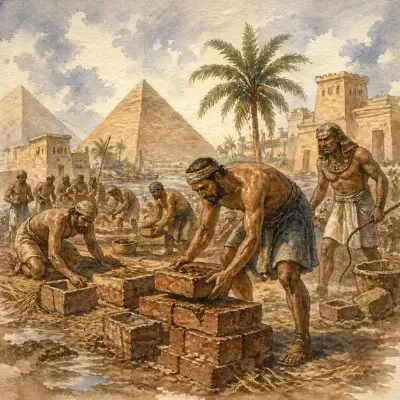
Exodus opens in direct continuation from Genesis: the same family, the same covenant, and the same unfolding purpose of God. What began as a household in Canaan has become a nation in Egypt, multiplying under divine blessing even as Pharaoh’s fear turns that blessing into bondage.
Persecution, Suffering, and the Promises of God
The book of Exodus opens by naming the sons of Israel who went into Egypt with Jacob.
The wording recalls Genesis chapter 46 and ties this book directly to the promises God made to Abraham.
As such, Exodus chapter 1 continues the story of Genesis without interruption: the same God, the same family, the same unfolding purpose.
We are reminded that Joseph was already in Egypt, but the text quickly notes that he died, along with his brothers and all that generation.
The age of the patriarchs has closed, and this is the continuing story of how God acts to save his chosen people.
As the deaths of the sons of Israel are all mentioned, we are reminded that death still reigns under the curse pronounced in Eden, however God’s promises move forward through their descendants.
In verse 7, we read that the sons of Israel were fruitful, increased greatly, multiplied, and grew so exceedingly mighty that the land was filled with them.
These are the same words used in Genesis chapter 1 verse 28 and repeated throughout the covenant story.
The creation blessing is active again, and the promise to Abraham, that his offspring would be as numerous as the stars in the sky begins to take visible form.
The small household that entered Egypt to survive famine has become a nation.
What God promised has taken place, even on foreign soil.
But, then the scene changes.
A new king comes to power over Egypt who does not know Joseph.
The memory of Joseph’s wisdom and of God’s saving hand fades quickly after the deaths of the twelve brothers.
Egypt forgets the man through whom God preserved its life.
Pharaoh looks upon Israel’s fruitfulness and instead of seeing blessing he sees threat.
We read in verse 9
“Behold, the people of the sons of Israel are more and mightier than we.”
God’s provision is reinterpreted as political danger, and gratitude is replaced with fear.
So Pharaoh enslaves the people.
He sets taskmasters over them to afflict them with hard labor.
The descendants of Joseph, once honored for saving Egypt, are forced to build its cities.
The repetition of words in verses 11 through 14—afflict, burden, bitter, slave—presses like weight upon the reader.
The language itself groans under the oppression it describes.
But even here the covenant promise continues to work.
The more they afflicted them, the more they multiplied.
Every act of cruelty serves only to fulfil the word spoken to Abraham.
Pharaoh’s hand cannot silence the word of God.
Centuries earlier, in Genesis chapter 15 verse 13 - God had told Abraham, “Know for certain that your seed will be sojourners in a land that is not theirs, and they will serve them, and they will be afflicted four hundred years.”
“But I will also judge the nation whom they will serve, and afterward they will come out with many possessions.”
The oppression in Egypt is actually foreordained.
The chosen family’s slavery unfolds inside the boundaries of what God has already set.
From a human view it seems that all is lost—God’s people are enslaved, and His promises are buried in suffering.
But the silence from heaven is not abandonment.
It’s actually the outworking of God’s covenant promises.
God is not defeated by affliction; He is fulfilling His word through it.
The brevity of the chapter emphasizes this point.
Four centuries of history pass in a few verses.
Many kings rise and fall, however only two are mentioned.
Scripture is not tracing Egypt’s dynasties but the single line of God’s purpose.
By compressing generations into a few sentences, the text shows that human power shifts and disappears, while the promises of God endure.
When verse 15 introduces the Hebrew midwives, the oppression deepens.
Pharaoh commands them to kill every son born to the Hebrews and to let the daughters live.
The text doesn’t state his reasoning, but it’s clear what he intends: Sons grow into warriors; daughters can be absorbed into Egyptian life.
His goal is not merely to weaken Israel but to erase it.
Therefore it appears as though the covenant seed is under threat of being wiped out.
But God is still in control.
Verse 17 tells us the midwives feared God and did not do as the king of Egypt had spoken.
They stand in awe of the Creator and preserve life despite Pharaoh’s command.
When questioned, they answer that the Hebrew women are vigorous and give birth before the midwives arrive.
So God was good to the midwives, and the people multiplied and became very mighty.
This is the first statement in Exodus of God’s direct action.
Because the midwives fear Him, He gives them households of their own—verse 21.
Where Pharaoh seeks death, God grants life.
Having failed in his first attempt, Pharaoh commands open slaughter.
“Every son who is born you are to cast into the Nile, and every daughter you are to keep alive”.
The Nile - Egypt’s source of life - becomes a river of blood.
The nation that once welcomed Jacob’s family now slaughters their children.
The chapter ends without deliverance.
There is no visible sign of God’s intervention.
Against the evil of Pharaoh’s command, God appears silent.
This is the lowest point yet in the covenant story.
The chosen people are enslaved, their sons condemned, and God seems to have abandoned them.
However, the silence of heaven does not mean that God isn’t there.
Everything taking place in Egypt is unfolding precisely as He told Abraham it would.
The affliction of Israel is not the collapse of the covenant but its confirmation.
God has not lost control; He is moving history along the very path He revealed centuries earlier.
The same word that promised blessing also promised suffering, and both are now being fulfilled.
From a human perspective, God’s promise appears to be buried under Pharaoh’s tyranny.
From God’s perspective, the time of affliction He appointed is running its course, preparing the nation for deliverance.
Israel’s suffering and persecution in Egypt is not a mistake but a crucible, shaping a people through whom His salvation will be displayed.
In this way the story exposes the difference between appearance and reality.
Those who forget God’s promises see only despair, but those who remember His word understand what is happening.
Exodus 1 calls the reader to remember Genesis.
If we recall what God said, we recognise His hand at work even in the darkness.
God’s faithfulness does not mean that His people avoid suffering.
It means that the evil meant to destroy His people becomes the very instrument He uses to keep His promise.
He rules over the oppressor, over the womb, over the river, and over time itself.
Every attempt to destroy His people only advances His plan.
In the midst of Pharaoh’s cruelty, God continues to preserve life and to multiply His people.
Exodus chapter 1 closes not with defeat but with divine precision.
What looks like chaos is covenant order and what seems like absence is perfect timing.
God’s promises govern every event, unseen but unbroken.
The same God who multiplies His people in affliction continues to rule unseen, His covenant purpose still unfolding.
Those who forget God and the words He spoke in Genesis see only despair. But those who remember His promises wait patiently. The suffering is real, but they remember God’s promises and wait for His deliverance.