
Exodus 20
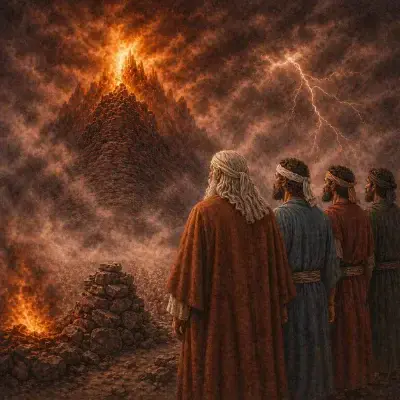
Exodus 20 records one of the most awe-filled moments in Scripture. Yahweh speaks directly to the entire congregation of Israel from Mount Sinai, in fire, thunder, smoke, and dense gloom. What follows are the Ten Commandments, not given as abstract moral rules, but as covenant words spoken by the redeeming God to a redeemed people.
Exodus 20 Explained: The Ten Commandments, God’s Holiness, and the Problem of the Human Heart
Exodus 20 opens with Yahweh speaking directly to the whole congregation of Israel from the mountain, in the midst of fire, thunder, smoke, and the sound of the trumpet. Yahweh does not begin with his covenant commands but with a declaration of who he is and how they got there:
“I am Yahweh your God, who brought you out of the land of Egypt, out of the house of slavery.” The law is grounded in grace already given. Israel is not being told how to escape Egypt. They are being told how to live now that Yahweh has delivered them. Obedience flows from redemption, not the other way around. The God who shattered Pharaoh now speaks as covenant Lord, defining the shape of life under His rule.
The first command establishes the foundation of the covenant relationship. “You shall have no other gods before Me.” Yahweh demands exclusive allegiance because He alone has acted as Redeemer. The exodus has already exposed the gods of Egypt as powerless idols, unable to save even their own worshippers.
To place another god alongside Yahweh would deny what He has revealed about Himself through His mighty acts. Covenant loyalty cannot be divided. Yahweh does not tolerate rivals because there are no rivals. The command is relational. Israel belongs to Yahweh because He has brought them out of the house of slavery.
The second command presses this exclusivity further by forbidding the making of images. The scope is intentionally total. Heaven above, earth beneath, and waters under the earth encompass all of creation. Nothing in the created order may be used to represent Yahweh.
This is not merely a ban on pagan idols but a rejection of every attempt to represent Yahweh by created form. At Sinai, Yahweh made Himself known not by form but by speech. Israel heard His voice but saw no likeness. To make an image would therefore contradict the way Yahweh has revealed Himself, replacing His living word with human imagination. Egypt’s gods were visible, manageable, and open to manipulation. Yahweh will not be reduced to anything He has made. He is the Creator, not a creature. To make an image would be to reverse that order.
Verses 4 to 6 belong together because Yahweh explains the reason for this prohibition. He is a jealous God. This jealousy is covenantal, not insecure. Yahweh has bound Himself to Israel through redemption. He guards that relationship with the rightful jealousy of a husband who will not share his wife with another.
Idolatry is not a neutral mistake. It is covenant unfaithfulness. For that reason Yahweh warns that He visits the iniquity of the fathers on the children to the third and fourth generation of those who hate Him.
Idolatry is not excused because it was learned. Learned idolatry is still hatred of Yahweh. Patterns of worship shape households, and covenant rebellion reproduces itself across generations. When a family turns from Yahweh, the consequences do not stop with one generation.
Yet the contrast is deliberate and overwhelming. Yahweh shows lovingkindness to thousands of generations of those who love Him and keep His commandments. Judgment is real, but mercy vastly exceeds it. Yahweh’s covenant is not balanced evenly between wrath and grace. Faithfulness is sustained across generations because Yahweh delights in steadfast love. The contrast between judgment and mercy reveals that Yahweh’s covenant is ordered toward mercy rather than judgment.
The third command turns from visible worship to spoken allegiance. “You shall not take the name of Yahweh your God in vain.” The immediate background is oath-taking. To invoke Yahweh’s name was to call Him as witness and judge. To swear falsely was to attach His name to a lie. Later covenant laws make this explicit by requiring that oaths sworn before Yahweh be kept.
But the wording of the command is intentionally broader. It does not specify oaths. It forbids emptying Yahweh’s name of weight, truth, and reverence in any context. Yahweh has placed His name upon Israel.
Any use of that name that misrepresents Him, trivialises Him, or divorces His name from obedience violates the command. This is why Yahweh declares that He will not leave the offender unpunished. To misuse His name is to corrupt the covenant itself.
The fourth command grounds Israel’s life rhythm in creation. “Remember the sabbath day, to keep it holy.” The sabbath is not introduced as a new institution but as a creation pattern. In Genesis chapter 1, Yahweh made the heavens and the earth in six days and rested on the seventh. Israel is commanded to order time according to Yahweh’s creative work.
The sabbath testifies that Yahweh is Creator and Sustainer of the universe. It is holy because He made it holy. To treat it as common is to deny His authority. The command extends rest to children, servants, foreigners, and even animals, revealing that sabbath rest reflects Yahweh’s generous rule. It is not about observing a religious ritual.
The fifth command forms a hinge between devotion to Yahweh and life within the covenant community. “Honor your father and your mother.” This command carries a promise tied directly to the land Yahweh gives. Covenant stability begins in the household. Honour for parents trains Israel to live under authority and protects the structure Yahweh established for the transmission of covenant faithfulness from one generation to the next.
This command reaches back to Yahweh’s covenant dealings with Abraham. Yahweh bound His covenant not only to Abraham himself but to the generations after him. We see this in Genesis 17, where Yahweh commanded Abraham, “you shall keep My covenant, you and your seed after you”.
Yahweh later made the purpose explicit in Genesis 18 verse 19: “For I have known him, so that he may command his children and his household after him, that they keep the way of Yahweh to do righteousness and justice, so that Yahweh may bring upon Abraham what He has spoken about him.”
The promise of prolonged life in the land therefore shows that family life and covenant blessing are inseparable. Where parental authority is despised, the transmission of covenant faithfulness breaks down, and covenant life in the land is placed at risk.
The remaining commands govern Israel’s life with one another, but they do more than regulate behaviour. “You shall not murder. You shall not commit adultery. You shall not steal. You shall not bear false witness. You shall not covet.”
These commands reveal Yahweh’s own character. He is the giver of life, faithful in covenant, just in possession, true in word, and pure in desire. Israel is called to reflect who Yahweh is by how they treat one another.
The final command against coveting exposes the human heart. It governs desire itself. Sin is not merely what is practiced but what is desired. By ending the commands this way, Yahweh exposes the human condition. The law demands inward holiness, not outward practice. Therefore, Yahweh’s law demands perfection. The final word quietly confirms that no one can keep this law without fault. The problem is not the law. The problem is the heart that receives it.
The people’s response confirms this reality. Thunder, lightning, trumpet blast, smoke, and trembling mountain overwhelm them. They do not argue with the commands. They fear the God who spoke them. Their plea to Moses, “Speak to us yourself, and we will listen; but let not God speak to us, lest we die,” reveals an instinctive recognition of danger. Yahweh’s holiness is not safe for sinners.
Moses explains that Yahweh has come to test them so that His fear may remain with them, restraining them from sin. Fear is not removed but rightly ordered. Yet the narrative shows that the people remain at a distance while Moses draws near. Mediation is now established as necessary. Yahweh dwells among His redeemed people, but access to Him requires a mediator.
The final section of the chapter moves deliberately from law to worship. The law has revealed Yahweh’s holiness and exposed human sinfulness and the proper response is worship. Yahweh therefore regulates how He is to be approached. He reminds Israel that He has spoken from heaven. No image is required and no substitute is allowed. Their worship must correspond to His self-revelation.
The altar instructions are strikingly simple. An altar of earth or uncut stone. No tools and no steps.
By prohibiting tools in the creation of the altar, Yahweh guards against worship itself from turning into an idol.
If Israel fashions the altar, refines it, elevates it, or beautifies it, the focus of worship shifts from Yahweh to the worship itself.
A manufactured altar would become something man controls rather than something Yahweh authorises. Yahweh forbids this. Worship must not be shaped by human invention. It must remain wholly responsive to His word. An altar made from what Yahweh has already made preserves the Creator and creature distinction. Man does not improve what Yahweh has made in order to approach Him.
This completes the movement of Exodus chapter 20. Yahweh speaks from the mountain, and the people fear and stand at a distance. Moses approaches as mediator on their behalf. Yahweh then gives instructions for worship, providing a way for Israel to remain in His presence, while guarding even the altar itself so that worship does not turn into idolatry.
Exodus 20 therefore brings obedience and worship together, not as parallel duties but as a single covenant life lived before Yahweh. But the chapter does not end with confidence in Israel’s ability to keep what has been spoken. The ten commandments have been declared in full, and the people have already recoiled from Yahweh’s voice.
Taken as a whole, the chapter reveals Yahweh’s character, defines covenant faithfulness, and exposes the condition of the human heart. The law does not lower the standard. It reaches inward and demands holiness. And having revealed that standard, Yahweh immediately provides mediation and regulated approach, because a sinful people cannot live before a holy God apart from His provision.