
Genesis 20
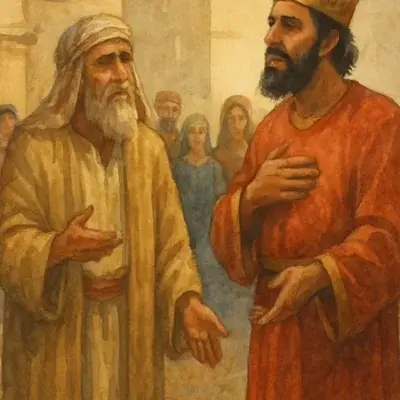
Abraham again deceives concerning Sarah in Gerar, exposing the weakness that lingers even in faith. Yahweh intervenes to preserve His covenant promise and confronts Abimelech in a dream. The episode reveals that divine faithfulness protects the promise despite human failure.
Abraham, Abimelech, and the Faithfulness of God
Genesis 20 opens with Abraham departing from the Oaks of Mamre, journeying south to the Negev, and sojourning in Gerar.
This chapter follows the same pattern as the deception in Egypt. The section of Genesis from chapter 11 to chapter 22 forms an overarching chiasm, with each part pointing toward the theological centre: Yahweh’s covenant promises of land and seed to Abraham in chapters 15 and 17.
This structure helps us see that Genesis 20 is not an isolated failure, but part of a larger narrative revealing how Yahweh’s covenant is preserved, even through the weakness of His chosen servant.
So, once again, Abraham’s deception, rooted in fear and self-preservation, endangers the offspring promised to him in chapter 12.
Despite having just witnessed God’s judgment on Sodom and His protection of Lot, Abraham fails to act in trust. The repetition of Abraham’s sin in this chapter is not just historical. It reveals something essential about Abraham’s weakness, and more importantly, God’s patience.
Because of Abraham’s lie, Abimelech, king of Gerar, takes Sarah into his household. The phrasing deliberately echoes the earlier episode with Pharaoh in Genesis chapter 12.
But the response this time is different. God comes to Abimelech in a dream and immediately declares, “Behold, you are a dead man.” The reason is clear: he has taken another man’s wife.
But Abimelech protests, and with good reason. He acted in ignorance, not knowing that Sarah was married. His question to God, “Lord, will You kill a nation, even though righteous?”, directly parallels Abraham’s intercession in chapter 19: “Will You indeed sweep away the righteous with the wicked?”
This is a powerful reminder of what had just taken place. Abraham had pleaded for Sodom’s safety; now Abimelech pleads for his own.
However, there are some important differences. Most obviously, Sodom was guilty; Gerar is not. Abimelech is portrayed as morally upright, careful, and sincere in his defence.
He appeals to his innocence and the deception he was subject to, and God affirms that integrity: “Yes, I know that in the integrity of your heart you have done this.”
God even claims credit for preventing further sin: “I also restrained you from sinning against Me; therefore, I did not let you touch her.”
Abimelech’s integrity and God’s providence to restrain him work together to preserve the promise that the seed would come through Abraham and Sarah, just as God had said.
But now the situation must be resolved. God commands Abimelech to return Sarah and tells him that Abraham is a prophet who will pray for him. It is a striking reversal.
The man who endangered Abimelech’s household is now the one who must intercede for its healing. This preserves Abraham’s prophetic role while exposing his personal failure.
It also mirrors Abraham’s intercession in chapter 18 and Lot’s rescue in chapter 19. In each case, God rescues others through Abraham’s line, but the initiative and power remain entirely with God.
Abimelech responds the next morning with urgency and integrity. He confronts Abraham in terms that recall God’s own earlier indictment: “What have you done to us? And how have I sinned against you, that you have brought on me and on my kingdom a great sin?” The language is forceful and just. Abimelech calls Abraham to account not just for deception, but for the danger it posed to his people. Once again, the man called to bless the nations has endangered one.
Initially, Abraham is silent. He has no answer to Abimelech’s first question, so Abimelech presses him again: “What have you seen, that you have done this thing?”
Abraham attempts to justify himself, repeating the half-truth about Sarah being his sister and confessing his fear: “I thought, surely there is no fear of God in this place.” The irony is plain. Abimelech has demonstrated greater moral clarity, fear of God, and willingness to repent than Abraham. Abraham’s presumption about the nations echoes his earlier assumption that Sodom was entirely wicked, but this time he is wrong. The narrative exposes the fragility of relying on appearances or assumptions. God alone knows the hearts of men.
Abimelech then responds with grace. He gives Abraham sheep, oxen, male and female servants, and permission to dwell in the land. He addresses Sarah publicly, affirming her innocence and honour. This public restitution is both generous and deliberate. It clears her name and reaffirms her rightful status as Abraham’s wife. More than that, it shows Abimelech’s genuine repentance. This is no begrudging return. This is restoration and reconciliation.
The chapter ends with Abraham praying to God, who heals Abimelech, his wife, and his maids, so that they bore children. The closing verse reveals what was at stake all along: “For Yahweh had closed fast all the wombs of the household of Abimelech because of Sarah, Abraham’s wife.” The issue was not just adultery, but divine judgment in the form of barrenness. By implication, Abimelech had also been struck with impotence. This affliction guarded the promised seed. If Sarah had conceived soon after leaving Gerar, there could be no doubt that the child was Abraham’s.
This final note is the only mention of Yahweh’s covenant name in the entire chapter. It is as though the narrator has deliberately withheld it until now, allowing the drama to unfold under the appearance of the Covenant God’s absence. Only in hindsight do we see His hand governing every detail, restraining sin, afflicting wombs, restoring life, all to preserve the covenant.
Though the name of Yahweh is mentioned only once, His covenant presence shapes the entire chapter.
This chapter also introduces a theological concern that will reappear later in the Law: unintentional sin.
Abimelech acted without knowledge, but he was still guilty. The narrative does not excuse sin based on intention alone, but it does affirm that God sees the heart, and that repentance, restitution, and intercession can restore what was broken. It also shows that God actually intervenes to prevent people from sinning.
This is tremendously important and shows that His intervention, even when it looks like judgment, as with Abimelech’s affliction, is in fact an act of mercy, protecting both the innocent and the integrity of His promises.
Genesis 20 is not a story of Abraham’s cleverness or morality. It is a story of Yahweh’s faithfulness. Yahweh acted to protect the covenant He made with Abraham, not because the covenant bearer is flawless, but because Yahweh protects His word, guards His promise, and upholds justice even among the nations. The promised seed will come from Abraham’s own body, just as Yahweh said. And He will ensure it, despite Abraham’s failure.