
Genesis 19
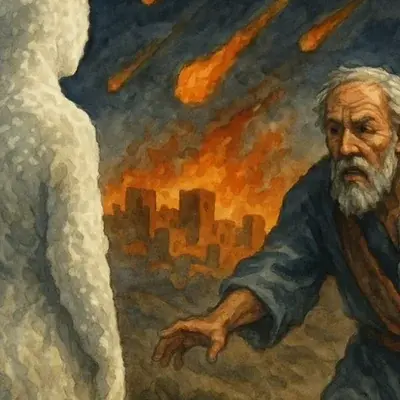
Two angels visit Sodom, and the city’s corruption reaches its full measure. Lot is delivered, yet his hesitation and the loss of his family reveal the peril of divided loyalty. The destruction of Sodom and Gomorrah stands as a lasting testimony of divine judgment.
The destruction of Sodom and the rescue of Lot
Genesis 19 is a confronting account of divine judgment on Sodom and Gomorrah, interwoven with God’s mercy toward Lot, a man whose faith, though real, is made ineffective by compromise.
The chapter’s structure emphasizes Yahweh’s merciful rescue of Lot, demonstrating that righteousness is credited by faith, not earned by merit.
However, Lot’s story is no triumph. Although he himself is saved, his failure as a spiritual leader leaves everything he worked for, including his own family, consumed by fire.
The opening scene mirrors Genesis 18, as two angels arrive at Sodom and are greeted by Lot, who sits at the city gate.
Like Abraham, Lot shows hospitality, urging them not to spend the night in the open square. He prepares a meal, including unleavened bread. This detail, though easy to overlook, signals urgency.
For the original audience of Genesis, it would call to mind the unleavened bread of the exodus, a meal eaten in haste, just before judgment fell and deliverance came.
Lot does not know what is coming, but his meal already points toward it. Still, there is a difference. Abraham hosted in peace under the oaks.
In contrast, Lot hosts in fear under the threat of a violent crowd. His righteousness is real, but his context is entirely different.
That contrast becomes sharp as the men of Sodom, young and old, surround the house. Their demand to “know” Lot’s guests leaves no room for ambiguity.
The city is united in its violence. Lot steps outside and pleads with them, calling them “my brothers.” It is a revealing moment. He recognises their wickedness, but still speaks as one of them.
Then, in a horrifying move, he offers his daughters to the mob. It is not righteousness, but desperation shaped by long years in a compromised place.
Lot is trying to uphold a form of honour, protecting those under his roof, but at the expense of his own family. The angels intervene, pulling him back and striking the men of the town with blindness.
At this point, the angels reveal their mission. Yahweh has sent them to destroy the city. Lot is told to gather his household and flee. He warns his sons-in-law, but they laugh, thinking he is joking.
This is very revealing of Lot’s influence in the city. Lot believes, but he cannot lead. His words carry no weight. He is righteous, but ineffective.
And when morning comes, he still hesitates. The city is about to be destroyed by fire, but Lot lingers. So the angels seize him, his wife, and his daughters by the hand and lead them out.
The reason is clear: Yahweh was merciful to him. This is the centre of the chapter, and everything turns on it. Lot is not saved because he makes good choices or because he acts decisively. He is saved because God is merciful to those He has counted righteous.
Once outside the city, Lot is told to flee to the hills. But again he hesitates, afraid he will not make it. He pleads for a smaller escape, a little town nearby. In mercy, his request is granted.
The town of Zoar is spared for his sake. Yahweh continues to show mercy, even when Lot lacks the strength to obey fully.
Here we see the grace of God condescending to meet human weakness. Lot is not leading. He is being led.
With Lot safely out of the city, Yahweh’s judgment comes. Fire and sulphur rain down from Yahweh out of heaven. It is complete, consuming everything.
The language here is very interesting:
And Yahweh rained on Sodom and Gomorrah brimstone and fire from Yahweh out of heaven.
Yahweh appears to be in two places at once, on earth and simultaneously in heaven.
This wording points to Yahweh’s divine presence both above and below. The use of the divine name, Yahweh, indicates this is personal judgment. God is not far off, like what we read in the flood story. This time Yahweh is personally present. This links Yahweh’s judgment to covenant.
This is not a natural disaster. It is Yahweh’s judgment. Unlike the flood, which cleansed and made way for a new beginning, this is fire judgment. The cities are completely destroyed. There is no coming back from it. This judgment of fire is total and complete.
Lot’s wife looks back and is swept away in the judgment. The command was clear. Her disobedience shows where her allegiance lies.
Lot could not lead her out, just as he could not lead his sons-in-law. His escape is real, but everything he was meant to build has crumbled.
The final section of the chapter shows just how far the collapse goes. Lot does end up escaping to the mountains. He hides in a cave with his daughters. They, shaped more by Sodom than by faith, formulate and execute a plan to get pregnant by their father.
Just like after the flood, where Ham shames his father, evil follows Lot out of Sodom, and his daughters shame him, treating him in a similar way to how he offered them to the men of Sodom.
The sons born from their incest, Moab and Ben-Ammi, will become nations known for evil and enemies to God’s people. The one man rescued from the fire leaves behind nothing but destruction.
And yet, Lot is rescued. That cannot be forgotten. Lot is righteous. Not because he led well, or stood firm, or built anything that endured, he did none of those things.
He is righteous because he believed. Yahweh does not abandon the righteous. The fire fell, and everything burned, but Lot was pulled from the flames. He escaped, though his life’s work did not.
Genesis 19 is a story of mercy in the midst of judgment. It shows what happens when a man of faith is swallowed up by a city of sin. It shows the cost of compromise. But more than that, it shows the God who saves, not because we are strong, but because He is faithful.
Lot’s story must be taken very seriously. Lot was considered righteous by Yahweh, and despite Lot’s failure, Yahweh is faithful. This shows the faithfulness of God is based on the promises of God, and He can be trusted to fulfil His promises.
This story is also a warning that the destruction of Sodom and Gomorrah is not the final judgment. It anticipates a greater judgment of fire still to come.
And only those who look to God as their Saviour to deliver them from the wrath of God will be saved.