
Genesis 37
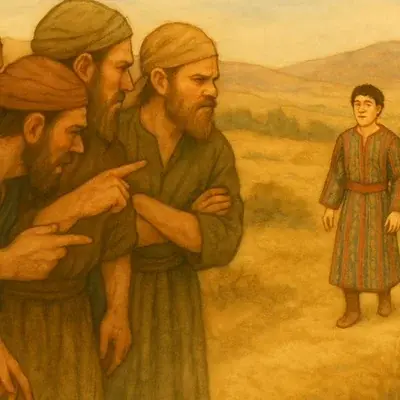
Genesis 37 marks the beginning of Joseph’s story — the famous “coat of many colours,” the dreams from God, and the betrayal by his brothers. But this chapter is far more than a family drama. It exposes the anatomy of sin: envy that festers, hatred that plots, cruelty that feasts while its victim suffers, and deception that leaves only grief behind.
The Rejected Prophet in His Multicoloured Coat - The Anatomy of Sin
Genesis 37 opens with the marker, “These are the generations of Jacob.” This indicates we are starting a new section in the book of Genesis. The Bible then immediately brings the focus to Joseph. The way the narrator introduces him signals that Joseph will carry forward the next stage of the covenant story. It is not that the other sons vanish, but that Joseph is the lens through which God moves His promises forward.
We meet him at seventeen years of age, a youth compared to his much older brothers, some of whom must by now be approaching forty. Already, Joseph is distinct. He brings back an evil report of his brothers to their father. The text does not tell us the content of this report, and the silence is instructive. We are not invited to speculate about what they did, only to see that Joseph’s truth-telling sets him against them. The one who speaks honestly about sin is resented by those who want it covered.
Jacob’s favouritism deepens the division between Joseph and his brothers. The Bible calls him Israel here, reminding us of his covenant identity, but Israel’s love for Joseph above the others is rooted in his personal affection. Joseph was the son of his old age, the firstborn of Rachel, the wife Jacob loved, and Jacob openly marks him with a robe that sets him apart.
The garment is long, ornate, and impractical for manual labour. It resembles royal clothing more than a shepherd’s cloak. Its symbolism is plain. Joseph is favoured by his father above his other sons. He is distinguished, perhaps even treated as a prince among them. The effect of such favouritism is predictable. His brothers see it and hate him for it to the point where they cannot even speak to him in peace. As a result, the household of promise is fractured, consumed with envy and jealousy.
Next come Joseph’s dreams. These are not ordinary dreams, but revelations from God, just as He gave dreams earlier in Genesis to Abimelech, Jacob, and Laban. The repetition of Joseph’s dreams confirms their divine origin. In the first, his sheaf rises upright while his brothers’ sheaves bow down. In the second, the sun, moon, and eleven stars bow before him.
Both dreams point to his exaltation over his family. His brothers do not miss the meaning. “Are you really going to reign over us?” Their hatred intensifies, this time not because of Jacob’s favouritism, but because of Joseph’s revelation. They despise him because God has spoken through him.
This is the first theological turning point. Joseph, like Abel before him, is hated because of divine favour. As Jesus said in His lament over Jerusalem in Gospel of Matthew 23:37, “You kill the prophets and stone those sent to you.” And in Acts of the Apostles 7:52, Stephen sharpened it further: “Which of the prophets did your fathers not persecute?” Joseph now joins that line of persecuted prophets.
Combined with his truth-telling and exposing of sin, his prophetic dreams expose the hearts of his brothers, and their hatred confirms it.
Jacob also responds with resistance. He rebukes Joseph: “Shall I and your mother and your brothers really bow down?” Jacob’s incredulity is clear. He cannot imagine the family bowing to this youth. Yet we are told he kept the saying in mind. Even in his rebuke, Jacob cannot dismiss the dream entirely. He has lived long enough to know that God’s word, however unlikely, cannot be ignored.
The story then moves from Jacob’s household to the open field. Jacob sends Joseph to check on the welfare of his brothers at Shechem. There is sharp irony here. Joseph’s mission is one of peace, seeking their good, while they are plotting his ruin.
Shechem itself is a loaded setting, the place of Simeon and Levi’s massacre in Genesis 34. Once again, bloodshed lurks in the background. Joseph goes willingly, and on the way an unnamed man finds him wandering and directs him to Dothan. At first glance, this seems like an incidental aside, but it matters. The man’s appearance ensures Joseph finds his brothers. By chance, he is guided directly to them.
Such chance is never random. In Genesis, Joseph is being led step by step to the place where the dreams will begin to unfold.
From afar, his brothers see him coming, and their hatred ripens into murder. “Here comes this dreamer. Come, let us kill him, and we will see what will become of his dreams.” Their words expose the real target. They do not merely want Joseph dead. They want to silence the revelation God has given him. They are not only rejecting their brother, they are rejecting the God who spoke through him.
Sin has matured. Jealousy ferments into plot, and the prophet is marked for death. The line from Cain to Joseph is direct. Cain could not bear God’s favour on Abel, so he slew him. Joseph’s brothers cannot bear God’s favour on him, so they conspire to destroy him.
Reuben, the eldest, intervenes. He persuades them not to shed blood, but to cast Joseph into a pit, secretly planning to rescue him later. His motive may be mixed, perhaps to regain favour with his father after his earlier sin with Bilhah. But even weak restraint is enough to prevent immediate murder.
When Joseph arrives, they strip him of his robe, the symbol of Jacob’s love, and cast him into a cistern, empty and without water. The one clothed in favour is now naked in a pit.
In verse 25, the story reaches its centre point: they sat down to eat a meal. This is the theological heart of the chapter. Their brother cries from the pit, and they feast, completely indifferent to his suffering. Sin has taken them to the point where they can find enjoyment while their brother suffers.
This is what unchecked sin becomes. It delights in cruelty. It finds unity in evil. It shares a meal over the anguish of the righteous. What began as envy has matured into callousness so deep it can feast beside the cries of its own flesh and blood.
At that very moment, traders appear. They are called Ishmaelites in one verse, Midianites in another, so it was likely a mixed caravan, but the point is theological, not geographical. Both Ishmael and Midian were sons of Abraham through women other than Sarah. Their descendants stand outside the covenant line.
Genesis highlights their presence deliberately. The covenant sons of Jacob now cooperate with the non-covenant sons of Abraham in cruelty. Those marked off for blessing act no differently from those outside. Together they profit from Joseph’s suffering.
Sin does not respect boundaries. It makes allies of the ungodly. The chosen family and the rejected lines unite in betrayal.
Judah voices the plan. “What profit is it if we kill our brother? Let us sell him, for he is our own flesh.” His words reveal sin’s twisted logic. He appeals to kinship, but only to cover greed. Better to sell him than kill him. Better to gain silver than guilt. They sell him for twenty shekels, the price of a slave.
The covenant family has betrayed its own. Reuben returns and discovers Joseph gone. He tears his clothes, but it is too late.
The brothers then devise their cover-up. They slaughter a goat, dip Joseph’s robe in blood, and present it to Jacob. “Please recognise whether this is your son’s tunic.” The echo of Cain is unmistakable. Cain denied knowledge of Abel. Joseph’s brothers will not even call him by name. He is only “your son.” Sin distances itself from responsibility, cloaks itself in lies, and hides behind deception.
Jacob recognises the robe, assumes the worst, and mourns with unrelenting sorrow. He refuses comfort, saying he will go down to Sheol in mourning for his son.
Sin’s wake is devastation. Joseph is gone. Jacob is broken. The brothers are bound together in guilt and deceit.
The chapter closes with Joseph absent, sold to Potiphar in Egypt, though Jacob believes him dead. God’s name is never spoken, and the dreams He gave Joseph have apparently been destroyed. The brothers have tried to silence the prophet, to kill the dream by betraying the dreamer.
But the question is left hanging. If the dreams are from God, can human actions erase them?
In addition to being a narrative of Joseph being sold into slavery, Genesis 37 shows us the anatomy of sin. It begins in envy. It ferments until it hatches in plotting. It acts in cruelty and indifference, feasting while its victim suffers. It seeks unrighteous gain, then cloaks itself in deception. Finally, in its wake, it leaves grief and ruin.
And all of this happens not in Canaanite cities, but within the covenant household itself. The people chosen for blessing act like Cain, cooperate with Ishmaelites and Midianites, and leave their father crushed.
The centre point highlights it. Evil delights in the suffering of the righteous. Joseph is hated not merely as Jacob’s favourite, but as God’s dreamer, a prophet among his brothers.
Abel, Joseph, the prophets, and ultimately Christ Himself belong to the same pattern. The story of Joseph is the story of how sin responds to God’s word. It hates, it silences, and it covers up.
Genesis 37 exposes that truth. Yet, by preserving Joseph’s dreams in the narrative, it also whispers that God’s word is not so easily erased. The rest of Genesis will show how. But for now, the chapter demands we face the full reality of sin. It ferments, it hatches, it acts, and it destroys.