
Genesis 24
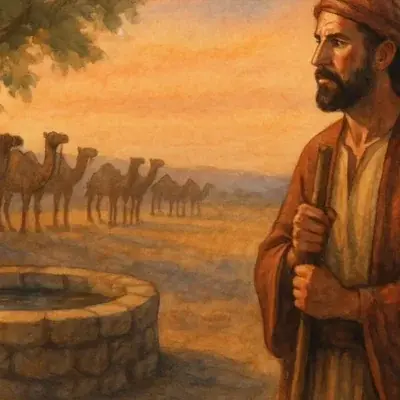
Genesis 24 marks the next stage in the unfolding of God’s covenant purposes. Abraham, nearing the end of his life, entrusts his servant with a crucial task: to find a wife for Isaac, the son God promised him. But this is no ordinary match—it is grounded in Yahweh’s faithfulness, guided by prayer, and sealed by providence.
Yahweh Provides A Bride for Isaac. The marriage of Isaac and Rebecca.
Genesis 24 marks the start of a new section in the unfolding story of Genesis. As the focus shifts from Abraham to his son and the generations that will follow, the question emerges with greater urgency: how will the promises of Yahweh continue?
How will Abraham ensure that his family remains faithful to God?
The heir has been born, but he is still unmarried. Sarah is gone and Abraham is aging.
The covenant cannot advance without the next generation. A wife must be found for Isaac, and not just any wife. The land has been promised, but the people who live in it worship false gods.
To intermarry with them would be to compromise the holiness of the seed and corrupt the line of worship.
Abraham understands this clearly because Yahweh Himself has taught him.
Back in Genesis 18:19, Yahweh declared the reason He had chosen Abraham: “so that he may command his children and his household after him, that they keep the way of Yahweh to do righteousness and justice, so that Yahweh may bring upon Abraham what He has spoken about him.”
That is the responsibility now in view.
If the promises are to continue, Abraham must ensure that the next generation remains faithful. The story of Sodom stands behind this moment, not just as a record of judgment, but as an object lesson.
Yahweh’s blessing will not advance in partnership with wickedness. Isaac’s marriage must reflect the holiness of the line.
Abraham summons the oldest servant in his house and places him under oath. The gesture, placing the hand under the thigh, is not explained, but the act is clearly solemn.
It binds the servant to the charge, invoking the covenant without needing to explain its every symbol.
Abraham’s command is specific: Isaac must not take a wife from the daughters of Canaan, but from Abraham’s own relatives.
This is not about ethnicity or bloodlines. It is about worship. The Canaanites are idolaters.
To bring one of them into the household would be to invite apostasy into the covenant line. Abraham’s concern for separation is not cultural. It is theological.
He has seen what happens when the righteous dwell too closely with the wicked. There must be distinction, or the way of Yahweh will not be kept.
Yet even as Abraham commands, he rests in the promises of God. “He will send His angel before you,” he says.
Abraham has not become passive in his old age. He acts in faith, trusting the God who brought him out of Ur, and who swore the land to his seed.
The servant is permitted to return alone if the woman refuses to come, but Isaac himself must not go back.
The SON of the covenant promise is not to leave the LAND of covenant promise.
The servant obeys. He takes ten camels and costly gifts and sets out for the region of Nahor. He arrives outside the city and stops by a well in the evening, the time when women come to draw water.
What he does next sets the tone for the entire chapter. He prays. He asks Yahweh, the God of his master Abraham, to show lovingkindness, to cause the mission to succeed in a way that can be recognised.
He does not ask for a sign in the sky or some dramatic wonder. He asks that the right woman would go beyond custom, that she would offer him a drink and then volunteer to water his camels as well.
This is not ordinary behaviour. It would take time, strength, and unusual generosity.
But it is precisely this kind of costly hospitality that marked Abraham himself, when he ran to serve the three visitors by the oaks of Mamre.
The servant is seeking a woman who will respond in the same way, not merely with politeness, but with open-hearted service. What he asks for is something only Yahweh can arrange: a visible marker of His choice, revealed through a striking act of kindness.
The servant is seeking a wife for Isaac, but he knows only Yahweh can identify the right one. So he prays, and he waits.
Before he finishes praying, Rebekah appears. The narrative slows, drawing attention to her arrival.
She is described as very beautiful and a virgin, yet the focus is not on her physical traits, but on her response. She does exactly what the servant had prayed for. She offers water to him and then draws water for his camels, a task that would have taken considerable effort.
The servant remains silent, watching carefully to discern whether Yahweh has made his journey successful. When she finally reveals her family line, that she is the granddaughter of Nahor, the servant sees the answer clearly.
He bows low and worships, praising Yahweh, who has not forsaken His lovingkindness and truth. The prayer has been answered. The bride has been provided. The servant does not celebrate himself or his plan. He gives glory to God alone.
Rebekah runs home, and her brother Laban comes out to meet the servant. Laban’s welcome is warm, though the narrative already hints at his motives. He sees the gold before he speaks.
Still, he offers hospitality. The camels are cared for, and a feast is set. But the servant refuses to eat until he has spoken. His mission must come before anything else.
Verses 34 to 49 form the theological centre of the chapter.
The servant recounts the entire journey, not to repeat the story, but to bear witness to Yahweh’s providence. His words are clear and ordered: Abraham’s commission, the servant’s prayer, the woman’s precise response, the revelation of her lineage, and the servant’s immediate worship.
This match was not random. It was a divinely appointed meeting.
The servant then turns to Rebekah’s family and places the decision before them. “If you are going to show lovingkindness and truth to my master, tell me…”
The language echoes Abraham’s own words, and more deeply, it echoes Yahweh’s covenant character. The servant does not negotiate. He calls them to recognise the same providence he has just described.
Laban and Bethuel answer rightly: “The matter comes from Yahweh.” They acknowledge what the servant has declared. There is no dispute. The match is made. The servant again responds with worship, bowing before Yahweh. He then gives further gifts, not only to Rebekah, but to her family, and prepares for the journey home.
Yet even here, a moment of hesitation arises. The family asks to delay her departure by ten days. It seems like a small request, but the servant refuses.
The matter has been made clear. Delay would only obscure what Yahweh has already revealed.
They ask Rebekah directly, and she agrees to go. Her willingness to go to the promised land mirrors Abraham’s own obedience years earlier.
She departs from her family because she trusts in Yahweh.
Her family sends her off with a blessing that reflects the language of covenant: “May your seed possess the gate of those who hate him.”
This is not a generic wish. It echoes Yahweh’s own words to Abraham after the offering of Isaac: “Your seed shall possess the gate of his enemies.”
The promise to Abraham is now spoken over Rebekah, confirming her place in the line through whom that promise will continue.
Isaac, for whom the entire journey has been undertaken, appears at last.
He is returning from Beer-lahai-roi, the well of the Living One who sees.
The location is important. It recalls Hagar’s encounter in the wilderness, where she learned that Yahweh sees the afflicted.
The idea of Yahweh being the God who sees also reflects the name Abraham gave to Moriah: Yahweh Yireh, “Yahweh will see and provide.”
These two names frame Isaac’s story. He is the child of promise, and the God who sees has always been the God who provides. On Moriah, Yahweh saw and provided a substitute.
Now, at the well, He sees again and provides a wife.
As Isaac walks in the field, Rebekah sees him. She veils herself in readiness for marriage and descends from the camel.
The servant recounts everything to Isaac.
No further proof is needed. Isaac receives her and brings her into Sarah’s tent. This act is rich with covenant meaning.
Sarah’s tent was the place of the matriarch, the space from which the promised seed first came. Her death left not only an emotional absence, but a theological one.
Now Rebekah enters to continue Sarah’s role. She will be the bearer of the next covenant generation.
Just as Isaac came from Sarah’s womb, so the future of the covenant must now come through Rebekah. She becomes the new vessel of Yahweh’s purpose.
The final sentence reveals a secondary, but still important aspect of Yahweh’s provision: “Thus Isaac was comforted after his mother’s death.”
Comfort is part of Yahweh’s provision. He has not only preserved the promise. He has comforted the heir.
The Living One who sees has seen Isaac’s sorrow and met it with covenant faithfulness. The next generation is in place, and the promise can move forward.
The name Yahweh appears nineteen times in this chapter. The prevalence of God’s covenant name makes the central theological point.
Everything that happens is from Yahweh.
Every prayer is to Him.
Every success is attributed to Him.
Every decision is measured by what He has revealed.
The servant does nothing apart from Yahweh, and the family recognises, “the matter comes from Yahweh.”
The covenant God is present, active, and faithful.
He sees. He provides. And He brings the next stage of His covenant to completion by His own hand.
Genesis 24 gives us a rare glimpse of a household ordering its life in response to Yahweh’s word, a family living under the covenant, with trust, obedience, and worship all rightly aligned.