
Genesis 34
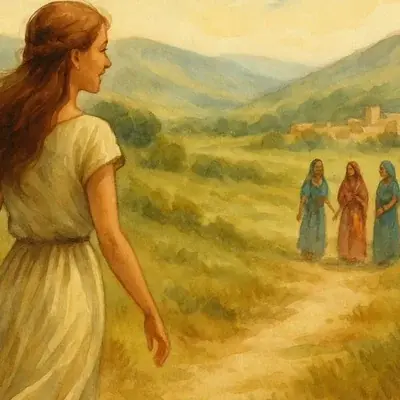
Genesis 34 records the troubling account of Dinah, the daughter of Jacob and Leah, who goes out to see the women of the land and is defiled by Shechem.
Jacob’s Escape, Laban’s Pursuit, and God’s Protection
Genesis 34 begins with Dinah, the daughter of Leah, going out to see the young women of the land. We already know who these people are. They are Canaanites. From the time of Abraham, there has been a clear command to remain separate from the peoples of the land. Isaac had sent Jacob away to avoid intermarriage with them.
We are not told why Dinah leaves the safety of her father’s household, but she goes of her own accord. Her visit puts her outside the protection of the covenant family and among those who neither share its worship nor live by its moral boundaries. This should remind us of Lot leaving Abram for the city of Sodom, moving away from covenant protection into the influence of those who do not know Yahweh.
Shechem, the son of Hamor the Hivite, ruler of the land, sees her, takes her into his house, sleeps with her, and humiliates her. In his own eyes, and in the eyes of his culture, this is not wrong. In Canaanite society, especially among rulers, it was common and acceptable for a man of rank to take a woman into his house without consulting her or her family, regularising the arrangement afterwards if he wished.
What makes the act grievous is not how it was viewed in Shechem’s world, but how it is measured by God’s covenant law in Israel. For an unmarried daughter to be taken in this way was a serious violation. In verse 7, God calls it a nevalah, a disgraceful act that ought not to be done in Israel.
This detail places the story alongside earlier moments in Genesis when a ruler of the land takes a woman into his house. Pharaoh took Sarai in Genesis 12, and Abimelech took Rebekah in Genesis 26. In both cases, God intervened to protect the covenant family. Here, there is no divine intervention, no warning dream, no plague to bring the woman back. The ruler takes her, and she remains in his house. She is treated like a Canaanite woman.
The Bible goes on to say Shechem is deeply drawn to Dinah, loved the young woman, and spoke to her heart. He wants to keep her as a wife. He asks his father to arrange the marriage and offers an open-ended bride price. His determination shapes the way the story unfolds. This is not a passing encounter, but a plan to bring her permanently into his household.
Jacob hears of Dinah’s defilement, but says nothing until his sons return from the field. The text does not tell us why he remains silent. He may be waiting to decide on a course of action with them, or to see how the local rulers will approach him. Whatever the reason, the head of the covenant family makes no public statement at this point.
When Hamor comes to speak with Jacob, the sons arrive. On hearing what has happened, they are grieved and very angry because it is a disgrace in Israel. Scripture pauses to underline this. Such an act is not just an offence to family honour. It is a violation against the moral order God has given His people.
Hamor’s proposal grows quickly from a marriage settlement to a plan for full integration. He urges intermarriage, mutual exchange of daughters, and shared access to the land. This is more than solving Dinah’s situation. It is a political and social merger. It would mean becoming one people with the people of the land, erasing the covenant separation God had commanded.
Jacob’s sons reply in verse 13. The text tells us they speak with deceit. That shapes how we read every word that follows. They say they cannot give their sister to an uncircumcised man, for that would be a reproach to them. They set one condition. Every male in Shechem’s city must be circumcised. Then they promise they will exchange daughters, live together, and become one people.
They speak the language of covenant inclusion, but their intent is not covenant faithfulness. The sign of belonging to Yahweh is being turned into bait. Instead of guarding the covenant, they profane it by using it to set up an act of revenge. There is sharp irony here. The brothers use the sign of separation to propose the very union God forbids, all the while planning to kill those who agree.
The Shechemites, for their part, have no understanding of circumcision’s covenant meaning. They do not know about Genesis 17. They have no knowledge of Yahweh’s promises to Abraham. To them, circumcision is a ritual that conceals a political and economic alliance. That becomes plain at the city gate.
Hamor and Shechem tell their men that Jacob’s family is peaceful with us, that the land is big enough for both, and that daughters can be freely exchanged. Then comes the real selling point. “Won’t their livestock and their property and all their animals be ours?” There is no mention of Yahweh, no thought of covenant loyalty. In their eyes, circumcision is simply the cost of gaining access to Israel’s wealth.
From both sides, the covenant sign is emptied of its meaning. For the Shechemites, it is a hollow ritual for mutual benefit. For Simeon and Levi, it is a tactic to disable their enemies. No one in this chapter treats it as the mark of God’s covenant. We can also see that the covenant name Yahweh never appears in this chapter. God is absent from their plans and absent from their speech.
This misuse of what is holy is the centre of the chapter’s structure. Everything before leads to it. Everything after flows from it.
On the third day after the circumcision, while the men are still in pain, Simeon and Levi, Dinah’s full brothers through Leah, take their swords, walk into the unsuspecting city, and kill every male. They kill Hamor and Shechem, and bring Dinah out of Shechem’s house. The rest of the brothers join in, plundering the city’s livestock, wealth, children, and wives. The scale of the violence is staggering.
Shechem’s sin was real, but their revenge engulfs an entire population. A single act of defilement is answered with the total destruction of every male and the seizure of everything they owned. This is not justice measured by God’s law. It is vengeance driven by rage. God gives no indication of His approval.
The problem is not only what they did, but the manner in which they did it, fierce, unrestrained, and far beyond the wrong committed.
Only now does Jacob speak. His concern is not God’s honour or the misuse of the covenant sign, but the danger they have brought on the household. “You have brought trouble on me by making me odious among the inhabitants of the land. I will be destroyed, I and my household.”
The brothers reply, “Should he treat our sister as a harlot?” The argument is framed entirely in terms of family honour. Neither side mentions Yahweh.
The absence of God in this chapter is deliberate. This is a chapter in which the covenant symbol is centre stage, but the covenant God is not present. The altar Jacob built in Shechem at the end of chapter 33, naming El, the God of Israel, is followed by a chapter where His name is not spoken, His sign is abused, and His people act for their own ends.
Jacob will remember this day in his final words to his sons: “Simeon and Levi are brothers; their swords are implements of violence. Cursed be their anger, for it is fierce, and their wrath, for it is cruel. I will divide them in Jacob and scatter them in Israel.”
This chapter presents a clear warning. God’s people are threatened from without, by the pull of assimilation, and from within, by zeal without holiness. The covenant sign can be stripped of meaning by outsiders and weaponised by insiders. And when God’s people act in His name without Him, they leave a stench, not a blessing, among the nations.