
Obadiah 1
Obadiah announces that the proud nation of Edom will fall, but the kingdom will belong to Yahweh. However the judgment will not stop with Edom. When the day of the Lord comes it will extend to all the nations.
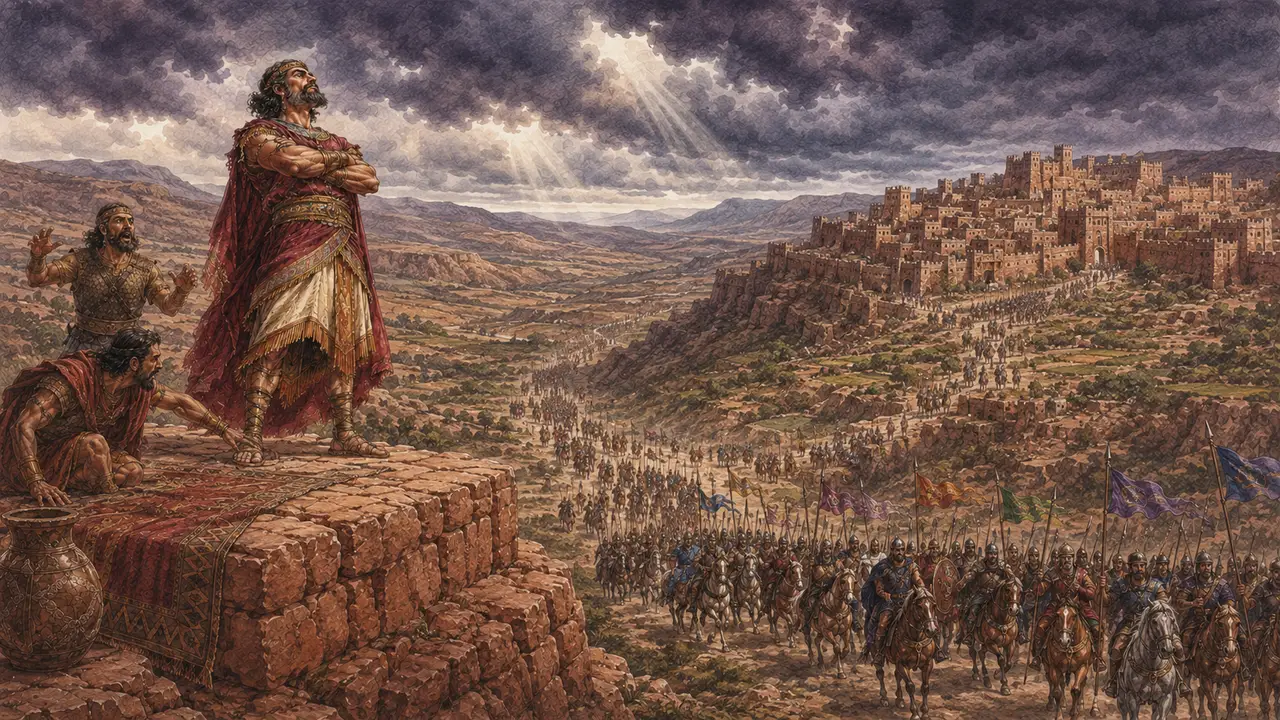
Obadiah: The Kingdom Will Belong to Yahweh
Obadiah is the shortest book in the Old Testament, but its message reaches from the fall of Edom to the final judgment of all nations. Edom trusted its mountain strongholds, rejoiced when Jerusalem suffered, plundered its brother’s possessions, and handed survivors over to the enemy. Yahweh therefore declared that Edom would be brought down, betrayed by its allies, stripped of its treasures, and cut off forever.
Obadiah’s prophecy does not end with Edom. Obadiah announces that “the day of Yahweh draws near on all the nations.” Edom becomes an example of every proud kingdom that opposes God, persecutes His people, and imagines itself secure from judgment. Yahweh will judge the nations according to their deeds, restore His scattered people, and establish His kingdom.
Obadiah does not identify the invasion of Jerusalem or tell us whether he prophesied before or after it. The events match Edom’s conduct surrounding Babylon’s destruction of Jerusalem in 586 BC, but prophetic language can describe future events as though they have already occurred. For example, Isaiah 53 speaks retrospectively of Christ’s suffering centuries before the crucifixion. Therefore we cannot date Obadiah simply because parts of the prophecy sound like he’s writing after the fact.
The prophet himself is otherwise unknown. His name means “servant of Yahweh,” which suits his message. Edom believed that its mountain belonged to itself. Obadiah announces that every nation and kingdom stands under Yahweh’s rule.
Yahweh brings proud Edom down
The prophecy begins:
“The vision of Obadiah. Thus says Lord Yahweh concerning Edom.”
This is Yahweh’s judgment, not Obadiah’s personal hostility towards a neighbouring nation. An envoy has gone among the nations, calling them to rise against Edom for battle. The nations act from their own ambitions, but Yahweh summons them as instruments of His judgment.
Edom descended from Esau and occupied the mountainous region south of Judah, around Mount Seir. Its cliffs and narrow approaches gave it a strong defensive position. Edom looked at its natural fortifications and asked:
“Who will bring me down to earth?”
Yahweh answers:
“Though you build loftily like the eagle,
Though you set your nest among the stars,
From there I will bring you down.”
Edom’s strength became the ground of its arrogance. Its mountain appeared to place it beyond the reach of any enemy, but no height could place it beyond Yahweh.
“The arrogance of your heart has deceived you.”
Pride had corrupted Edom’s judgment. The nation misread its strength, underestimated Yahweh, and mistook temporary security for permanent safety. Jesus later states the principle plainly:
“Everyone who exalts himself will be humbled.”
Luke 14:11
The judgment would also be thorough:
“If thieves came to you,
If robbers by night—
Oh how you will be ruined!—
Would they not thieve only until they had enough?
If grape gatherers came to you,
Would they not allow some gleanings to remain?”
Ordinary thieves stop when they have taken enough. Grape gatherers leave something behind. Edom’s enemies, however, would search out everything:
“Oh how Esau will be searched out
And his hidden treasures ransacked!”
The repetition of Esau draws us back to Genesis. Esau became Edom, and his descendants became the nation now addressed by Yahweh. The name “Esau” appears seven times in the book, while Yahweh’s covenant name also appears seven times. Seven commonly marks completeness in Scripture. The paired pattern reinforces the prophecy’s final outcome: Yahweh acts with complete sovereignty, and His judgment upon the house of Esau is brought to completion. Esau will be searched out, cut off, consumed like stubble, and left without a survivor, while the kingdom will belong to Yahweh.
Edom also trusted its alliances:
“All the men who have a covenant with you
Will send you forth to the border,
And the men at peace with you
Will deceive you and overpower you.”
Those who ate Edom’s bread would set an ambush. The nation that betrayed its brother would itself be betrayed.
Edom’s wisdom and military strength would also fail:
“Will I not on that day,” declares Yahweh,
“Cause the wise men to perish from Edom
And discernment from the mountain of Esau?”
Teman was an Edomite clan and region associated with wisdom. Genesis identifies Teman as a grandson of Esau. Jeremiah later asks, “Is there no longer any wisdom in Teman?” Yet human counsel cannot preserve a people whom Yahweh has appointed for judgment.
“Then your mighty men will be dismayed, O Teman.”
Edom trusted its cliffs, treasures, alliances, wisdom and warriors. Yahweh removes them all.
Edom betrays its brother
Verse 10 states the reason for judgment:
“Because of violence to your brother Jacob,
You will be covered with shame,
And you will be cut off forever.”
Edom’s guilt was intensified by brotherhood. Israel descended from Jacob, while Edom descended from Esau. Yahweh had commanded Israel:
“You shall not abhor an Edomite, for he is your brother.”
Deuteronomy 23:7
Israel was required to remember the family bond. Edom rejected it.
The hostility between the nations had deep roots. When Israel travelled from Egypt towards the promised land, Moses requested peaceful passage through Edom. Israel promised not to take crops, water or property. Edom refused and came out with a strong force.
Obadiah describes a greater betrayal:
“On the day that you stood aloof,
On the day that strangers took his wealth captive
And foreigners entered his gate
And cast lots for Jerusalem—
You too were as one of them.”
Edom may not have led the invading army, but it rejoiced over Judah’s destruction and joined the destroyers.
The sin progressed from observation to participation:
“Do not look on your brother’s day with triumph,
The day of his misfortune.
And do not be glad over the sons of Judah
In the day when they perish;
And do not let your mouth speak great things
In the day of their distress.”
Edom looked upon Judah’s disaster with triumph, rejoiced when Judah’s sons perished, and boasted in their distress.
Then Edom entered Jerusalem, reached for Judah’s wealth, blocked the roads, cut down those who escaped, and handed survivors over to the enemy.
The progression is deliberate. Edom stood aloof, rejoiced, boasted, plundered, hunted fugitives, and delivered survivors over.
Psalm 137 remembers Edom’s conduct:
“Remember, O Yahweh, against the sons of Edom
The day of Jerusalem,
Who said, ‘Raze it, raze it
To its very foundation.’”
Ezekiel also condemns Edom for seeking to possess Israel’s land after its ruin. Edom treated Judah’s judgment as an opportunity to enrich and exalt itself.
Judah’s suffering had come under Yahweh’s discipline, but that did not authorise Edom’s hatred. Babylon could serve as Yahweh’s instrument without sharing His holiness or righteous purpose. Edom acted from pride, greed and cruelty, and therefore remained answerable to God.
The Day of Yahweh comes upon all nations
Verse 15 widens the prophecy:
“For the day of Yahweh draws near on all the nations.”
Edom’s judgment becomes a pattern of the judgment awaiting every nation. The Day of Yahweh is the appointed time when God intervenes openly to judge His enemies, vindicate His people, and establish His rule.
The principle already seen in Edom’s judgment now extends to all nations:
“As you have done, it will be done to you.
Your dealings will return on your own head.”
This is not an impersonal law of fate. Yahweh judges and repays according to works.
Paul writes:
“Who will repay to each according to his works.”
Romans 2:6
Christ says:
“Behold, I am coming quickly, and My reward is with Me, to render to every man according to his work.”
Revelation 22:12
The New Testament takes up Obadiah’s Day of Yahweh language and applies it to the return of Christ.
“For you yourselves know full well that the day of the Lord will come just like a thief in the night.”
1 Thessalonians 5:2
Those who believe themselves secure will face sudden destruction. Edom asked, “Who will bring me down?” The Day of the Lord exposes every false refuge.
Peter carries the prophetic expectation to its final fulfilment:
“But the day of the Lord will come like a thief, in which the heavens will pass away with a roar and the elements will be destroyed with intense heat, and the earth and its works will be found out.”
2 Peter 3:10
The New Testament also speaks of “the day of our Lord Jesus Christ,” “the day of Christ Jesus,” and “the day of Christ.” The Day of Yahweh is the Day of the Lord Jesus Christ. Yahweh’s final judgment and salvation come through Him.
Verse 16 introduces the image of drinking:
“Because just as you all drank on My holy mountain,
All the nations will drink continually.
They will drink and swallow,
And they will be as if they never were.”
Edom and the nations had drunk in celebration on conquered Mount Zion. Yahweh declares that the nations themselves will drink the cup of His wrath.
Revelation takes up the same image:
“He also will drink of the wine of the wrath of God, which is mixed in full strength in the cup of His anger.”
Revelation 14:10
Obadiah is not directly quoted in the New Testament, but its themes run through the New Testament teaching about final judgment. Proud nations oppose God’s people, rejoice over their suffering, and imagine themselves secure. The Lord returns, repays according to works, vindicates His people, and establishes His kingdom.
Yahweh restores His people and establishes His kingdom
Judgment is not the final word for Zion:
“But on Mount Zion there will be those who escape,
And it will be holy.”
Mount Zion stands in deliberate contrast with the mountain of Esau. Edom’s mountain appeared secure, but it would be judged. Zion appeared defeated, but Yahweh would make it the place of escape and holiness.
Deliverance and holiness belong together. Yahweh rescues His people and consecrates them to Himself.
Obadiah then announces a reversal:
“And the house of Jacob will possess their possessions.”
Edom reached for Judah’s wealth in the day of disaster. Jacob would possess what had belonged to Edom.
Verse 18 adds:
“Then the house of Jacob will be a fire
And the house of Joseph a flame;
But the house of Esau will be as stubble.”
The mention of Jacob and Joseph points towards the restored unity of God’s people. Joseph often represents the northern tribes, especially Ephraim. The kingdom had been divided and both parts had suffered exile, but Obadiah looks towards a restored people acting together under Yahweh.
Esau, however, would be stubble before the fire:
“And they will set them on fire and consume them
So that there will be no survivor of the house of Esau,”
For Yahweh has spoken.
This judgment does not authorise personal vengeance. Yahweh declares it, directs it, and brings it to pass.
Verses 19 and 20 describe the restoration of territory. The Negev, the Shephelah, Ephraim, Samaria, Gilead and the cities of the Negev would be possessed by the restored people.
The inheritors are exiles:
“And the exiles of this military force of the sons of Israel”
“And the exiles of Jerusalem”
Those who had been scattered and dispossessed would return and possess cities.
This pattern reaches beyond the immediate return from exile. Jesus says:
“Blessed are the lowly, for they shall inherit the earth.”
Matthew 5:5
God’s people inherit through Christ. He is the true heir, and those united to Him become fellow heirs. The promise is not fulfilled by Christians seizing the property of their enemies. It is fulfilled when Christ receives the kingdom and shares His inheritance with His people.
Obadiah concludes:
“And the saviors will ascend Mount Zion
To judge the mountain of Esau,
And the kingdom will belong to Yahweh.”
These saviours are subordinate deliverers or rulers whom Yahweh raises up. Scripture uses similar language for the judges who delivered Israel. They do not rival Yahweh. Their authority comes from Him and serves His kingdom.
The final line governs the whole prophecy:
“And the kingdom will belong to Yahweh.”
The mountain of Esau looked secure. Mount Zion looked defeated. Judah’s possessions had been taken, and its people had been killed or scattered. Edom appeared to have profited from Judah’s ruin.
Yahweh declares the opposite outcome. The proud mountain will fall, Zion will be holy, the exiles will inherit, and the nations will answer for their deeds.
The New Testament reveals that Yahweh establishes this kingdom through Jesus Christ:
“The kingdom of the world has become the kingdom of our Lord and of His Christ; and He will reign forever and ever.”
Revelation 11:15
Christ gathers God’s scattered people, judges the nations, vindicates the saints, and reigns until every enemy is placed under His feet.
The final outcome does not belong to Edom, Babylon, or any other kingdom of men.
The kingdom belongs to Yahweh.