
Exodus 38
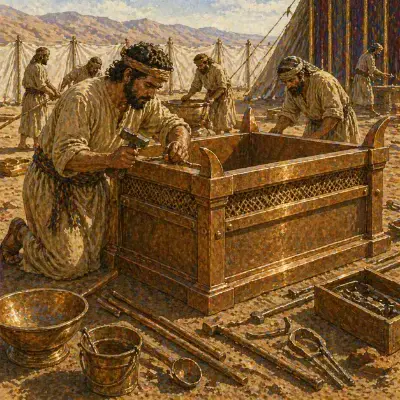
Exodus 38 moves outward from the tabernacle itself to the place where Israel approaches Yahweh. The bronze altar for sacrifice, the basin for washing, and the courtyard boundary are all made according to His command, establishing the ordered way by which sinners draw near. The chapter also records the materials used, showing that the dwelling of Yahweh rests on atonement and is built from the willing offerings of His people.
Exodus 38 Explained: The Altar, the Courtyard, and the Accounting of the Sanctuary
Exodus 38 records the making of the bronze altar, the bronze basin, the courtyard, and the counting of the materials used for the tabernacle. The previous chapter described the construction of the most sacred objects inside the tabernacle: the ark, the mercy seat, the table, the lampstand, and the altar of incense. This chapter now moves outward, from the tent itself to the courtyard where the people will come to worship. The work is carried out by Bezalel, the man whom Yahweh filled with His Spirit. Bezalel makes everything as Yahweh commanded Moses.
The chapter begins with the bronze altar. Bezalel makes the altar from acacia wood and overlays it with bronze. He makes its horns on its four corners, its grating, its poles, and all its utensils for the sacrifices. This altar will stand in the courtyard at the entrance to the tabernacle. Every burnt offering, peace offering, sin offering, and guilt offering will be brought to this altar. Before anyone may approach the holy place, there must be sacrifice. The altar will stand between the people and the tabernacle. No one may come near to Yahweh without first coming to the altar. Blood must be shed, and atonement must be made. The altar shows that access to Yahweh begins with sacrifice.
After the altar, Bezalel makes the bronze basin and its stand from the mirrors of the serving women who served at the entrance of the tent of meeting. The basin is made for Aaron and his sons to wash their hands and their feet before they serve at the altar or enter the tent. If they approach without washing, they will die. Aaron and his sons will be fully washed with water at their ordination, but they must still wash their hands and their feet whenever they come near to minister before Yahweh. The altar deals with guilt through sacrifice while the basin deals with uncleanness through washing. Both stand in the courtyard, and both are necessary. Atonement and cleansing are required for those who draw near to Yahweh.
The chapter then describes the courtyard itself. Linen hangings form a barrier around the tabernacle area, supported by pillars with bronze bases and silver hooks and bands. The entrance on the east side is a screen of blue, purple, and scarlet material and fine linen, the work of a weaver. The courtyard forms a boundary around the dwelling place of Yahweh. Not everyone may come wherever they wish. There is an entrance, there is a boundary, and there is an appointed way to approach. The people come to the altar with their sacrifices. The priests wash before they enter and serve in the tent of meeting. The high priest enters the most holy place once a year on the Day of Atonement. Moses, as the mediator of the covenant, goes before Yahweh and receives His word for the people. Access to Yahweh is ordered, and it is given through the way that He has appointed.
The chapter ends with a detailed accounting of the gold, silver, and bronze used for the work. The totals are recorded, and the silver from the census is specifically mentioned as being used for the bases of the sanctuary and for the pillars and hooks. The silver used for the bases of the sanctuary came from the atonement money collected from the people. The dwelling place of Yahweh will rest on the silver connected with atonement. The gold, silver, and bronze used for the tabernacle came from the offerings of the people, given willingly for the work. The sanctuary in the midst of the camp is built from the atonement silver and from the freewill offerings of the people whom Yahweh had redeemed.
Exodus 38 therefore shows the place of approach to Yahweh being prepared. The altar for sacrifice, the basin for washing, and the courtyard that forms the boundary around the sanctuary are all made according to what Yahweh commanded, by the man whom Yahweh had filled with His Spirit for this work. If Exodus 37 showed the place where Yahweh would meet with Moses, and where the high priest would enter once a year on the Day of Atonement, Exodus 38 shows the place where the people will come to Yahweh. The people will bring their sacrifices to the altar in the courtyard, and the priests will wash at the basin and serve before Yahweh. All will come by the appointed way. The dwelling place of Yahweh will stand in the midst of the camp, but the altar, the basin, and the courtyard show that sinners may only approach Him through sacrifice, cleansing, and the way that He has appointed.