
Exodus 28
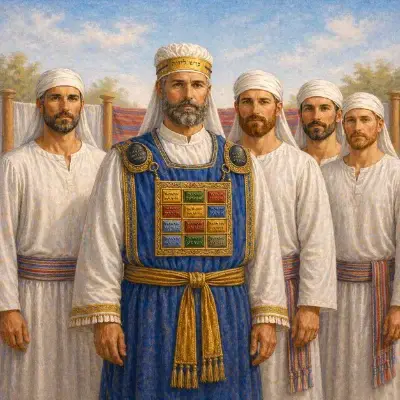
Exodus 28 turns from the structure of the sanctuary to the men who will serve within it. Yahweh appoints Aaron and his sons as priests and commands garments that mark them as set apart for His presence. Every detail shows that the priest represents Israel before God, bearing their names and carrying their guilt. The chapter teaches that approaching Yahweh requires not only sacrifice, but a mediator appointed and prepared according to His word.
Exodus 28 Explained: The Priestly Garments and the Representation of Israel
Exodus 28 continues the sanctuary instructions by turning from the structure of the tabernacle to the men who serve inside it. The previous chapter described the courtyard and the bronze altar where Israel brings its sacrifices. This chapter explains how the priest who ministers in Yahweh’s dwelling must be clothed.
The chapter begins with Yahweh calling Aaron and his sons to serve as priests. Aaron, Nadab, Abihu, Eleazar, and Ithamar are brought near from among the sons of Israel to minister before Him. Moses does not appoint the priests and the people do not select them. Yahweh calls the men who will stand before Him.
The role is described as an honour. The priest approaches the dwelling place of the living God and serves there on behalf of the nation. No man takes this role for himself.
Aaron’s clothing is described as holy garments made for glory and for beauty. In Scripture, the word holy refers to something that belongs to Yahweh and is set apart for His use. These garments mark the priest as a man who serves in the presence of God.
The craftsmen who make the garments are described as wise at heart, men whom Yahweh has filled with the spirit of wisdom. The same God who revealed the pattern of the sanctuary now provides the skill required to produce the garments worn inside it.
The materials used for the garments match those used throughout the sanctuary: gold, blue, purple, scarlet yarn, and fine linen. The priest ministers inside Yahweh’s dwelling clothed in the same colours that surround it.
The ephod forms the central garment of the high priest. It hangs from the shoulders and holds two engraved stones, each carrying the names of six tribes of Israel. When Aaron enters the sanctuary he carries the people with him. Yahweh explains that the stones serve as a remembrance before Him. The priest appears before God representing the nation whose names he bears.
The breastpiece forms the next major part of the priest’s clothing. It rests over the priest’s chest and is called the breastpiece of judgment. Twelve stones are set into it, each engraved with the name of one of the tribes of Israel. Aaron therefore carries the names of the sons of Israel over his heart when he comes before Yahweh. The tribes are carried on his shoulders and over his heart as he enters the holy place.
Inside the breastpiece are placed the Urim and the Thummim. These are connected with seeking Yahweh’s judgment for the nation. Scripture does not describe their form or explain how they function, which stands out in a chapter that gives detail for nearly every other part of the priest’s clothing.
The text never provides enough detail to reproduce these objects or use them independently. Their names give some indication of their purpose. Urim is related to light, and Thummim to completeness or integrity. When the priest seeks Yahweh’s decision, the answer comes from Him. What is hidden is brought into the light and the true judgment is made known.
The lack of description guards against misunderstanding. The Urim and Thummim do not generate answers. The priest brings the matter before Yahweh, and Yahweh gives the judgment. This stands in contrast to the surrounding nations, who practised divination and sought hidden knowledge through rituals and objects. Yahweh later forbids such practices. Israel does not seek knowledge through technique. The priest stands before Yahweh, and Yahweh answers.
The chapter then describes the robe worn beneath the ephod. This robe is made entirely of blue. Around its hem are pomegranates made from blue, purple, and scarlet yarn, together with bells of gold arranged in an alternating pattern.
When Aaron enters the holy place and when he leaves, the bells produce sound. His movement inside the sanctuary is heard as he ministers before Yahweh. The pomegranates between the bells add imagery of fruitfulness and abundance. The hem of the robe combines sound and life as the priest ministers before God.
The next object described is the plate of pure gold fastened to the priest’s turban. The plate carries an inscription declaring that the priest is holy to Yahweh. This rests on Aaron’s forehead when he enters the sanctuary. The priest appears before God marked by holiness.
Yahweh explains the reason for this. Aaron bears the iniquity connected with the holy things offered by the sons of Israel. Even the gifts that the people dedicate to Yahweh are affected by sin. The priest carries that guilt so that the offerings may be accepted before Him.
The chapter then describes the tunic of fine linen together with the turban and sash that complete Aaron’s clothing. These garments form the inner layer beneath the more elaborate pieces already described.
Aaron’s sons also receive garments. They wear tunics, sashes, and caps as they minister alongside him. Their clothing is also described as being made for glory and for beauty. The priesthood belongs to Aaron and his sons together, who serve before Yahweh.
The chapter concludes with linen undergarments worn beneath the priestly garments. These cover the body from the waist to the thighs. When the priests approach the altar or enter the tent of meeting, their nakedness must not be exposed. If they enter improperly, they incur guilt and die.
Exodus 28 shows what must happen for Israel to approach Yahweh. The man who ministers in His house must appear as Yahweh has commanded. The priest enters the sanctuary carrying the people before Him, seeking Yahweh’s judgment for them, and bearing the guilt connected with their offerings.