
Exodus 32
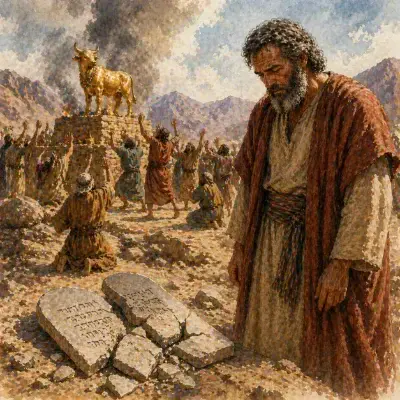
Exodus 32 records Israel’s sin while Moses is on the mountain receiving Yahweh’s covenant and instructions. The people turn from the unseen God and make an idol, calling it a feast to Yahweh while breaking His command. The covenant is shattered, judgment falls, and Moses intercedes as mediator, yet cannot bear the people’s sin himself. The chapter exposes the central problem: Yahweh has promised to dwell among Israel, but they are a sinful people who cannot keep the covenant.
Exodus 32 Explained: The Golden Calf and the Breaking of the Covenant
Exodus 32 shows what happens while Moses is on the mountain receiving the covenant and the instructions for the tabernacle. While Yahweh speaks about dwelling among Israel, the people at the foot of the mountain make an idol. The chapter sets Yahweh’s word against mankind’s sin.
The chapter begins with the people seeing that Moses delays in coming down from the mountain. Their response is immediate. They say to Aaron, “Make us gods who will go before us; as for this Moses, we do not know what has become of him.” The issue is not only that Moses is gone. They refuse to trust the unseen God and demand something visible to lead them.
Aaron tells them to bring their gold, and he fashions it with a graving tool and makes a molten calf. He builds an altar before it and proclaims, “Tomorrow shall be a feast to Yahweh.” The people offer burnt offerings and peace offerings and hold a feast.
This shows that Israel has not abandoned religion. They are active in sacrifice and celebration, and Aaron uses the name of Yahweh. The sin is that they worship Yahweh through an image, which He has already forbidden. Worship is not defined by sincerity or activity, but by obedience to Yahweh’s word.
The text then shifts to the mountain. While the people worship the calf, Yahweh tells Moses, “Go down at once, for your people have corrupted themselves.” He says they have quickly turned aside from the way He commanded them. What the people call a feast, Yahweh calls corruption.
Yahweh calls them a stiff-necked people and declares that He will consume them and make a great nation from Moses. The covenant is broken almost immediately after it is given. The law reveals what is in their hearts rather than producing obedience.
Moses then intercedes. He appeals to Yahweh’s work in bringing Israel out of Egypt, to His reputation among the nations, and to His promises to Abraham, Isaac, and Israel. Moses does not claim the people are innocent. He pleads on the basis of Yahweh’s covenant promises.
Yahweh relents from the destruction He had declared. Israel is spared because of His promises and because a mediator stands between Him and the people.
Moses then comes down from the mountain with the two tablets of the testimony. The text emphasises that the tablets are the work of God, written by His own hand. When Moses sees the calf and the dancing, he throws the tablets from his hands and shatters them. This visibly declares that the covenant has been broken.
Moses destroys the calf completely. He burns it, grinds it to powder, scatters it on the water, and makes the sons of Israel drink it. The idol cannot save itself. It is reduced to dust and becomes part of their judgment.
Moses then confronts Aaron. Aaron blames the people and claims that the calf came out of the fire by itself. The text has already stated that he made it. Aaron refuses to take responsibility.
The situation is then made clear. Aaron has let the people get out of control. This is significant because Aaron is to be Israel’s first high priest. The one who will represent the people before Yahweh is himself a sinner who led them into idolatry. The priesthood is flawed from the beginning.
Moses stands at the gate of the camp and calls, “Whoever is for Yahweh, come to me.” This divides the people. The sons of Levi gather to him and are commanded to execute judgment in the camp. About three thousand men fall that day.
Moses then says that they are set apart to Yahweh because they chose loyalty to Him over family. The covenant creates a division between those who are for Yahweh and those who are not.
The next day Moses tells the people they have committed a great sin and that he will go up to Yahweh to seek atonement. He confesses their sin and says, “If You will forgive their sin—but if not, please blot me out from Your book.”
Moses offers himself in their place, but Yahweh responds that each sinner will bear his own guilt. Moses cannot take their sin upon himself.
Yahweh then tells Moses to lead the people on and says that His angel will go before them, but He will punish them for their sin. The chapter ends with Yahweh striking the people because of the calf.
Exodus 32 shows the covenant being broken almost immediately. It shows that false worship is sin, that sin brings judgment, that a mediator is necessary, and that even the priesthood is flawed. It also shows that atonement is needed, but Moses cannot provide it.
The chapter leaves a pressing question. Yahweh has promised to dwell among Israel, but Israel is sinful. How can a holy God dwell among a sinful people without destroying them?