
Genesis 23
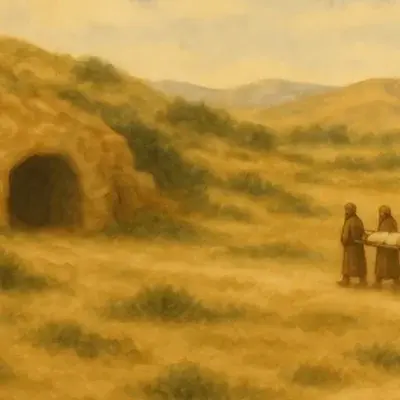
Genesis 23. Sarah dies in the land of Canaan, and Abraham buys a burial site—as a man of faith laying claim to the land Yahweh swore would be his. This chapter is more than a funeral—it’s a down payment on the inheritance to come.
A Grave in the Promised Land – Abraham Buries Sarah in Faith
Sarah’s death at the start of Genesis 23 marks an important moment in the life of Abraham.
She is the only woman in Scripture whose age at death is recorded, and her 127 years affirm her importance in the covenant story.
As the mother of Isaac, the child of promise, her death closes a chapter in the unfolding plan of God.
What follows is not a reflection on grief. It is a careful account of land, ownership, and burial.
This chapter never mentions Yahweh by name. Yet beneath the surface, God’s covenant promises are still unfolding. The Covenant God may seem absent, but His word is quietly being fulfilled.
The entire chapter is focused on one thing: Abraham securing a burial site for Sarah.
That may seem like a side detail in the wider story of Genesis, but it is not. Abraham has been promised all the land of Canaan, but to this point, he owns none of it. He lives in tents. He moves from place to place.
Now, with Sarah’s death, he seeks a permanent possession in the land. This is the first time Abraham acquires legal ownership of any part of the promised land.
The way the transaction is described, carefully, publicly, and in detail, shows how much it matters.
Abraham wants no favours and no future dispute. He refuses to accept the land as a gift and instead insists on paying full price.
This is not just a burial. It is the first downpayment on the land that Yahweh promised him back in chapter 12.
The conversation with the sons of Heth takes place at the city gate, the place of legal decisions and public agreements. Abraham shows respect to the people of the land, bowing before them and acknowledging his status as a sojourner and foreigner.
They respond with honour, calling him a “mighty prince,” or more precisely, “a prince of God.” Though it is not clear which god they had in view, the phrase may still carry real theological weight. Like Abimelech earlier, they seem to recognise that Abraham stands under divine favour. In any case, they offer him the choice of their burial places.
But Abraham has something specific in mind: the cave of Machpelah, owned by Ephron the Hittite. He asks to buy it, not borrow it.
He wants it transferred to him “for a possession of a burial site.” The repetition of that phrase, “possession of a burial site,” throughout the chapter draws attention to the central concern: legal ownership.
The field lies adjacent to Mamre, where Abraham had previously pitched his tent and built an altar to Yahweh, so the location is deeply tied to his life of worship.
By securing this site, he ensures that he can approach the burial place directly from his dwelling without crossing another man’s land. Abraham is planting his claim in the land God promised, and he is doing it in a way that cannot be undone.
Ephron at first offers the field and cave as a gift, which sounds generous but in context was likely a form of negotiation.
Abraham refuses.
He wants a clean, formal purchase.
So Ephron names a price, “four hundred shekels of silver,” but does so in a way that implies it is trivial between men of honour. In reality, this was likely far more than the land was worth.
But Abraham accepts the offer without haggling.
This is striking. He does not negotiate. He does not push back.
Instead, he weighs out the full amount of silver in the hearing of witnesses.
Why? Because he is not trying to get a good deal. He is establishing a permanent, undisputed claim.
The fact that he paid the full 400 shekel asking price would be remembered for generations. The field is his, legally, publicly, and irrevocably.
This moment also shows a shift. Abraham had earlier trusted Yahweh’s promise by leaving his homeland and living as a nomad. Now he trusts the same promise by purchasing a tomb. Burial in this land expresses his hope in the future.
He could have sent Sarah’s body back to Haran, where their family came from. But he does not. He buries her here, in Canaan, because this is the land God promised.
He believes his descendants will one day live here, and he wants to be buried among them.
The New Testament reflects on this kind of hope in Hebrews 11:13, saying that the patriarchs died in faith, not having received the things promised, but having seen them from afar and greeted them.
It is worth noticing that burial, not cremation or scattering of ashes, is the pattern in Scripture.
Abraham’s careful handling of Sarah’s burial reflects a belief in the body’s significance and a future hope. The grave is not the end. The dead will rise.
Later, Abraham himself will be buried in the same tomb, along with Isaac, Rebekah, Jacob, and Leah.
This burial site becomes a symbol of faith in God’s promises.
Even in death, they are tied to the land of promise.
Throughout this episode, Abraham is acting in line with the promises of God, securing a piece of the land for the future generations who will inherit it.
While the name of Yahweh is absent from this chapter, Genesis 23 is a strong affirmation of the covenant promises. It reminds us that God’s faithfulness does not depend on dramatic signs.
Sometimes it unfolds in legal agreements, silver weighed out in public, and graves dug in the land of promise.
This chapter ends with Sarah buried in Canaan and Abraham owning a field. It may seem small, but it is the first real foothold of the covenant people in the land.
What began with the promise of land back in Genesis 12 is now grounded in actual soil. The child of promise has come through Sarah, and now she is laid to rest in the land God swore to give.
Abraham’s trust in Yahweh is expressed not just by moving out in faith, but by purchasing land and burying his wife in the land God promised.
The land of Canaan is still filled with other nations, but one field, one cave, one burial site now bears witness to the covenant of Yahweh. Genesis 23 prepares us for the long, slow, faithful unfolding of that promise, a promise that will not fail.