
Genesis 35
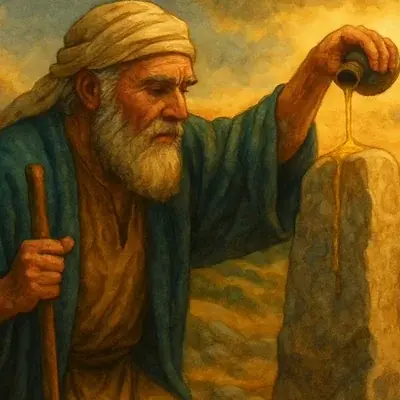
Genesis 35 records Jacob’s return to Bethel, the place where God first appeared to him in his flight from Esau. Here God commands Jacob to build an altar, his household buries their idols, and God Almighty reaffirms His blessing with the promise of nations and kings.
Jacob Returns to Bethel, God Blesses, Reuben Sins, Isaac’s Death
Genesis 35 opens with God’s command to Jacob to return to Bethel, the place where he met Him in his flight from Esau. “Arise, go up to Bethel and live there, and make an altar there to God, who appeared to you when you fled from your brother Esau.”
This divine call is more than geographical. The mention of an altar recalls Jacob’s earlier vow at Bethel, when Jacob was alone and fearful for his life, and he had promised that Yahweh would be his God. Now God commands him to return to that very place and worship. This is not Jacob deciding to return. This is God giving a command, ensuring that the promise given decades earlier will not fade from memory. Now Jacob is being called to return and keep his vow.
Jacob responds by commanding his household to put away foreign gods, cleanse themselves, and change their garments. The very fact that such gods were present shows that the household is not wholly devoted to Yahweh. We are not told where the idols came from, but there are two likely candidates. They could be Rachel’s stolen idols, or they could be the spoils from Shechem in Genesis 34. However, we do not have to guess whether it is one or the other. It is most likely both.
Regardless of their origin, these idols have been present in the house of the family that is supposed to worship God alone, and Jacob knows they should not be there. So Jacob calls his household to purify themselves. He gathers up the idols and buries them under an oak near Shechem. He does not destroy them.
Jacob’s action exposes divided loyalty. He is not burying them as one might bury someone who has died. He is burying them as a treasure that may one day be dug up again.
The point is not Jacob’s perfect obedience and wholehearted devotion, but God’s sovereign mercy. Though Jacob’s household is compromised, God acts to protect them. As the family travels toward Bethel, terror from God falls upon the surrounding cities, and none pursue them. Their survival is not secured by their purity, but by God’s power. His chosen people are preserved not by their righteousness, but by His sovereign choice.
At Bethel, Jacob builds the altar as commanded, naming the place El-Bethel, the God of Bethel, because here God revealed Himself. This is the same place Jacob prayed and vowed to serve God if only He would be with him and bring him back safely. True to His promises, He is the one who answered Jacob in the day of distress and has been with him wherever he has gone.
Jacob acknowledges that his survival has always been due to divine faithfulness, not his own craft. Yet grief mingles with this moment. Deborah, Rebekah’s nurse, dies and is buried beneath an oak named Allon-bacuth, oak of weeping.
Rebekah herself receives no recorded burial, her silence echoing her earlier words when she took the curse upon herself in Isaac’s deception. Whatever the reason, Deborah is honoured with an obituary. Rebekah is not. Even here, the narrative reminds us that God’s promises continue not because of human worthiness, but because of His sovereign hand.
The centre of the chapter comes when God appears again and confirms Jacob’s identity. The renaming to Israel, first spoken in the night of wrestling, is now reaffirmed in a divine appearance. God identifies Himself as El Shaddai, God Almighty, the same title first spoken to Abram, declaring His sovereign authority to bring forth nations and kings.
He declares fruitfulness, the birth of nations, the rise of kings, and the gift of the land to Jacob and his seed. Here, the promises spoken to Abraham and Isaac are explicitly passed on. The blessings are upheld by God’s word, enforced by His authority, and guaranteed by His power. Jacob’s pillars, his drink offering, and his anointing with oil are outward acts of worship in response to God’s declaration.
The promises are secure because they rest on Him. However, this does not mean God’s people have lives free from pain and suffering. God’s hand of protection does not spare His people from grief, but it carries His promises through every loss.
Rachel dies in childbirth on the way to Ephrath, naming her son Ben-oni, son of my sorrow. Jacob renames him Benjamin, son of my right hand, preserving the child’s place of honour and lifting his destiny above grief. Even in the loss of his beloved wife, Jacob sees God bringing the promised increase.
Rachel’s death is marked with a pillar of remembrance. Standing beside the pillar that marked God’s promise at Bethel, the pairing of these stones captures the reality of life. Even the life of those who worship God, blessing and grief, promise and loss, bound together as God works out His purposes.
Even those chosen and blessed by God are not immune from suffering.
The next scene records Reuben’s sin with Bilhah, Jacob’s concubine. The act is presumptuous, as if the firstborn were seizing authority while his father yet lived. The text offers no extended comment, simply noting that Israel heard.
Judgment will come later when Jacob denies Reuben the rights of the firstborn. For now, the text moves immediately to list the twelve sons of Jacob. The nation and assembly of nations that God promised to Abraham is beginning to take shape.
The chapter concludes with the death of Isaac at Hebron, gathered to his people at 180 years and buried by Esau and Jacob together. Just as Isaac and Ishmael buried Abraham, the divided sons unite in death to bury their father.
These deaths serve to wrap up Jacob’s role in the book of Genesis. Abraham is gone. Isaac is gone. But God’s promises continue through Jacob, the one named Israel. After Genesis 36, the remainder of the book will be devoted to the sons of Israel.
Taken as a whole, Genesis 35 is about God fulfilling His promises. Every scene, whether it highlights weakness, grief, or sin, is drawn into that purpose. The idols buried at Shechem show the family’s divided heart, yet God protects them anyway. The deaths of Deborah and Rachel show the reality of grief and loss, yet God still moves His chosen people toward the fulfilment of His promise.
Reuben’s sin shows the corruption even within the chosen household, yet God establishes the full number of twelve sons. The burial of Isaac marks the close of an era, yet the promises of God carry on unbroken.
At the heart of the chapter is God Almighty, who asserts His authority by blessing Jacob and promising that nations and kings will arise from his line. The central truth is that His promises do not depend on man’s righteousness, but on His sovereign choice. He is the God who appeared, the God who commanded, the God who protected, the God who blessed, and the God who will bring His word to pass.