
Exodus 29
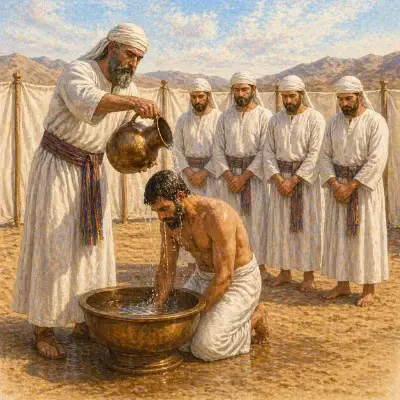
Exodus 29 sets out Yahweh’s instructions for the consecration of the priesthood. The garments alone are not sufficient. The priest must be washed, atoned for, anointed, and set apart through sacrifice. Every step shows that even the mediator must first deal with his own sin before he can serve on behalf of the people. The chapter culminates in the command for continual offerings, establishing that ongoing atonement is required if Yahweh is to dwell among Israel.
Exodus 29 Explained: Instructions for the Consecration of the Priests and the Continual Sacrifices
Exodus 29 continues the sanctuary instructions by turning from the garments of the priest to the instructions for the ceremony that will establish the priesthood. The garments described in the previous chapter are for glory and for beauty, and they mark the priest as set apart for the service of Yahweh. But the garments do not make a man fit to stand before God. The man himself must be washed, atoned for, anointed, and consecrated.
The chapter begins with Yahweh giving Moses instructions for the consecration ceremony, which will later be carried out in Leviticus 8. A bull and two rams without blemish are to be taken, together with unleavened bread made from fine wheat flour. Some of the bread is mixed with oil and some is spread with oil, and all of it is brought together in a basket. The ceremony is prepared in careful detail because the priesthood exists entirely according to Yahweh’s command.
Aaron and his sons are to be brought to the doorway of the tent of meeting and washed with water. The men who will stand before Yahweh must first be cleansed. Aaron is then to be clothed with the garments described in Exodus 28, and Moses is to pour anointing oil on his head. This marks Aaron as chosen and set apart. The priesthood begins with Yahweh’s appointment.
Aaron’s sons are also to be clothed with tunics, sashes, and caps. The priesthood is declared to belong to Aaron and his sons by a perpetual statute. From this point forward the priestly office will remain within his family. The priests come from the tribe of Levi, and the ministry before Yahweh is to continue from generation to generation.
Once the priests are clothed and anointed, the sacrifices are to begin. The first offering is a bull as a sin offering. Aaron and his sons are to lay their hands on its head, identifying with the sacrifice. The bull stands in their place. Its blood is placed on the horns of the altar and poured at its base, while the fat is burned on the altar. The rest is burned outside the camp. Even the priest must begin with atonement.
The next sacrifice is the first ram, to be offered as a burnt offering. The entire animal is burned on the altar as a soothing aroma to Yahweh. This offering signifies complete dedication. The priest who serves before Yahweh belongs entirely to Him.
The second ram is the ram of ordination. Aaron and his sons again lay their hands on it, but this time the blood is applied directly to them. Moses is to place blood on the lobe of the right ear, the thumb of the right hand, and the big toe of the right foot. The ear represents what the priest hears, the hand what he does, and the foot the path he walks. His whole life is to be marked by the blood of the sacrifice.
Blood from the altar is then to be mixed with anointing oil and sprinkled on Aaron, his garments, and the garments of his sons. Both the priest and his clothing are set apart as holy. The garments represent the office that stands before Yahweh on behalf of Israel.
The ram of ordination also introduces the wave offering. Portions of the ram and the unleavened bread are to be placed in the hands of Aaron and his sons and waved before Yahweh. After being presented, they are placed on the altar. Other portions are given to the priests as their food. Those who serve at the altar are sustained by the offerings brought before Yahweh.
The ceremony is to conclude with a sacred meal. The flesh of the ram is to be boiled in a holy place, and Aaron and his sons are to eat it at the doorway of the tent of meeting with the bread. They eat the things by which atonement is made to consecrate them. No one else may eat this food, and whatever remains until morning must be burned because it is holy.
The consecration is to last for seven days. Each day a bull is to be offered as a sin offering, and the altar itself is purified and anointed. At the end of the seven days the altar becomes most holy. This seven-day pattern reflects the order of creation. A new order of life is being established within Israel.
Once the priests and the altar are consecrated, regular worship is to begin. Yahweh commands that two lambs be offered every day, one in the morning and one at twilight, each with a grain and drink offering. The altar is to burn continually before Yahweh. Worship is constant, not occasional.
The purpose of these continual offerings is then explained. Yahweh declares that the sacrifice will be made at the doorway of the tent of meeting, where He will meet with His people and speak to them. His glory sanctifies the tent, the altar, and the priesthood.
The chapter ends with a declaration of covenant purpose. Yahweh will dwell among the sons of Israel and be their God. They will know that He is Yahweh who brought them out of Egypt so that He might dwell among them.
Exodus 29 lays the foundation of Israel’s worship. Yahweh gives the instructions for the priesthood, and the priests themselves require atonement before they can minister for others. The shedding of blood marks every part of their service. Sacrifices are to continue because the need for atonement remains constant. Through these instructions, Yahweh provides the means by which He will dwell among the people He has redeemed.