
Exodus 39
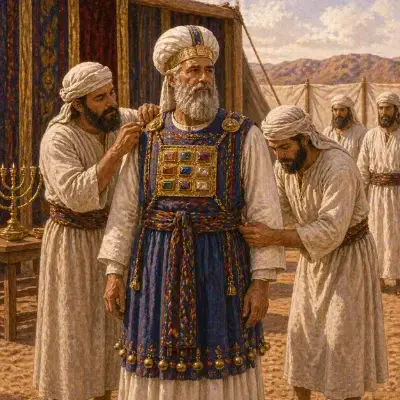
Exodus 39 records the making of the priestly garments, completed exactly as Yahweh commanded Moses. The high priest bears the names of Israel before Yahweh, clothed in garments made for glory and for beauty, yet still dependent on atonement and mediation. The chapter concludes with Moses examining the finished work and blessing the people, showing that everything has been done according to Yahweh’s word and is ready for His dwelling among them.
Exodus 39 Explained: The Priestly Garments Completed in Obedience
Exodus 39 records the making of the priestly garments, just as Yahweh had commanded Moses in Exodus 28. The chapter does not introduce new designs or new instructions. It shows the creation of what Yahweh had spoken. Yahweh’s Spirit is at work in the craftsmen whom He had filled with skill, men whom He had called by name for this purpose. What they make is done ‘as Yahweh commanded Moses,’ a repeated statement that explains the meaning of the chapter. All the garments are made in careful obedience to the word of Yahweh.
The chapter begins with the garments for the priests ministering in the holy place and the holy garments for the high priest, Aaron. The ephod is made of gold, blue, purple, and scarlet material, and fine twisted linen. Gold is hammered into thin sheets and cut into threads so that it may be woven into the fabric. Two onyx stones are set on the shoulder pieces, engraved with the names of the sons of Israel, six names on one stone and six on the other, according to their birth. When Aaron comes before Yahweh, he bears the names of the sons of Israel on his shoulders for a memorial before Yahweh continually. The priest therefore represents the people before God. He does not come in his own name, but in the name of the tribes of Israel.
The breastpiece is made next, set with twelve stones in four rows, each stone engraved with the name of one of the tribes of Israel. The breastpiece is attached to the ephod with gold chains and blue cords so that it will not come loose. The breastpiece rests over Aaron’s heart when he goes in before Yahweh. The priest therefore bears the names of the sons of Israel on his shoulders and over his heart when he comes into the presence of God. He carries the people before Yahweh in the place of representation and intercession.
The robe of the ephod is made entirely of blue, with an opening at the top reinforced so that it will not tear. Around the hem of the robe are pomegranates made of blue, purple, and scarlet material, with bells of gold between them all around the hem. The bells will sound when Aaron ministers, so that he will not die when he goes into the holy place before Yahweh and when he comes out. The sound of the bells announces his approach as he ministers before Yahweh, a reminder that no man comes silently or casually into the presence of the holy God.
Tunics of fine linen are made for Aaron and his sons, along with the turban, caps, linen undergarments, and the sash of blue, purple, and scarlet material. These garments are made for glory and for beauty, set apart for those who will serve in the presence of Yahweh. The priest does not choose how he will appear before God. Even his clothing is determined by Yahweh’s command.
These garments are glorious and beautiful, but the garments themselves do not remove sin or make the priest acceptable before Yahweh. Before Aaron can serve, he must be washed, atonement must be made for him, and he must be ordained. The garments clothe the priest for his office, but sacrifice and consecration are what allow him to come near and minister before Yahweh.
Finally, the plate of pure gold is made and engraved with the words, “Holy to Yahweh.” It is fastened on a blue cord to the turban, on the front of it. This plate rests on Aaron’s forehead as he ministers. In Exodus 28, Yahweh explained its meaning: Aaron bears the iniquity of the holy things which the sons of Israel consecrate. Even the offerings of the people are not pure in themselves. The priest stands before Yahweh on behalf of the people, bearing their guilt even in their worship.
The chapter ends with all the work of the tabernacle and the priestly garments being finished. The sons of Israel bring all the work to Moses: the tent, the furniture, the utensils, and the garments. Then Moses examines all the work and sees that it has been made just as Yahweh commanded and he blesses the people.
This final scene is important. Yahweh had commanded the work. The Spirit-filled craftsmen carried out the work. Moses, the mediator, examines the work and sees that it matches the command of Yahweh. Then Moses blesses the people. The work of the tabernacle and the priestly garments is complete, and it has been done in obedience to Yahweh’s word.
There is an important echo here of Genesis. In Genesis, Yahweh finished His work, saw all that He had made, and blessed. Here in Exodus, the work of the tabernacle is finished, Moses sees all the work and that it has been done as Yahweh commanded, and Moses blesses the people. The pattern is the same: command, work, completion, inspection, and finally, blessing. In Genesis, Yahweh formed the world as the place where He would dwell with mankind. Here, Israel constructs the tabernacle as the place where Yahweh will dwell in the midst of His people. The tabernacle is therefore a dwelling place of God among men, a guarded and holy place like Eden, but now in the midst of a sinful people and approached only through sacrifice and priesthood.
Exodus 39 concludes with everything prepared and waiting. The garments for Aaron and his sons are finished, and the tabernacle and its furnishings are finished. Everything has been made just as Yahweh commanded. Moses, the mediator, has examined the work, seen that it is good, and has blessed the people. Now they must wait for the word of Yahweh.