God
What does the Bible say about God?
The God of Scripture is not a philosophical concept or a religious ideal. He is a person who speaks, acts, creates, judges, redeems, and keeps his word. The Bible does not begin with arguments for God’s existence; it begins with God acting: “In the beginning, God created the heavens and the earth.” Everything that follows flows from who this God is.
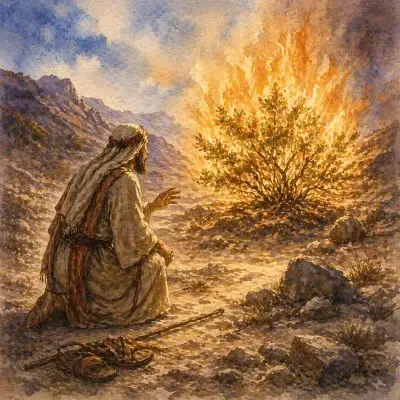
His name in the Old Testament is Yahweh: the personal covenant name he revealed to Moses at the burning bush. It means something like “I am who I am” or “I will be what I will be.” It is a name that defies full definition. What it points to is God’s absolute self-existence, his freedom from any dependence on creation, and his personal commitment to be present with his people in ways that will be revealed as history unfolds. Every time the LSB uses “Yahweh,” it is a reminder that the God who acts is not an abstract force but a specific person who has named himself and bound himself to his people.
The character of Yahweh is revealed through his acts in history. He is holy: utterly set apart from sin and from all that opposes his nature. He is righteous: he always acts in accordance with what is right. He is faithful: he keeps every word he has spoken. He is merciful: he does not deal with his people as their sins deserve. These are not separate attributes balanced against each other but the unified character of the one God who governs all things.
Does the Bible offer proof that God exists?
Scripture never sets out to argue for God’s existence as though it were an open question awaiting a verdict. It simply assumes it, from the first sentence onward. Paul explains why in Romans: “since the creation of the world His invisible attributes, both His eternal power and divine nature, have been clearly seen, being understood through what has been made, so that they are without excuse” (Romans 1:20). The created world itself is treated as sufficient evidence, not a neutral fact requiring separate proof. That is why the psalmist can describe denying God’s existence not as an honest intellectual conclusion but as folly: “The wicked fool says in his heart, ‘There is no God’” (Psalm 14:1). Scripture’s approach to God’s existence is not to construct an argument mankind was missing, but to name the refusal to see what has already been made plain.
What are God’s attributes?
Alongside his moral character, holy, righteous, faithful, merciful, Scripture describes attributes that belong to God alone. He is eternal, without beginning or end: “Before the mountains were born, or You brought forth the earth and the world, even from everlasting to everlasting, You are God” (Psalm 90:2). He is the source of all wisdom and power, not a being who acquired them. He does not change, and he does not need anything outside himself to be complete. Every attribute Scripture assigns to God describes what he has always been, not what he became. Follow how this theme develops through the Bible.