
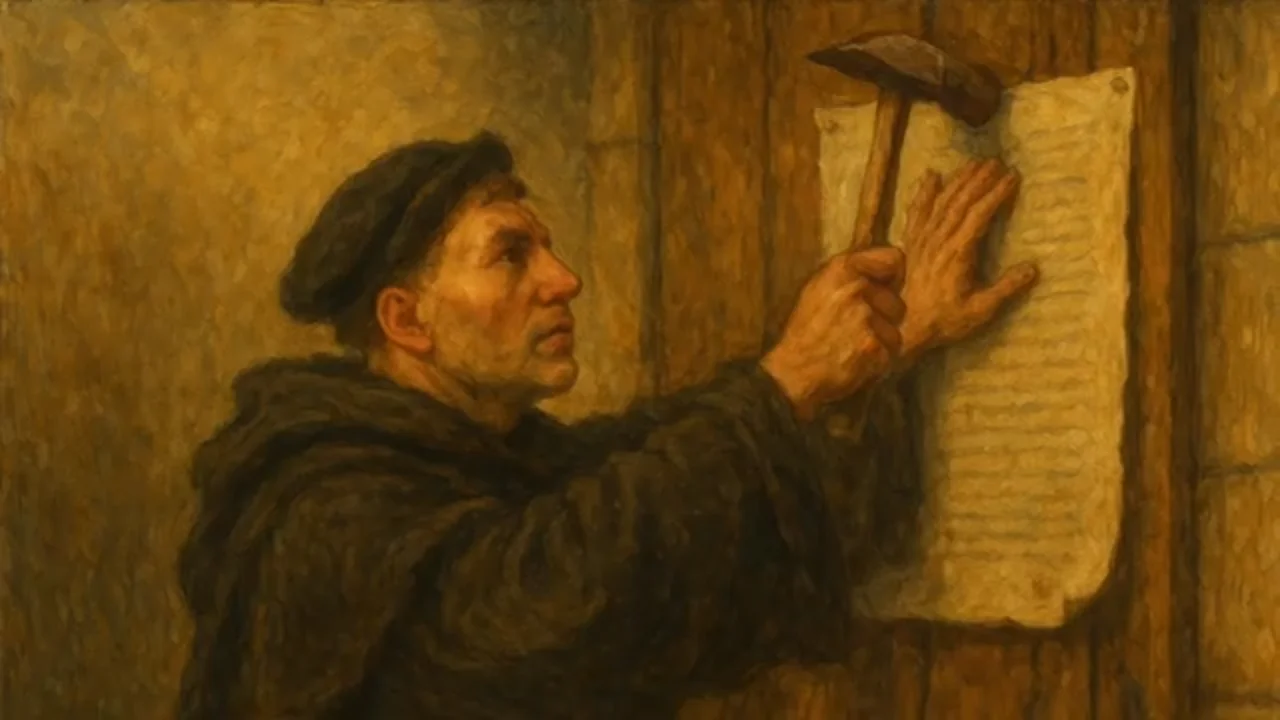
The Reformers risked their lives because they knew the gospel had been obscured. Their work was not a political revolt but a call back to biblical truth. What they recovered still matters today: the same gospel that justifies the ungodly and brings peace with God through Jesus Christ. Every generation must hold fast to this truth, for as Paul wrote, “the gospel… is the power of God for salvation to everyone who believes” (Romans 1:16).
What Had Gone Wrong?
By the sixteenth century, the Western church had drifted far from the gospel of the New Testament. Salvation was taught as something partially earned — through penance, indulgences, pilgrimages, and the merit of saints. The Bible was kept from ordinary people, read only in Latin, and interpreted exclusively through the authority of the Pope and church councils. The clear scriptural teaching that sinners are justified before God by faith alone, on account of Christ alone, had been buried under centuries of tradition.
It was not that the Reformers invented something new. They recovered something ancient — the gospel itself, as proclaimed by Paul, Augustine, and the apostles before them.
Luther and the Rediscovery of Grace
When Martin Luther, an Augustinian monk and Bible professor in Wittenberg, began reading Paul’s letter to the Romans, he came face to face with words that shattered his religious world: “the righteous shall live by faith” (Romans 1:17). Luther had been trying to earn peace with God through religious effort. He found none. But as he studied Scripture, he discovered that justification — being declared righteous before God — is not something you achieve. It is something God gives, freely, to those who trust in Christ.
This discovery was not merely academic. It was personal, urgent, and explosive. Luther’s Ninety-Five Theses in 1517 challenged the sale of indulgences — the practice of paying for the forgiveness of sins. What began as a dispute over church abuses became a battle over the gospel itself.
Five great statements came to summarise what the Reformers recovered. Each begins with the Latin word Sola, meaning alone — Scripture alone, faith alone, grace alone, Christ alone, and to the glory of God alone. Together they tell the story of how the gospel was rediscovered.
Sola Scriptura — Scripture Alone
The first of the five was about authority. The Roman Church taught that divine authority came from both Scripture and Church tradition, with the Pope as the final interpreter of both. But this gave ultimate power to men rather than to the Word of God. Over time, human decrees and traditions began to outweigh what God had actually spoken. People were told they could not understand the Bible for themselves, and the truth was kept in Latin — locked away from ordinary believers.
The Reformers pushed back, saying that the Bible alone is God-breathed, sufficient for all faith and practice, and clear in its main message. 2 Timothy chapter 3 verses 16 and 17 says, “All Scripture is God-breathed and profitable for teaching, for reproof, for correction, for training in righteousness, so that the man of God may be equipped, having been thoroughly equipped for every good work.”
This truth means that every teaching, every tradition, and every human opinion must be tested by Scripture, never the other way around. The church does not stand above the Word of God — it stands under it. The Bible is the voice of the living God, and when it speaks, God speaks.
This is why Luther stood before the Emperor and said, “My conscience is captive to the Word of God.” Sola Scriptura is the foundation of the Reformation, because once the Bible alone is recognised as the ultimate authority, all the other truths fall into place.
Sola Fide — Faith Alone
The second great truth was about how a sinner is justified — that is, declared righteous before God. The Roman Church taught that justification was a process. Grace, they said, was infused through the sacraments. You were justified by cooperating with that grace, by doing good works, and by making satisfaction for your sins. You could lose that grace through mortal sin, and regain it by confession, penance, and the Mass.
But the Reformers saw that this system contradicted the clear teaching of Scripture. Romans chapter 3 verse 28 says, “For we maintain that a man is justified by faith apart from works of the Law.” Justification is not a lifelong process of becoming righteous — it is a once-for-all declaration by God that the sinner who believes in Christ is counted righteous in His sight.
Faith is not a work we perform; it is the empty hand that receives Christ and His righteousness. Through faith, God credits to us the perfect obedience of His Son, and our sins are laid upon Him at the cross. That is what the Bible means when it says in 2 Corinthians chapter 5 verse 21, “He made Him who knew no sin to be sin on our behalf, so that we might become the righteousness of God in Him.”
Faith alone was the heartbeat of the Reformation. Luther called it the article by which the Church stands or falls. To add works, sacraments, or merit to faith is to deny the sufficiency of Christ’s righteousness. Sola Fide proclaims that we are saved by trusting in Christ’s finished work, not by trusting in ourselves.
Sola Gratia — Grace Alone
The third truth of the Reformation answers the question of why anyone is saved at all. The Roman Church taught that grace was like a spiritual power dispensed through the sacraments — a help that enables you to do your part in earning salvation. Grace was made to depend on human cooperation.
The Bible presents grace very differently. Ephesians chapter 2 verses 8 and 9 says, “For by grace you have been saved through faith, and this is not of yourselves, it is the gift of God, not of works, so that no one may boast.” Grace is not a reward for those who try hard; it is the unmerited favour of God toward those who believe.
The Bible teaches that salvation begins with God, continues by God, and is completed by God. From His choosing us before the foundation of the world, to regeneration, to faith, to justification, and all the way to glorification and eternal life — every step is a work of divine grace. We contribute nothing. That is, nothing aside from the sin that made salvation necessary in the first place.
Sola Gratia humbles the proud heart. It tells us that no human effort, no religious ritual, and no moral improvement can bring us one inch closer to God. Salvation is God’s gift from beginning to end. That is why we can have assurance — because what God starts, He finishes.
Solus Christus — Christ Alone
The fourth truth proclaims the central person of the gospel. In the medieval system, people were told they could not come directly to God. They needed priests to mediate, saints to intercede, and Mary to plead for mercy. Christ’s work was said to be applied through the Church’s sacraments, as though what He had done on the cross was incomplete.
The Reformers boldly declared that Christ alone is the Mediator between God and man. Acts chapter 4 verse 12 says, “And there is salvation in no one else, for there is no other name under heaven that has been given among men by which we must be saved.” And Hebrews chapter 7 verse 25 says, “Therefore He is also able to save forever those who draw near to God through Him, since He always lives to make intercession for them.”
This means that everything necessary for salvation has already been accomplished by Jesus Christ. His death satisfied God’s justice. His obedience fulfilled the Law. And His resurrection secured eternal life for all who believe in Him. There is no need for another priest, another sacrifice, or another mediator.
Solus Christus tears down every false altar and exalts the work of Jesus accomplished at the cross. The Reformers risked their lives to say it: Christ is enough. To add anything to His finished work is to deny the very heart of the gospel.
Soli Deo Gloria — Glory to God Alone
The final truth shows the ultimate purpose of everything God has done in salvation. In the medieval church, glory was shared — to God, yes, but also to Mary, to the saints, and to the Pope and the Church itself. Salvation had become man-centred, focused on human effort and religious achievement.
The Reformers saw that this robbed God of His glory. Romans chapter 11 verse 36 says, “For from Him and through Him and to Him are all things. To Him be the glory forever. Amen.” From creation to redemption, everything exists for God’s glory. When salvation is by Scripture alone, by grace alone, through faith alone, in Christ alone — then all glory goes to God alone. That is why these truths fit together. Remove one, and you distort them all. But hold them together, and you have the true gospel, which brings glory to God alone.
Soli Deo Gloria reminds us that the purpose of salvation is not first about us being rescued from hell, but about God displaying His mercy, His power, and His grace in Jesus Christ. The Reformation was not a story of men seeking fame; it was about God reclaiming His glory in His Church.
Why the Reformation Still Matters
The Reformation was not about rebellion or division. It was about the recovery of the gospel — the good news that God gave His only Son, Christ Jesus, who lived the perfect life we could not live, died for our sins, and rose again, so that whoever believes in Him will not perish but have eternal life.
These truths still matter today, because the same false gospel that the Reformers opposed still exists — a gospel of faith plus works, grace plus merit, and Christ plus mediators. The question that shook Europe five hundred years ago is still relevant for all of us: Are we trusting in Christ alone for our salvation?
The Bible says in John chapter 3 verse 36, “He who believes in the Son has eternal life, but he who does not obey the Son will not see life, but the wrath of God remains on him.” This is what the Reformers lived and died to proclaim — that salvation is found in Christ alone. Put your trust in Him, because it is only through Jesus that we find forgiveness, grace, and everlasting life.