
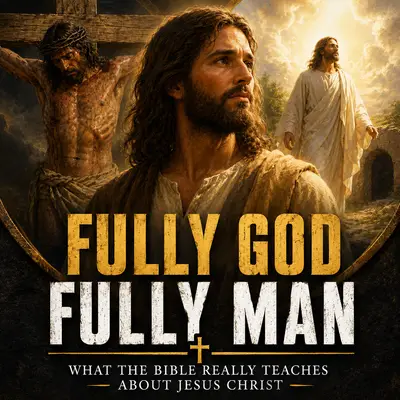
Does the Bible describe Jesus as half man and half God? In ancient mythology, demigods were a mixture of the divine and the human, producing something in between. Is that what the Bible says? The Bible teaches something far more precise and far more profound.
What the Bible Teaches About the Person of Christ
Jesus is one person who is fully God and fully man. Both realities remain completely true at the same time. Neither is watered down, blended into something new, or divided into two separate subjects.
The Apostle John begins his gospel by writing, “In the beginning was the Word, and the Word was with God, and the Word was God” (John 1:1). Then without explanation or softening, he continues: “And the Word became flesh and dwelt among us” (John 1:14). The same eternal subject who is God becomes genuine flesh and blood and lives among us.
Thomas sees the risen Christ, touches the wounds in his hands and side, and says directly, “My Lord and my God” (John 20:28). Jesus accepts that confession without correction. Years later, after the resurrection and ascension, Paul still refers to him as “the man Christ Jesus, the one mediator between God and men” (1 Timothy 2:5). His humanity does not disappear once he is glorified.
The Gospels display this throughout. Jesus becomes exhausted like any other man and falls asleep in the boat while a fierce storm surrounds the disciples. Then he rises and commands the wind and the sea, and they obey him immediately. He stands at the tomb of Lazarus and weeps with real human grief. Then he calls out with divine authority and a man who has been dead four days comes back to life. He is nailed to the cross in genuine weakness and shame, suffering and dying as a man, yet Paul writes that “the rulers of this age crucified the Lord of glory” (1 Corinthians 2:8).
All of these actions belong to the same single person. The New Testament never presents him as two centres of action or as something in between God and man.
From these passages, a clear biblical Christology takes shape. Jesus Christ is one person. He is fully God, as John 1:1, Colossians 2:9, and Thomas’s confession all state directly. And he is fully man, as John 1:14, Hebrews 2:17, and 1 Timothy 2:5 make plain. Both remain true at the same time. His saving work rests on both. As man, he represents us completely before God. As God, his life, obedience, and death carry the full power to save.
What Scripture Does Not Tell Us
The Bible shows us this reality again and again, but it does not explain the internal mechanics of how deity and humanity are united in one person. It requires us to hold what it reveals without reducing it or speaking in ways that contradict any part of it. We are not able to fully comprehend God or his purposes. This should not surprise us, because Scripture itself tells us that there are limits to what we are given to understand, and that God does not explain everything when he speaks. Daniel is told, “Go your way, Daniel, for these words are concealed and sealed up until the end time” (Daniel 12:9). David says, “Such knowledge is too wonderful for me; it is too high, I cannot attain to it” (Psalm 139:6). And God himself says, “My thoughts are not your thoughts, nor are your ways my ways” (Isaiah 55:8).
There are things God has revealed clearly and there are things he has not explained. We are not told to cross that boundary. We must remain within what God has revealed. We are not asked to fully explain the incarnation. We are required to believe what God has revealed, and to refuse to speak about Christ in a way that contradicts it.
The Council of Chalcedon (451 AD)
The moment you try to speak carefully about who Jesus is without denying anything the Bible says, you find yourself facing the same tension that divided the church over 1,600 years ago.
If you emphasise Christ’s oneness too strongly, you risk blurring the real distinction between God and man. If you emphasise the distinction too strongly, you risk dividing him into two acting subjects.
Errors of both kinds appeared early. Some denied his full deity, as seen in Arianism. Others weakened his humanity. Others effectively divided him into two persons, in what later came to be called Nestorianism. These were not minor disagreements. They struck at the heart of the gospel itself.
To address these heresies, the church responded by drawing boundaries to protect the biblical witness rather than to invent new doctrine. This process reached its clearest expression at the Council of Chalcedon in 451 AD.
The council did not attempt to explain how the incarnation works internally. It set limits on how Christ could be spoken about faithfully. Jesus Christ is one person, fully God and fully man, existing in two natures, divine and human, without confusion, without change, without division, and without separation.
The wording was chosen carefully to guard everything the New Testament presents so that nothing would be lost or weakened.
The Split: Eastern Orthodox and Oriental Orthodox
Not everyone accepted that formulation. Large parts of the church, especially in Egypt, Syria, Armenia, and later Ethiopia, rejected the council. These churches became what we now call the Oriental Orthodox churches.
They were not trying to deny that Jesus is fully God and fully man. They insisted on the language of one united nature after the incarnation, drawing from the language of Cyril of Alexandria, because they believed the Chalcedonian expression risked dividing Christ in practice.
The churches that accepted Chalcedon, which later formed the Eastern Orthodox churches, saw the opposite danger. Without a clear distinction between the two natures, the deity and humanity would eventually be blended together, losing the full reality of each as Scripture presents them.
At this point, the disagreement was still theological. But it did not remain there.
When Politics Hardened the Divide
The Roman Empire enforced unity in the church for political stability. Emperors backed one side and installed bishops by force. In Egypt, where many Christians rejected Chalcedon, imperial authorities imposed Chalcedonian leadership. This led to exile, conflict, and division. Churches were seized, bishops were removed, and parallel structures formed within the same cities. Riots broke out and families were divided.
What began as a question about faithful speech became entangled with power, geography, language, and identity. Over time, the split hardened and became embedded in history.
Today, the Eastern Orthodox churches are organised along national lines: Russian, Greek, Serbian. The Oriental Orthodox churches remain rooted in Egypt, Armenia, and Ethiopia. Each carries its own memory of the division. That is why the split still feels alive more than 1,500 years later.
Comparing Both Traditions Against Scripture
Both sides affirm that Jesus is one person who is fully God and fully man. At that level, there is real overlap with the biblical picture. The difference appears in how they describe the relationship between those realities.
Eastern Orthodoxy maintains a clear distinction between the divine and human natures while affirming their unity in one person. This reflects the pattern you see throughout the New Testament: Christ suffers and dies as man, is worshipped and rules as God, mediates as man, and upholds all things as God. This emphasis on distinction is also understandable because Scripture continues to speak in ways that clearly reflect both realities.
Oriental Orthodoxy speaks of one united nature after the incarnation. Their goal is to protect the unity of Christ as a single person, fully God and fully man, joined together without division. They are not denying his humanity. They reject any idea that it is absorbed, diminished, or mixed away. The union, they insist, takes place without confusion or change.
However, when you look at the full pattern of Scripture, you still see Jesus acting in ways that clearly reflect both realities: weeping, sleeping, and dying as man, while commanding storms, forgiving sins, and rising from the dead with divine authority. The biblical witness continues to maintain a distinction that the Oriental Orthodox way of speaking can tend to blur, even if that is not the intention.
The Deeper Issue: Tradition and Authority
Behind the Christological difference is also a difference in method.
Both traditions give significant authority to what they call holy tradition alongside Scripture: councils, writings, and liturgy. At first, these formulations are attempts to explain and defend what Scripture teaches. They are not presented as replacements for Scripture, but as faithful summaries of it.
Over time, however, something shifts. What began as an explanation becomes a standard. The standard becomes fixed. The fixed standard is then treated as something that cannot be questioned or revised, even when the wording itself goes beyond what Scripture explicitly states.
At that point, it is no longer functioning as a tool under Scripture. It is functioning as an authority alongside it. And once that happens, it becomes extremely difficult to step back, because to question the formulation is no longer seen as testing it against Scripture, but as rejecting the tradition itself.
The New Testament gives us the truths about Christ. It does not give a full philosophical system explaining how those truths relate internally. When theology builds beyond the text, it can introduce layers that are not stated in Scripture.
Something does not become true simply because it is old. Heresies can be extremely old. False teaching about Christ appeared in the first century and had to be confronted by the apostles. Other major errors arose within a few hundred years and spread widely. The age of a teaching proves nothing. What matters is whether it matches what the Bible actually says.
Jesus warned about this directly: “You nullify the word of God for the sake of your tradition” (Matthew 15:6). Tradition can preserve truth in one place and distort it in another. Every claim must be tested.
Can the Division Be Healed?
After more than 1,500 years, is reconciliation possible?
Not through agreements that allow both sides to keep everything unchanged. Not through giving tradition equal authority with Scripture. Everything must come back under the word of God. Councils must be tested. Traditions must be tested. Long-standing language must be tested. This applies to everyone.
In Acts 17, the Bereans are described as more noble-minded because they examined the Scriptures daily to see whether what they were taught was true, even when that teaching came from the apostles. We must not come to Scripture trying to protect what we have inherited out of loyalty to our own group. We must approach God’s word humbly and be willing to be corrected.
The authority of God’s word is not shared, and it is not negotiable.
Therefore, we must return to what the Bible actually says. Jesus Christ is one person. He is fully God and he is fully man. “In him all the fullness of deity dwells bodily” (Colossians 2:9). He is the mediator because he is man. He is the saviour because he is God.
Tradition may preserve truth, but it cannot define it. Everything, even traditions, must be tested by Scripture. Scripture alone defines the truth, and it defines the truth about Jesus Christ.