
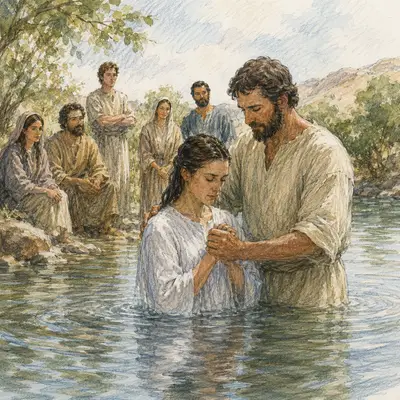
God has always related to His people through covenants, from Adam to Christ. Hebrews 9:15 tells us that Jesus is the Mediator of a new covenant. Baptism belongs to this covenant, sealed by His death and resurrection. If this covenant guarantees that all its members know God through faith, who then should receive its sign?
The New Covenant Is Not Like the Old
Covenant theology rightly sees the Bible as one unfolding story. But Scripture itself shows that the new covenant is not the same as the old. Jeremiah 31:31–34 says:
“Behold, days are coming,” declares the Lord, “when I will cut a new covenant with the house of Israel and with the house of Judah, not like the covenant which I cut with their fathers in the day I took them by the hand to bring them out of the land of Egypt, My covenant which they broke, but I was a husband to them,” declares the Lord. “But this is the covenant which I will cut with the house of Israel after those days,” declares the Lord: “I will put My law within them and on their heart I will write it; and I will be their God, and they shall be My people. And they will not teach again, each man his neighbour and each man his brother, saying, ‘Know the Lord,’ for they will all know Me, from the least of them to the greatest of them,” declares the Lord, “for I will forgive their iniquity, and their sin I will remember no more.”
The new covenant is different because all of its members truly know the Lord, having their sins forgiven and His law written on their hearts. The old covenant included many who did not believe, because membership was tied to physical descent and outward signs. The new covenant is not like this. Every member is born again. Therefore, baptism must reflect this covenant reality.
Baptism Follows Repentance and Faith
In the New Testament, baptism always follows repentance and faith. At Pentecost, Peter says in Acts 2:38:
“Repent, and each of you be baptized in the name of Jesus Christ for the forgiveness of your sins; and you will receive the gift of the Holy Spirit.”
Acts describes the Spirit’s coming in visible and powerful ways as the gospel spread, but these were historical markers, not a rigid sequence for every believer. Jesus taught in John 3:5–8 that entering the kingdom requires being “born of water and the Spirit,” a spiritual regeneration by the Spirit, cleansing the heart for faith, which precedes baptism. This echoes God’s promise in Ezekiel 36:25–26 to cleanse His people spiritually and give them a new heart.
From this we can see a clear general pattern: repentance and faith in Christ go hand in hand with the indwelling of the Holy Spirit, as Romans 8:9 and Ephesians 1:13 tell us. Baptism is an act of obedience to Christ’s command, publicly identifying with Jesus, as Galatians 3:27 says.
When the Ethiopian eunuch hears the gospel, he asks in Acts 8:36, “What prevents me from being baptized?” Philip answers in verse 37, “If you believe with all your heart, you may.” Belief is the condition. Likewise, in Corinth, Acts 18:8 says, “many of the Corinthians when they heard were believing and being baptized.”
Cornelius’ household shows the same order. The Spirit fell when they believed, and only afterwards were they baptized, as Acts 10:44–48 tells us. There is no biblical example of an infant being baptized. Baptism is always joined to repentance, faith, and obedience to Christ’s command.
Does Baptism Replace Circumcision?
Some argue that baptism replaces circumcision as the covenant sign, and so should be given to children. But the New Testament never makes this connection. When Paul speaks of circumcision and baptism together in Colossians 2:11–12, his point is that both point to inward change:
“…in Him you were also circumcised with a circumcision made without hands, in the removal of the body of the flesh, in the circumcision of Christ, having been buried with Him in baptism…”
The continuity is not outward sign to outward sign, but circumcision of the flesh to circumcision of the heart, fulfilled in Christ. Romans 2:28–29 makes this clear. Baptism, then, belongs only to those who have received this reality through faith.
What About Household Baptisms?
The New Testament mentions several household baptisms: Lydia in Acts 16:15, the Philippian jailer in Acts 16:33, Stephanas in 1 Corinthians 1:16, and Crispus in Acts 18:8. These accounts show the Spirit at work in families, bringing whole households to hear the gospel, believe together, and then be baptized.
They never mention infants. Instead, they stress that the households heard the gospel, believed, and then were baptized. It is a mistake to assume infants were present when the text does not say so.
A helpful parallel is Joshua 24:15, where Joshua says: “As for me and my house, we will serve the Lord.” Joshua was very old at this point, and his words show that his household’s allegiance was to serve the Lord. He was not speaking of infants, but of those able to follow him in faith and obedience.
Similarly, the Philippian jailer’s household heard the word in Acts 16:32 and “believed in God” before baptism in verse 34. Stephanas’ household served the saints in 1 Corinthians 16:15, which rules out infants. Crispus’ household also “believed” in Acts 18:8. These passages show God’s grace in saving families; they do not show families baptizing unbelievers.
The Church Is Defined by Faith, Not Bloodline
Because all members of the new covenant know God, baptism cannot be given to those without faith. Unlike the old covenant, the new covenant must not include a mixture of believers and unbelievers. The church is not a nation defined by bloodline but a people defined by faith in Christ. Peter writes in 1 Peter 2:5:
“You also, as living stones, are being built up as a spiritual house for a holy priesthood.”
Only those who are alive in Christ are part of this house. To baptize those who do not believe is to misrepresent the covenant itself.
Baptism in the New Testament is never a rite performed on infants apart from faith, but always a sign joined to repentance, belief, and God’s promises. To baptize without faith is to misrepresent the new covenant, for God has said that in this covenant all will know Him. Similarly, to refuse baptism to someone who has come to faith in Christ is to withhold the sign God appointed for His people.
Baptism is the outward sign of the inward reality of faith and union with Christ. It marks entrance into the covenant people, the church, but only because faith joins the believer to the covenant Mediator, Jesus Christ.
What If Someone’s Profession of Faith Proves False?
Some people say that even those who practise believer’s baptism may still baptize unbelievers, since we cannot know a person’s heart. It is true that only the Lord knows those who are His, as 2 Timothy 2:19 says. But the church is called to act on the basis of a credible profession of faith.
When Philip baptized the Ethiopian eunuch in Acts 8, he did so because the eunuch confessed with his mouth that he believed. The same is true of Simon the sorcerer in Acts 8:13. He professed faith, was baptized, and later Peter exposed his unbelieving heart.
This shows that the apostles required a profession of faith before baptism, even though some professions proved false. As 1 John 2:19 explains, “They went out from us, but they were not really of us.” Therefore, the possibility of false professions does not undermine believer’s baptism. It only reminds us that baptism is not a guarantee of salvation, but a sign of faith and obedience to Christ.
What Does “The Promise Is For You and Your Children” Mean?
Some quote Acts 2:39, “the promise is for you and for your children,” to argue that children of believers should be baptized. But if we read on, the verse explains what it means: “and for all who are far off, everyone whom the Lord our God calls to Himself.”
Peter had just told them to repent in Acts 2:38. The promise is not automatic to children by descent, but belongs to all whom the Lord calls — children included, but only through repentance and faith. The promise belongs to those who believe, as Romans 10:9 explains.
What About Sanctified Children?
1 Corinthians 7:14 says children of believers are sanctified by their believing parent. This means they are set apart in a holy household, enjoying a holy standing until they personally confess Christ. During this time they receive the church’s care, teaching, and prayers, as part of the visible church by sanctification.
Yet they are not members of the new covenant apart from personal faith. Baptism is covenantal, but in the New Testament covenant community is made up only of true believers. Faith, not descent, brings someone into Christ’s church. The place of children is honoured, but the sign of baptism belongs only to those who repent and believe the gospel.
Did Jesus Welcome Children to Baptism?
Some say Jesus welcomed little children, so we should baptize them. It is true that Jesus welcomed children, but He never baptized them or commanded their baptism. He teaches that the kingdom belongs to those with childlike faith, as in Matthew 18:3. The gospel as stated in 1 Corinthians 15:3, “Christ died for our sins,” is simple enough for a child to believe. When they do believe, they should be baptized.
Therefore, even young children who believe should not be denied baptism. But they should always be baptized after their profession of faith, not before.
What About Church History?
Some argue that church history shows infant baptism as an early tradition. While infant baptism emerged in the second or third centuries, reflecting early interpretive debates, age alone does not make a church practice right. Some heresies are very ancient too. The standard is not later church tradition but the teaching of the Apostles, the eyewitnesses of Christ.
The New Testament never records infant baptism. What the Apostles preached and practised is what we must follow. We should remember that false teaching crept in very early. The apostles themselves warned about wolves coming into the flock and distorting the truth, as Acts 20:29–30 and 2 Peter 2:1 tell us. That means we should not be surprised to find error appearing even in the first generations of the church. Our measure must always be Scripture, not tradition.
Believer’s Baptism and the Great Commission
The biblical teaching on baptism flows directly from the Bible’s covenant theology. The new covenant is not like the old. In the new covenant, every member knows God. Baptism belongs to believers because only they share in this covenant.
The New Testament examples all confirm this pattern, and the household baptisms are no exception: they describe families who believed together and were baptized together. Therefore, baptism is rightly given to those who repent and believe in Jesus Christ.
Baptism is part of obedience to the Great Commission. In Matthew 28:19–20, Jesus says:
“Go therefore and make disciples of all nations, baptizing them in the name of the Father and of the Son and of the Holy Spirit, teaching them to observe all that I have commanded you. And behold, I am with you always, to the end of the age.”
Believers are called to obey Christ’s command to be baptized, and churches must faithfully administer this sign only to those who confess faith, upholding the new covenant’s truth.
Because baptism belongs to the new covenant, it belongs to believers. To give it to those who do not profess faith denies what God has promised: that in this covenant, all will know Him. And to withhold it from believers denies their obedience to Christ.
Believer’s baptism, therefore, proclaims the true gospel to the church and to the watching world.