
Does Jesus ever say the words “I am God”? Not in that exact English sentence. But the objection assumes Scripture must state a doctrine in one preferred formula before it counts as taught, and that is not how the Bible identifies Jesus. Scripture does not leave Him as a prophet, a teacher, an exalted angel, or a lesser divine being. Taken as a whole, Scripture identifies Jesus as the eternal Son who is God, who became flesh, and who is personally distinct from the Father. That last point needs to be said clearly at the outset, because the objection often rests on a misunderstanding of the doctrine itself. Christians do not claim that Jesus is the Father. Scripture distinguishes Father, Son, and Holy Spirit while teaching that there is one God. The real question this article answers is not whether Jesus used one particular sentence. It is what Jesus claims about Himself, what the biblical writers claim about Him, and how the Old and New Testaments identify Him together.
Even Before Jesus Speaks, His Name Already Claims It
Matthew’s Gospel establishes who Jesus is before Jesus has said a single word. When Joseph learns that Mary is pregnant, “an angel of the Lord appeared to him in a dream” (Matthew 1:20), not Gabriel, who appears to Mary in Luke’s Gospel, but an unnamed angel sent to Joseph. What the angel says next carries the weight of the whole argument: “she will bear a Son; and you shall call His name Jesus, for He will save His people from their sins” (Matthew 1:21). The name Jesus, from the Hebrew Yeshua, means “Yahweh saves” or “Yahweh is salvation.” After explaining the name’s meaning, the gospel directly explains what this means: this child will Himself save His people from their sins.
That claim only makes sense against its Old Testament background, because saving people from sin is Yahweh’s own prerogative. Isaiah records Yahweh’s own words: “I, even I, am Yahweh, and there is no savior besides Me” (Isaiah 43:11). The Psalms describe the same truth: “with Yahweh there is lovingkindness, and with Him is abundant redemption. And it is He who will redeem Israel from all his iniquities” (Psalm 130:7-8). Redemption from sin belongs to Yahweh alone, and Matthew places Jesus in that position. Notice, too, precisely how the angel phrases it: not that Jesus will save God’s people, but that “He will save His people from their sins.” That wording is significant. Throughout the Old Testament, Israel belongs to Yahweh as His people, bound to Him by covenant, and Yahweh is the one who redeems His people from their sins. Matthew now says that Jesus will save His people from their sins.
Matthew then adds a second layer to the same argument, quoting Isaiah’s prophecy that “the virgin shall be with child and shall bear a Son, and they shall call His name Immanuel,” which translated means, “God with us” (Matthew 1:23). Before Jesus performs a single miracle, teaches a single parable, or makes a single claim about Himself, Matthew has already told his reader who this child is: the one who bears Yahweh’s own saving name, who does Yahweh’s own saving work, and whose coming is God Himself present with His people.
The Bible Explicitly Calls Jesus God
John opens his Gospel with the clearest possible statement: “In the beginning was the Word, and the Word was with God, and the Word was God” (John 1:1). Three things stand together in that single verse. The Word already existed “in the beginning,” before anything was made. The Word was personally “with God,” distinct from the Father as one person facing another. And the Word “was God,” sharing fully in what God is. John then identifies who this Word is: “the Word became flesh, and dwelt among us” (John 1:14). The eternal Word who was God is the same person who took on human flesh and lived among His people.
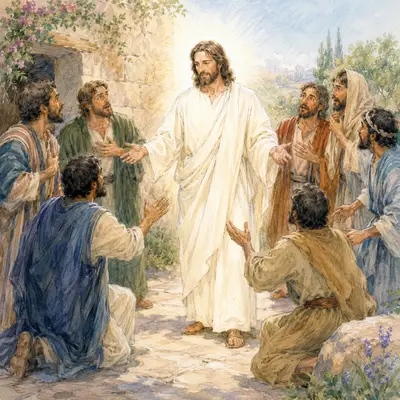
John’s Gospel ends where it begins. When the risen Jesus appears to Thomas, who had doubted the resurrection, Thomas responds with the clearest confession in the Gospel: “My Lord and my God!” (John 20:28). Jesus does not correct him. He does not tell him to redirect that confession to the Father. He accepts it, just as John’s opening verse said He could.
The rest of the New Testament confirms this in writer after writer. The Father Himself addresses the Son as God: “of the Son He says, ‘Your throne, O God, is forever and ever, and the scepter of uprightness is the scepter of Your kingdom’” (Hebrews 1:8). Paul calls Jesus “our great God and Savior, Jesus Christ” (Titus 2:13), and Peter writes to those who share in “the righteousness of our God and Savior, Jesus Christ” (2 Peter 1:1). These are not isolated, disputed proof texts. They are independent writers, across different books, converging on the same identification.
Jesus Takes Yahweh’s Own Identity Upon Himself
In a dispute with the religious leaders in Jerusalem, Jesus makes a claim that goes beyond having existed before Abraham: “Truly, truly, I say to you, before Abraham was, I am” (John 8:58). His wording reaches back into the Old Testament language by which Yahweh identifies Himself, including the divine self-identification of Exodus 3 and the repeated “I am” declarations of Isaiah. Their response shows they heard His words as far more than a claim to extraordinary age: “they picked up stones to throw at Him” (John 8:59). Their attempted stoning fits the charge of blasphemy that repeatedly follows Jesus’ claims about His relationship to the Father.
The New Testament Applies Yahweh’s Own Words to Jesus
This is where the biblical case for Christ’s deity becomes difficult to explain away as a scattering of individually disputable texts, because the same pattern repeats across multiple New Testament writers quoting multiple Old Testament passages that are explicitly about Yahweh.
Isaiah announces the coming of Yahweh Himself: “Prepare the way for Yahweh in the wilderness; make smooth in the desert a highway for our God” (Isaiah 40:3). Matthew identifies John the Baptist as the fulfilment of this very prophecy: “The voice of one crying in the wilderness, ‘Make ready the way of the Lord, make His paths straight!’” (Matthew 3:3). The one whose way John prepares in the wilderness is Yahweh, and the one who then arrives to be baptised by John is Jesus.
Joel promises that “everyone who calls on the name of Yahweh will be delivered” (Joel 2:32). Paul has just told the Romans that salvation comes through confessing “Jesus as Lord” and believing “that God raised Him from the dead” (Romans 10:9). He then proves that claim by quoting Joel’s promise directly: “whoever calls on the name of the Lord will be saved” (Romans 10:13). Paul takes Joel’s promise about calling on Yahweh’s own name and applies it, without qualification, to calling on Jesus.
Isaiah 6 records one of the most overwhelming visions in the Old Testament: the prophet sees “the Lord sitting on a throne, high and lifted up,” while the seraphim, angelic beings who surround God’s throne, cry, “Holy, Holy, Holy, is Yahweh of hosts; the whole earth is full of His glory” (Isaiah 6:1, 3). John’s Gospel later comments directly on this vision: “these things Isaiah said because he saw His glory, and he spoke about Him” (John 12:41). The “Him” in that sentence, as the surrounding passage in John 12 makes clear, is Jesus. Isaiah, seven centuries before Christ was born, saw the glory of the One John identifies as Jesus.
The most striking instance is Psalm 102. The psalmist addresses Yahweh directly as the eternal Creator: “Of old You founded the earth, and the heavens are the work of Your hands” (Psalm 102:25). Hebrews takes those very words, spoken to Yahweh, and addresses them to the Son: “You, Lord, in the beginning founded the earth, and the heavens are the works of Your hands… But You are the same, and Your years will not come to an end” (Hebrews 1:10-12). Hebrews is not claiming that Jesus resembles Yahweh the Creator. It takes words the Psalm speaks to Yahweh and applies them, without qualification, to the Son.
Across four separate Old Testament texts and four separate New Testament passages, the same pattern holds: Jesus is treated as sharing the identity the Old Testament reserves for Yahweh alone.
Jesus Does What Only God Can Do
Jesus creates all things. “All things came into being through Him, and apart from Him nothing came into being that has come into being” (John 1:3). That wording is deliberately exhaustive. If everything that came into being came into being through Him, He cannot Himself belong to the category of things that came into being. Paul says the same: “in Him all things were created, both in the heavens and on earth, visible and invisible… all things have been created through Him and for Him” (Colossians 1:16). Jesus is not one item within creation’s list. He is its maker.
He also sustains what He made. Hebrews describes Him as the one who “upholds all things by the word of His power” (Hebrews 1:3). Creation does not run on its own momentum once God sets it going. It continues to exist because the Son continues to hold it together.
Jesus forgives sins, and His opponents recognise what that claim means. When Jesus tells a paralysed man, “your sins are forgiven,” the scribes present object immediately: “Why does this man speak that way? He is blaspheming; who can forgive sins but God alone?” (Mark 2:7). Jesus does not correct their premise that forgiveness of sins belongs to God. Instead, He demonstrates that the Son of Man possesses that very authority, healing the man on the spot, “so that you may know that the Son of Man has authority on earth to forgive sins” (Mark 2:10).
Jesus also raises the dead and judges all mankind, roles the Old Testament assigns to God alone. Jesus says plainly: “just as the Father raises the dead and gives them life, even so the Son also gives life to whom He wishes… not even the Father judges anyone, but He has given all judgment to the Son” (John 5:21-22). The reason He gives for this is even more striking: “so that all will honor the Son even as they honor the Father” (John 5:23). Jesus does not ask for a lesser honour appropriate to a creature. He claims the same honour due the Father, and treats withholding it as identical to dishonouring God.
Jesus Receives Worship
When Jesus calms the storm and walks on water, “those who were in the boat worshiped Him, saying, ‘You are truly God’s Son!’” (Matthew 14:33). After the resurrection, the women at the tomb “took hold of His feet and worshiped Him” (Matthew 28:9), and when the eleven disciples see Him in Galilee, “they worshiped Him” (Matthew 28:17). In every one of these scenes, Jesus receives worship and does not redirect it.
That silence is only meaningful against the pattern Scripture sets elsewhere. When the apostle John, overwhelmed by the visions given to him, falls down to worship the angel showing them to him, the angel’s response is immediate: “Do not do that! I am a fellow slave with you and your brothers the prophets… Worship God!” (Revelation 22:9). A genuinely faithful angel, confronted with worship, refuses it without hesitation. Jesus repeatedly receives worship without rebuking those who offer it, while Revelation explicitly places the Lamb alongside the One seated on the throne as the object of the worship of all creation: “To Him who sits on the throne, and to the Lamb, be the blessing and the honor and the glory and the might forever and ever” (Revelation 5:13). The Lamb receives what a faithful angel refuses, because the Lamb, unlike the angel, is not a creature.
Jesus Possesses the Attributes of God
Much of this ground has already been covered by the arguments above. Taken together with them, a few more details round out the picture. Jesus already existed “in the beginning” (John 1:1) and prays to be glorified “with the glory which I had with You before the world was” (John 17:5), a glory presupposing His existence before creation. John records that Jesus “knew all men” and “had no need that anyone bear witness concerning man, for He Himself knew what was in man” (John 2:24-25). And He promises a presence with His people that only God could keep: “I am with you always, even to the end of the age” (Matthew 28:20). None of these attributes proves deity in isolation the way the earlier sections do. Read alongside them, they fit what the rest of this article has already established.
If Jesus Is God, Why Does He Pray to the Father?
This objection needs a direct answer, because it is the one most readers will already be forming. Scripture is emphatic that there is only one God: “Hear, O Israel! Yahweh is our God, Yahweh is one!” (Deuteronomy 6:4). Christians have never claimed otherwise. The historic Christian confession is that the Father is God, the Son is God, and the Holy Spirit is God. The Father is not the Son, the Son is not the Spirit, and the Spirit is not the Father; nevertheless, Scripture teaches one God, not three. Jesus praying to His Father does not disprove His deity. It demonstrates exactly what Scripture teaches: a real, personal distinction between the Father and the Son within the one God.
The incarnation, the eternal Son taking on a genuine human nature and becoming man while remaining fully God, explains the rest. John has already told us that “the Word became flesh” (John 1:14). Paul explains what that meant for the eternal Son: though He existed “in the form of God” and “did not regard equality with God a thing to be grasped,” He “emptied Himself, by taking the form of a slave, by being made in the likeness of men” (Philippians 2:6-7). The Son does not empty Himself of deity. He empties Himself by taking the form of a slave and becoming truly man. The eternal Son did not cease to be God when He became man. Because He truly became man, Jesus prays, grows tired, grows hungry, weeps, suffers, and dies, while never ceasing to be God.
What About “The Father Is Greater Than I”?
Jesus tells His disciples plainly, “the Father is greater than I” (John 14:28), and this is worth handling alongside the previous objection, because both come from the same misunderstanding. Jesus speaks these words from His humbled, incarnate condition, the position Philippians describes Him as having taken on by becoming a servant. The same Gospel that records this statement has already told its reader that “the Word was God” (John 1:1) and will end with Thomas confessing Him as “my Lord and my God” (John 20:28). Whatever “the Father is greater than I” means, John cannot be contradicting what he has already written and what he will go on to record. The Son who is fully God willingly takes the place of a servant in the work of redemption and submits to the Father. That submission concerns the role He took in becoming man; it does not mean that He is less than fully God.
Was Jesus Only Claiming to Be Like God, Not Actually God?
When Jesus calls God His own Father, John records exactly how His hearers understood the claim: “the Jews were seeking all the more to kill Him, because He not only was breaking the Sabbath, but also was calling God His own Father, making Himself equal with God” (John 5:18). If this were a misunderstanding, this is the moment for Jesus to correct it. He does not. Instead, in the verses that follow, He describes Himself doing the works of the Father, giving life to whom He wishes, and receiving the same honour due the Father. Jesus does not walk back the claim His accusers heard. He explains it and defends it.
The Resurrection Confirms Who Jesus Claimed to Be
The Jewish authorities condemned Jesus as a blasphemer because of the claims He made about His identity and handed Him over to Rome, which carried out His crucifixion. Paul says that the resurrection powerfully declared who Jesus is: He “was designated as the Son of God in power, according to the Spirit of holiness, by the resurrection from the dead” (Romans 1:4). The resurrection is not an isolated miracle attached to an otherwise ordinary teacher. The resurrection publicly vindicates the identity and claims of the One who had been crucified.
The risen Jesus then claims the universal authority Daniel had already described belonging to the one “like a Son of Man” who comes near before the Ancient of Days and receives “dominion, glory, and a kingdom, that all the peoples, nations, and men of every tongue might serve Him,” a dominion that “will not be taken away” and a kingdom that “will not be destroyed” (Daniel 7:13-14). Jesus takes up that same authority in His own words to His disciples: “All authority has been given to Me in heaven and on earth” (Matthew 28:18). Daniel’s vision and Jesus’ own claim describe the same reality: universal, everlasting dominion, given to the Son.
Why This Matters
If Jesus is a creature, however exalted, then Christianity does not need minor correcting. It collapses. Every act of worship Christians have ever offered Him would be worship given to a creature rather than the Creator, precisely what Scripture elsewhere condemns as idolatry. If Jesus were only a creature, Christians would be trusting a creature for the salvation that Scripture says belongs to Yahweh alone (Isaiah 43:11). The gospel does not rest on Jesus being an unusually good man, or an unusually exalted angel. It rests on who Jesus actually is.
Matthew’s Gospel gives the cleanest frame for the whole argument. It opens by identifying the child born to Mary as “Immanuel,” which means “God with us” (Matthew 1:23), before Jesus has spoken a word or performed a single miracle. It closes with the risen Jesus making a promise only God could keep: “I am with you always, even to the end of the age” (Matthew 28:20). Between those two bookends stands everything this article has traced: a name that claims Yahweh’s own saving work, direct declarations that Jesus is God, Old Testament passages about Yahweh applied to Him without qualification, works only God can do, worship only God may receive, and a resurrection that vindicates every one of these claims. God Himself has come among His people, and He has promised never to leave.